

If you’re reading this, you already know why you need one (if not, short reading list for you at the end, before the).
A few months ago, I wrote up a list of 18 things people obsess over instead of starting their newsletter. This is the other half — the short list of what you need to do, in order, to get a first issue out the door. Note that I’m writing from a B2B background and this is focused on newsletters used to market a business (that includes all the businesses of one out there). The advice is similar for paid newsletters where the newsletter is the product, but there are some differences.
Think you’re too late? You’re wrong. Sure, the best time to start was last year. Second best is now.
It’s not rocket science. You can do this.
1. Understand why you’re doing this — and who it’s for
Before you touch a tool or pick a name, you need to know two things::
• Why you’re doing this
• Who it’s for
You don’t need a 12-month strategy. A sentence or two will do.
Not to get too guru or granola-eating, tree huggerish*, but you need to set the right intention to build on from the beginning.
Help your customers solve a problem and make their lives easier. Use your newsletter to deliver useful, helpful information to your customers that builds trust over time. Trust builds businesses.
This also helps you stay top of mind and can bring in new, potential customers.
You know your customers. Pick one or two and have them in mind while writing. I did this with the second newsletter I did with AIIM. By then, I had met many of the readers during my time as magazine editor. I always had a rotating cast of real people in my mind as I put each issue together.
It made me want to do a good job for them because I knew and liked them, which also made the newsletter better.
Of course, the big, underlying “WHY” of a newsletter is that it’s the one relationship you own online, not one dependent on an algorithm than might change (again) tomorrow.
*I’m a child of the 80s, this is how we explained new aged thinking back in the day. The current nomenclature seems to be “woo woo thinking.”
2. Pick a platform
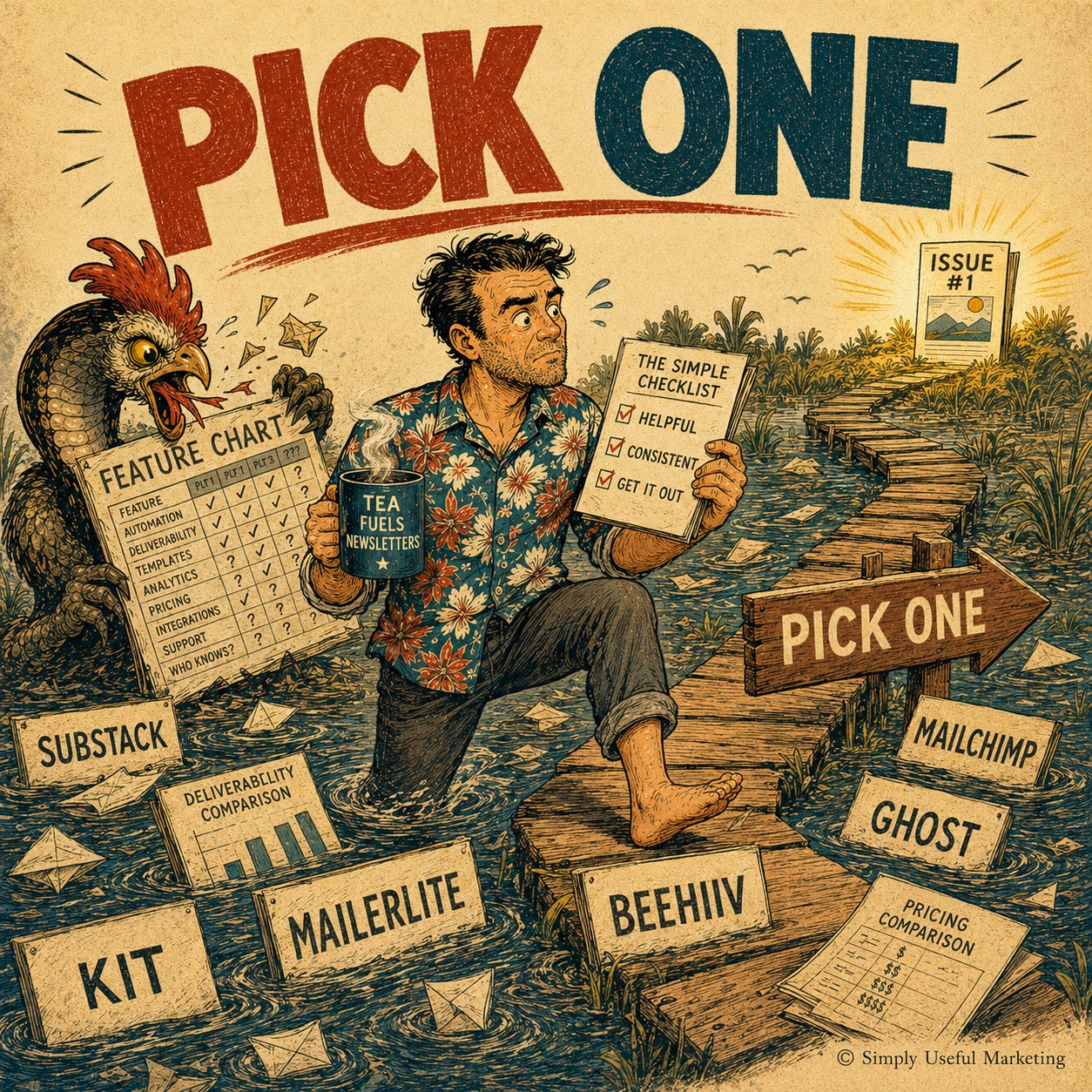
This is where people disappear for three weeks comparing feature charts. Don’t.
Every platform does the same three things: collect emails, send emails, and let you export both if you ever want to leave. That’s all you need. Mailchimp, Kit, Beehiiv, Ghost, Substack — any of them will work.
For most people starting from zero, I’d point you at Substack. It’s free, it takes about ten minutes to set up, and it comes with built-in discovery — other writers and readers can find you through Notes and recommendations, which a standalone email tool won’t give you. You can start today and worry about nothing else.
The exception: if you already have a real customer list — people who’ve bought from you, with new ones coming in steadily — an email-first tool like Kit or MailerLite may serve you better. Those are built for working a list you already own: tagging people by what they bought, sending different messages to different groups, tying a send to a sale. Substack is great for building an audience from scratch. Email-first tools are great when you already have one and want to put it to work.
You can import an existing list into Substack, so it still could be the right choice, but you need to take a little more time to think through the pros and cons, but no longer than a few hours.
Either way, pick one this week. You can move later — that’s what the export button is for. The tool has never been the thing standing between you and a published newsletter.
3. Handle the boring setup
Give this an afternoon, not a week.
Name it. “[Business Name] Notes” or “[Business Name] Updates” is fine. Nobody subscribes — or unsubscribes — over the name. Pick one and move on.
Set the “From” name to your actual name, or your name plus the business. People open emails from humans, not from “Marketing Department.”
Start in plain text. A clean email with a few links and a little bold beats a fancy template you fussed over for hours. Add design later if it helps your readers — not your ego. If you’re like me, you have plenty of text-only newsletters in your inbox now.
Write one or two sentences saying who it’s for, what they’ll get, and how often. That’s your description. Done.
4. Decide how often — and be honest about it
Pick a cadence you can keep for three months without starting to hate your life.
Monthly is fine. Twice a month if you’ve got it in you. Weekly if you’re sure — but be sure.
Consistency beats frequency every time. One solid issue a month, every month, beats four issues in three weeks followed by silence for the next three and the accompanying vague sense of shame.
The fastest way to kill a newsletter is to promise weekly and deliver “whenever.” Promise less. Deliver it every time
5. Figure out what to write (and you already have it)
This is the step where most people freeze. The blank page. What the hell do I even say every month?
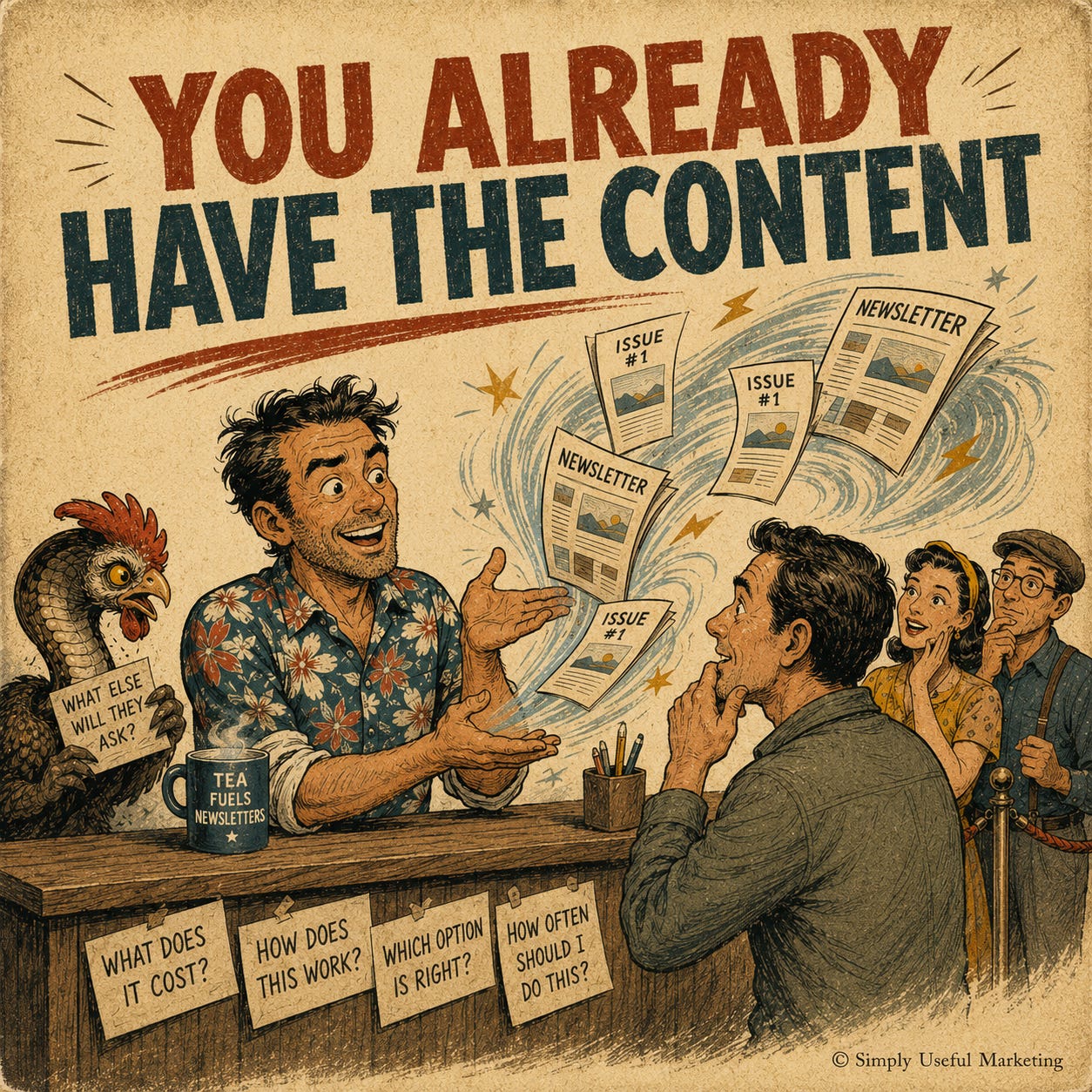
Relax. You already have the content. You’ve just been giving it away one customer at a time.
You answer questions all day. How does this work? What does it cost? How often should I do this? Which option is right for me? Every one of those is an issue.
Marcus Sheridan — a guy who installed fiberglass pools, not a writer — saved his company during the 2008 recession by answering customer questions on his blog. He traced $2 million in sales to a single post about what a pool costs. His book, They Ask, You Answer, is a great practical read of writing content to help your customers (not a ready, he gives away the whole thing in the title). He’s now a successful content marketing consultant; and he still owns the pool company.
Here’s the exercise to get unstuck:
Write down the three questions customers ask you most. Pick one. Answer it the way you would in person — like you’re talking to a customer you actually like. Stop when you’ve answered it. That might be 200 words. It might be 800. Don’t pad it. Don’t stop too soon because it’s “too long.”
That’s your first issue.
No list of questions handy? Email your last 20 customers two questions: “What’s the one thing you wish you understood better about [your thing]?” and “What do you keep asking us?” Or pick up the phone and call a dozen. You’ll have months of topics by Friday.
If the part that’s got you stuck isn’t the writing but the figuring out — what to send, in what order, where to put the ask without feeling gross about it — that’s exactly what I built Newsletter-in-a-Box for. I’ll set up the structure, the cadence, and a simple system for turning real customer questions into issues, so you’re not staring at a blank page every month. You bring the expertise; I get it out of your head and onto the page.
6. Put signup forms everywhere
Once people have a place to sign up, put the link everywhere they might run into you:
• Your email signature
• Your LinkedIn bio — and the occasional post
• Your website header and footer, not buried on a “blog” page
• The end of every piece of content you publish
And give people a reason. “Subscribe for updates” is not a reason. “A short monthly email on [the specific thing you help with] — one useful idea, no spam” is. Tell them what they get.
One more: every issue needs a CTA. That’s marketing-speak for “ask the reader to do one thing” — reply, book a call, buy the thing. You’re running a business, not a hobby blog. Make the ask, keep it relevant to the issue, and don’t cram five of them in. I do two an issue – the one immediately preceding this and a PS at the end.
7. Get your first subscribers — you start at zero, everyone does
The threshold to start a newsletter is zero subscribers. Don’t wait for “enough.” Enough is a moving target that never arrives.
If you have customers or even an older list, start there. These are people who have already raised their hand and you have permission to email — customers, past clients, the folks who’ve done business with you or asked to hear from you. Import them and send. One caveat: that means people with a real connection to you, not a list you bought or scraped off LinkedIn. Emailing strangers is how you land in spam folders and torch your reputation before you’ve built one.
Then tell people you have a newsletter and keep telling them.
Build from there, one issue at a time. A small list of people who want to hear from you beats a big list that doesn’t.
8. Write issue one and hit send
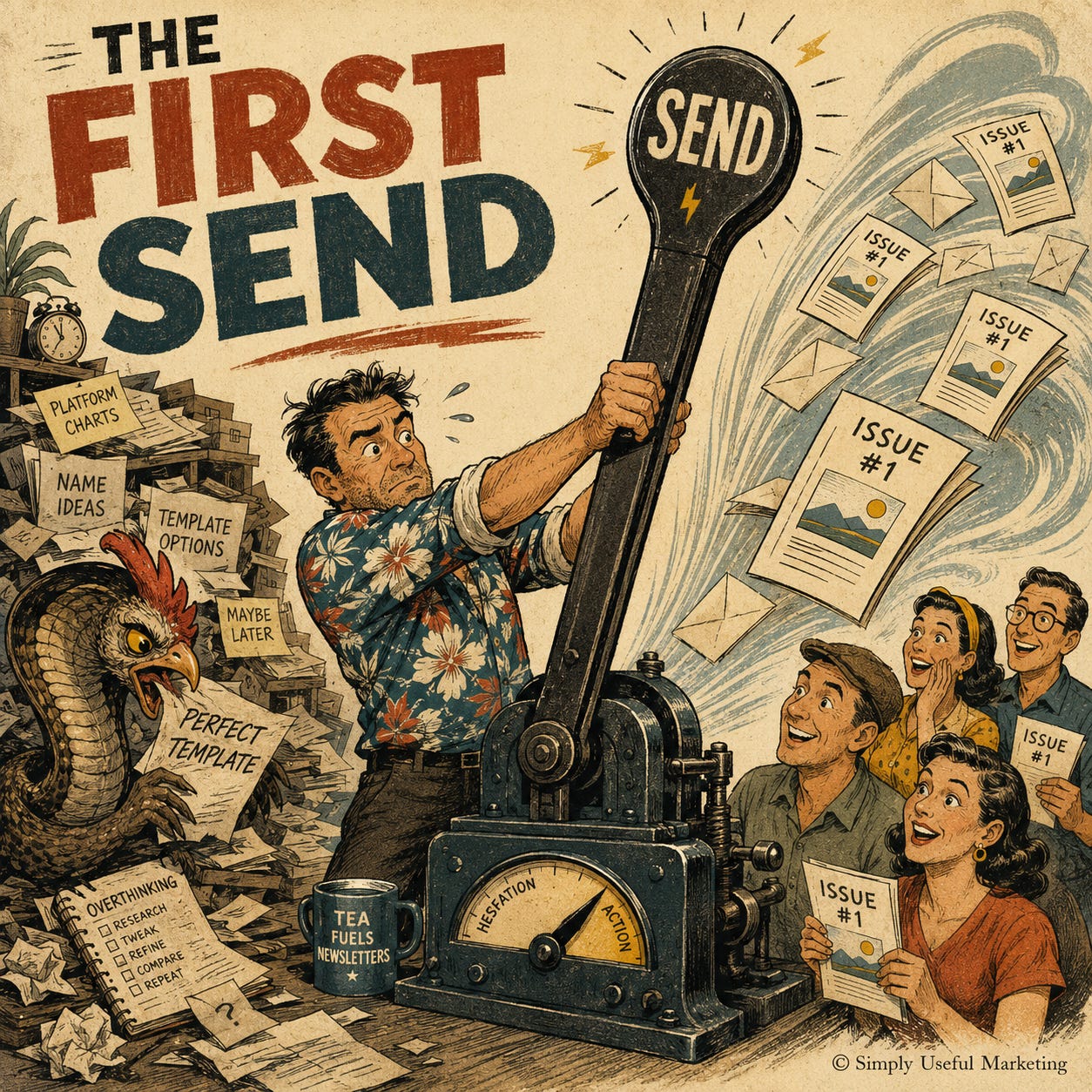
This is the step that matters, and it’s the one people skip by perfecting steps one through seven forever.
Draft your first issue. Make it sound like you — like you’re talking to a customer you like, because you are. Read it out loud (I sound like I’m talking to myself when editing; sometimes I even startle my co-worker, Knox); if you trip over a sentence, your reader will too. Fix it.
Then send it. Not after one more edit. Now.
It will not be perfect. Mine aren’t. You’ll learn more from one published issue — who opens it, what they click, who replies — than from another month planning the perfect one that never leaves your hard drive.
Lather, rinse, repeat.

9. Write a welcome message and a welcome email.
When you send your first issue, include a message explaining what you’re doing. Something like:
Welcome to Kooking for Kats, our first newsletter from Katzatopia. You’re reading this because you’re a customer. Thank you! While we hope you’ll love the tips for healthier and happier kats you’ll receive every other week in this newsletter, we know how full inboxes are. You can unsubscribe by clicking here.
A welcome email is sent to new subscribers when they subscribe. Over time, the welcome email can also be used as a sales tool. BUT THAT’S FOR LATER. Keep your first one simple. Tell them thank you, what to expect frequency-wise, and a little bit about what you’ll be sharing.
None of this is complicated, though it is easy to over-complicate it.
Planning, research, and thinking about each of these steps feels like research and work. Mostly it’s just procrastination in disguise.
Or fear.
Focus. Decide. Act. Send your newsletter.
As you grow, the decisions do become more complex and require more research based on your goals and what has been working.
But you ain’t getting nowhere if you allow fear and pointless concern over “what do I do with 5,000 subscribers” when you have a list of 15 people and haven’t sent them a single issue.
P.S. — If you’d rather not learn all this the slow way like I did, I take on a handful of Newsletter-in-a-Box clients at a time. Reply here or hit me at bryant@simplyusefulmarketing.co and I’ll tell you straight whether it’s a fit.
Short reading list, for those interesting, music below the list.


Musical Fun
For anyone who’s ever had a crap job; sing it loud and with feeling!
One of my many favorite Johnny Cash songs, love this version. He loved that woman something fierce.
I don’t generally like gospel, but Cash can take me to church most days.
This should be required reading for anyone stuck in “Substack vs Beehiiv vs Ghost” hell.
Pick one. Write one. Send one.
Happy Thursday Bryant.