

A newsletter is the most direct trust-building tool you own.
It should and can be the critical connection point with your customer.
Not a flashy one. Not a viral one. A steady, reliable one — the kind that builds trust the same way showing up on time and doing good work builds trust. Over time, people start to expect you. They start to rely on you. And when they’re ready to buy, you’re the name that comes up.
That’s what a newsletter does when it’s working. It helps. It educates. It can amuse. It earns attention instead of begging for or demanding it. And unlike social media, where a platform decides who sees what you post (yes, even here), a newsletter lands in someone’s inbox because they asked for it.
That’s a one-to-one relationship. And it’s the only one in digital marketing that you actually own.
That subscriber list is yours. And every issue you send is a chance to grow it — someone forwards it to a colleague, a reader shares it on LinkedIn. Each one of those moments adds a person to an audience you own, not one you’re renting from an algorithm.
Everything else I’m about to explain — what a newsletter is, what it isn’t, how it works — flows from that. The trust-building part is the point.
It’s a Container Word
Think of the word “book.”
The thing every book has in common is two covers with some dead trees and ink sandwiched between them. Beyond that, it could be an illustrated manuscript from the 1300s, a tabletop art book, a huge historical tome, or a 25-cent Bantam paperback from the 50s.
A newsletter works the same way.
It can be a hundred words delivered daily — Seth Godin’s been doing that for roughly 20 years now — or it can be a monthly deep-dive that runs novella-length. It can be one article, five short bits, curated links with commentary, an image followed by an essay about the image, or a combination of all of those things. It can be delivered by email, by paper, or — if you’re old enough — by fax.
The format is the least important thing about a newsletter. What matters is whether it’s useful to the person receiving it.
Don’t Confuse the Delivery Truck for the Package
One quick distinction, because it trips people up.
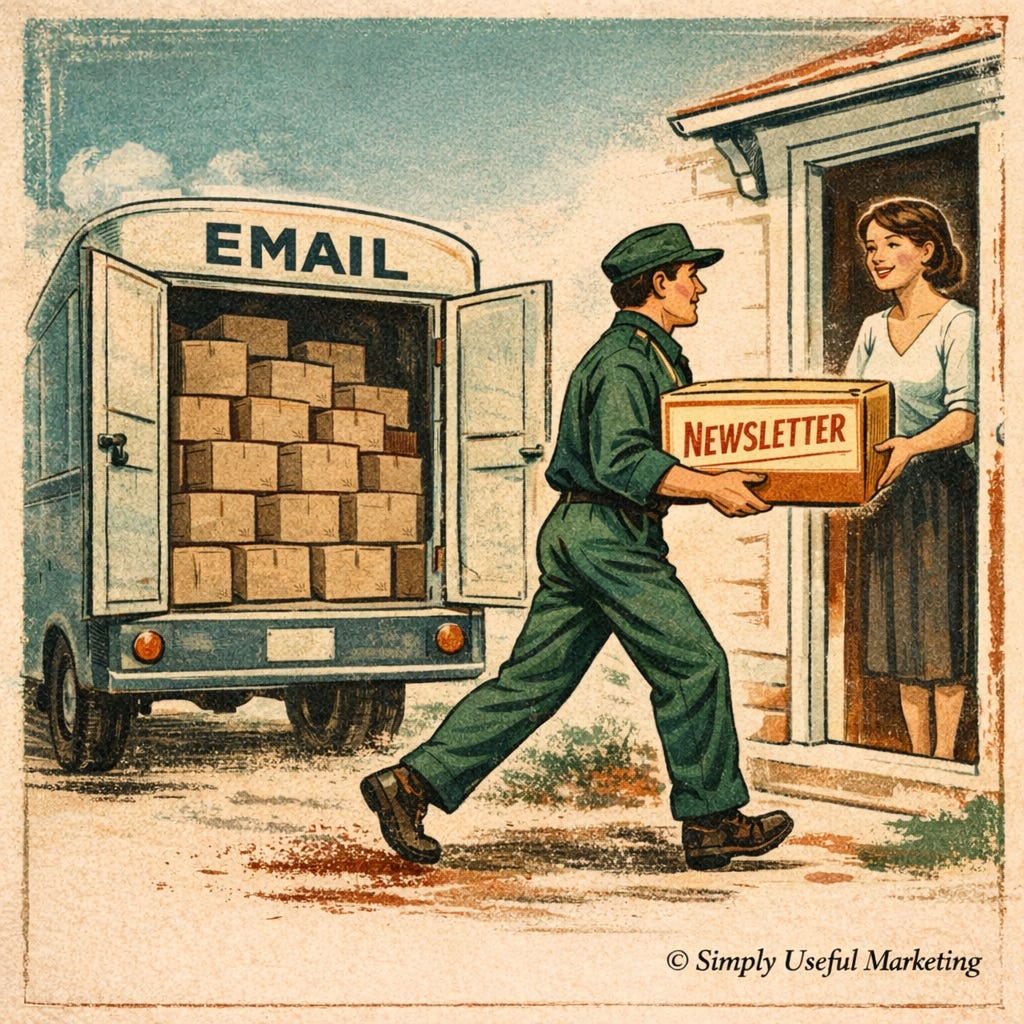
Email is a delivery mechanism. It’s how most newsletters reach people. But email is not the newsletter — the same way UPS is not the thing inside the box.
And when someone says “I have a Substack” what they mean is they have a newsletter on a platform. The platform is just plumbing. If the same content lived on a WordPress site with a subscribe button, it’d work (mostly) the same way.
This matters because if you ever decide to move platforms — and you might — your content and your subscriber list are what you take with you. The platform is replaceable. The relationship with your readers is not.
A Newsletter Is Not a Sales Email
Confusing these things can cause real damage to your marketing efforts.
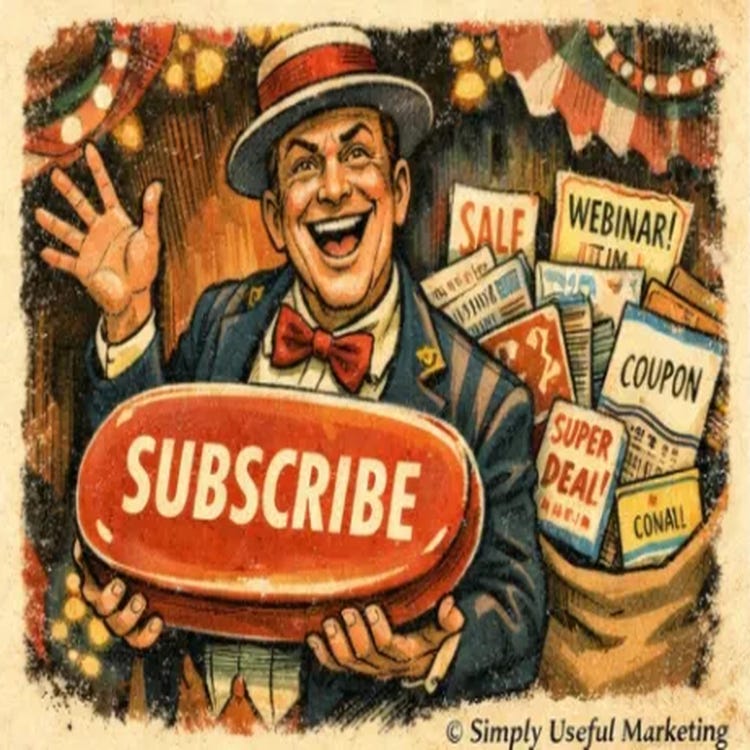
If someone says they have a “newsletter” and all they do is pitch you — webinar invitations, product announcements, case studies that are thinly veiled press releases — that’s not a newsletter.
That’s a pitch with a subscribe button (if you ever hear “email marketing” that’s what they’re talking about).
The mechanism is the same. The design can be identical. But the intent is completely different.
A pitch-with-a-subscribe-button delivers no value on its own. It exists entirely to make a sale. It says “buy me.”
A newsletter says “trust me — and when you’re ready, buy from me.”
A newsletter answers customer questions. It’s helpful. It’s useful. It treats the reader’s attention like the gift it is. And over time, that builds the kind of trust that makes selling easier.
Intent is the distinction between a newsletter and email marketing.
But You Do Want to Stay in Business, Right?
Being useful and making sales are not opposites.
The difference isn’t whether you sell in your newsletter. It’s whether you’ve earned the right to ask. If you’ve spent issue after issue helping people — answering their questions, giving them something they can actually use — then asking for the sale isn’t pushy. It’s natural; a next step rather than an interruption.
So within your newsletter, believe in your product. Include a CTA (call to action) — that’s marketing-speak for “ask the reader to do something,” whether it’s reply to the email, book a call, or buy the thing you sell. You should always include one. You do want to stay in business, right?
And on the back end, if you’ve got a decent email tool — HubSpot, Kit, whatever — you can see who’s opening, what they’re clicking on, and use that information to make smarter, better-timed sales outreach. The newsletter builds trust on the front end and gives you data on the back end. It’s doing double duty.
If the part you dread isn’t the writing but the figuring out — what to send, how often, where to put the ask without feeling gross about it — that’s what Newsletter-in-a-Box is built for. Reply to this email or hit me at bryant@simplyusefulmarketing.co.
A Quick Side Note: Newsletters as Products
Some newsletters are the product — people pay directly for subscriptions, or the newsletter generates ad revenue. There are plenty of those in my inbox.
That’s not what I’m talking about here.
I’m talking about the newsletter as a marketing tool — a vehicle that builds trust, connects you with your customers, and creates the conditions for sales. Similar fundamentals, different playbook.
But that’s an entirely different post.
The Fax Machine Days
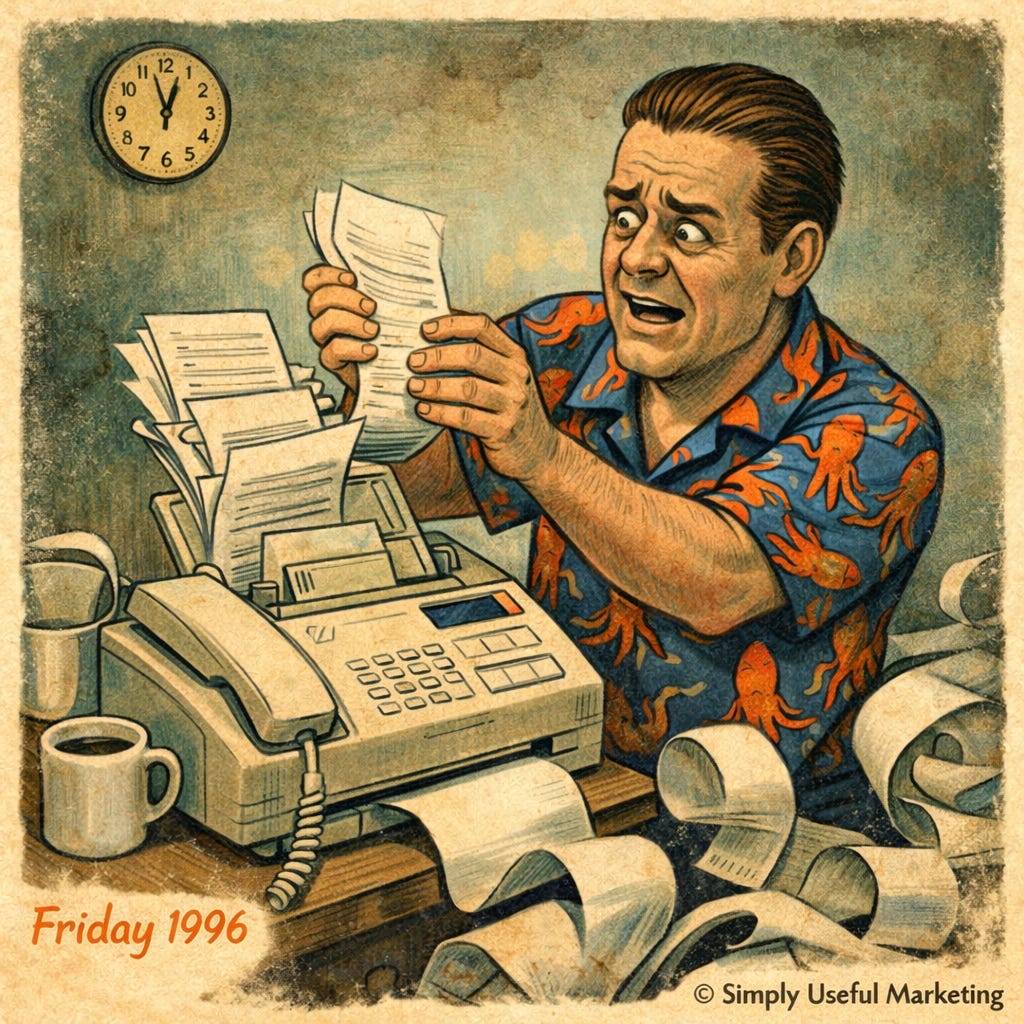
The first newsletter I ever wrote (well, compiled, it was essentially condensed press releases from mail — until the late 90s/early 2000s and the email takeover, I got 3 to 4 plastic mail bins full of press releases each week) — was delivered via fax. This was 1996. Every Friday night, I spent two to two-and-a-half hours after five o’clock feeding four to five thousand names through in chunks of six or seven hundred, praying they went through.
We actually charged extra for email delivery when that became an option — because it cost us more to send emails than faxes. If that seems inconceivable today, it was the reality at the time.
Point is: newsletters aren’t new, though the tools to manage and send them are MUCH easier to use these days.
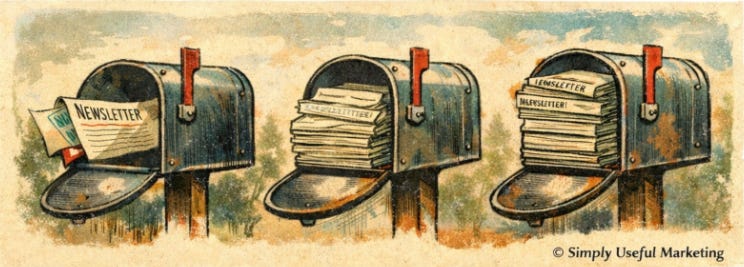
Be You
Your newsletter should sound like you. If you can take your name and logo off of it and no one can tell it’s you because you ran it through legal and marketing and three execs with conflicting styles; start over.
Make it sound like a human being who knows their business and gives a damn about their customers.
This matters more than the design, more than the platform, more than the frequency. If the personality is right, people will forgive almost everything else.
And if you’re thinking “but I’m hiring someone to write it for me, so how is it still me?” — that’s exactly the job. A good ghostwriter doesn’t replace your voice. They get it out of your head and onto the page in a way that sounds like you on your best day.
A newsletter isn’t a platform, a particular format, or an email.
It’s how you show up, stay useful, and build the kind of trust that turns readers into customers — one issue at a time.
PS — If “I’ll start a newsletter when things settle down” has been on your to-do list for more than six months, things aren’t going to settle down. I can get you from blank page to first send without it becoming your second job. bryant@simplyusefulmarketing.co
Musical Fun
A couple-three songs in the background as I pulled this together.
Between this and John Batiste at the end, I’m really missing home in SW Louisiana and needing a trip to New Orleans.
I always think this is Van Morrison
“OOOHH! OOOHH! OOOHH!” If you know, you know.
You can never go wrong listening to Bill Withers, or being lucky enough to start your day with someone who you look at, teeth unbrushed, still groggy from sleep and think “the world’s alright with me.”
I’m late to the John Batiste party, but better late than never.
The ownership point is huge.
Social builds awareness, but newsletters build memory.
And memory is what drives decisions later.
I did overthink formats, and I am probably still not doing susbstack the right way, but at this point, IDGAF lol
TGIF Bryant.
I hope you have a wonderful Friday and a good weekend.