

I’ll do it when . . .
Insert whatever magical fairy tale you’d like to tell yourself about how you’ll start your newsletter “someday when conditions are perfect.”
They never are; never will be.
Because “perfect” is “now.”
Somewhere out there, a small business owner is staring at one of the dozens of available tools (such as Mailchimp, Substack, or ConvertKit) and thinking:
“Once I pick the right template… I’ll start.”
“Once I name it… I’ll start.”
“Once I figure out the perfect font pairing… I’ll start.”
I get it. These feel like “being responsible.”
But most of the time? It’s just procrastination with better branding.
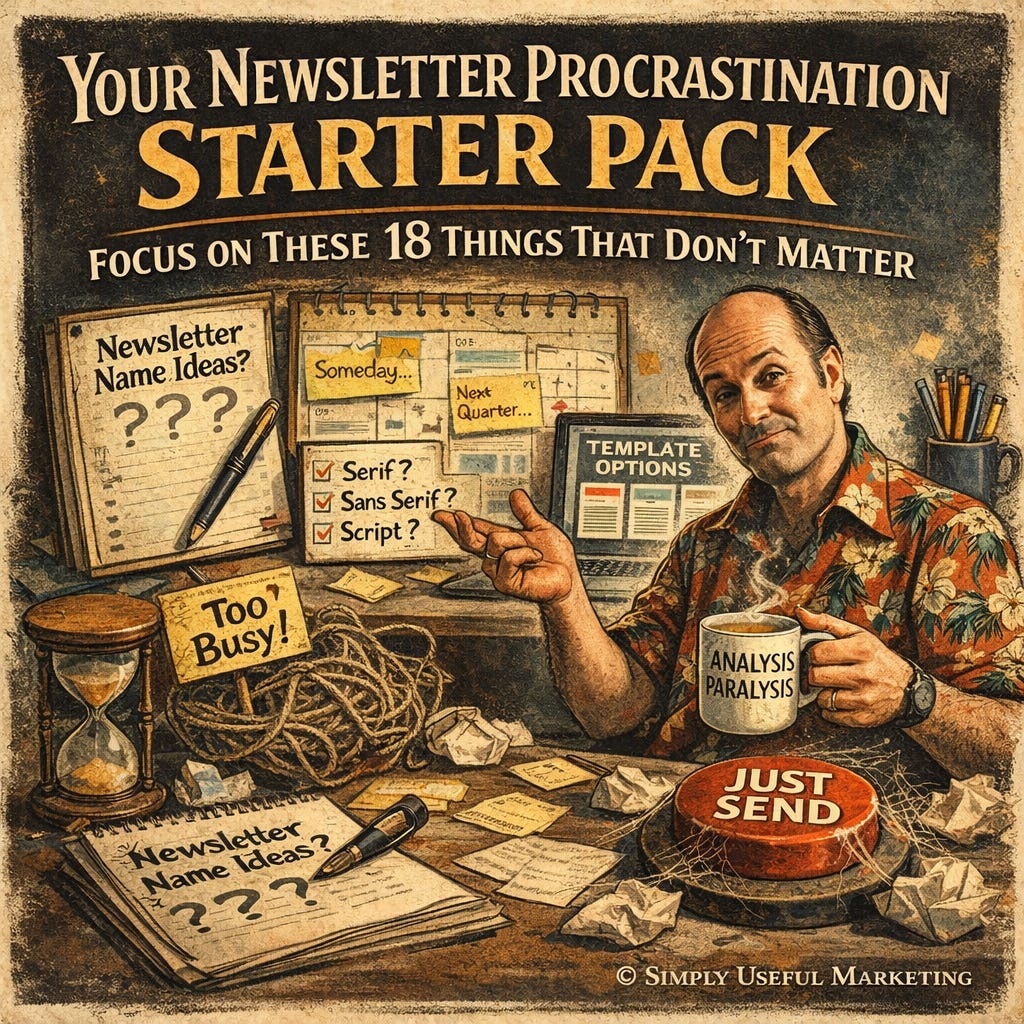
So here are 18 initially unimportant things that somehow manage to block a newsletter from ever leaving the station — and the simple move that gets you unstuck.
How do I know these? I’ve lived each and every one.
Quick note before diving in; this is from the perspective of using a newsletter as a marketing vehicle, not a newsletter as a product. While I think in general the advice works for both, some things, like a name, can be more important for a product than for a marketing method. Also, over time, these things ARE important. But, here’s the thing, the can’t BECOME important until you start.
Cool? On we go.
1. Naming the Newsletter.
Shakespeare nailed this one. Nobody cares what it’s called. The best name possible is pointless if no one ever hears about it because you won’t publish.
Do this instead: Name it “(Business Name) Updates” — or something in the same vein — and move on.
2. Agonizing Over The Fonts.
Unless you’re writing about Web design or publishing, your readers aren’t typography critics.
Do this instead: Use the default. If you can read it on your phone, it’s fine.
3. Choosing a Perfect Template.
“Pretty” is optional. Useful is not. Most of my favorite newsletters are plain text with minimal HTML formatting (bold, italics, headers, and links) to improve flow and readability.
Do this instead: Start in plain text. Add design later if you feel like it or, better, think it will improve connection with your audience and sales.
4. Logo and Logo Placement.
No one is opening your email to admire the header or your logo.
Do this instead: Put your name in the “From” field and make the first line helpful. Create a simple header and move on with your life.
5. Writing an Epic “About” blurb.
No one needs your brand manifesto in email form via your newsletter.
Do this instead: Explain who it’s for, what they’ll get, how often you’ll send. One or two sentences will do the trick.
6. Looking for the “Perfect” Platform.
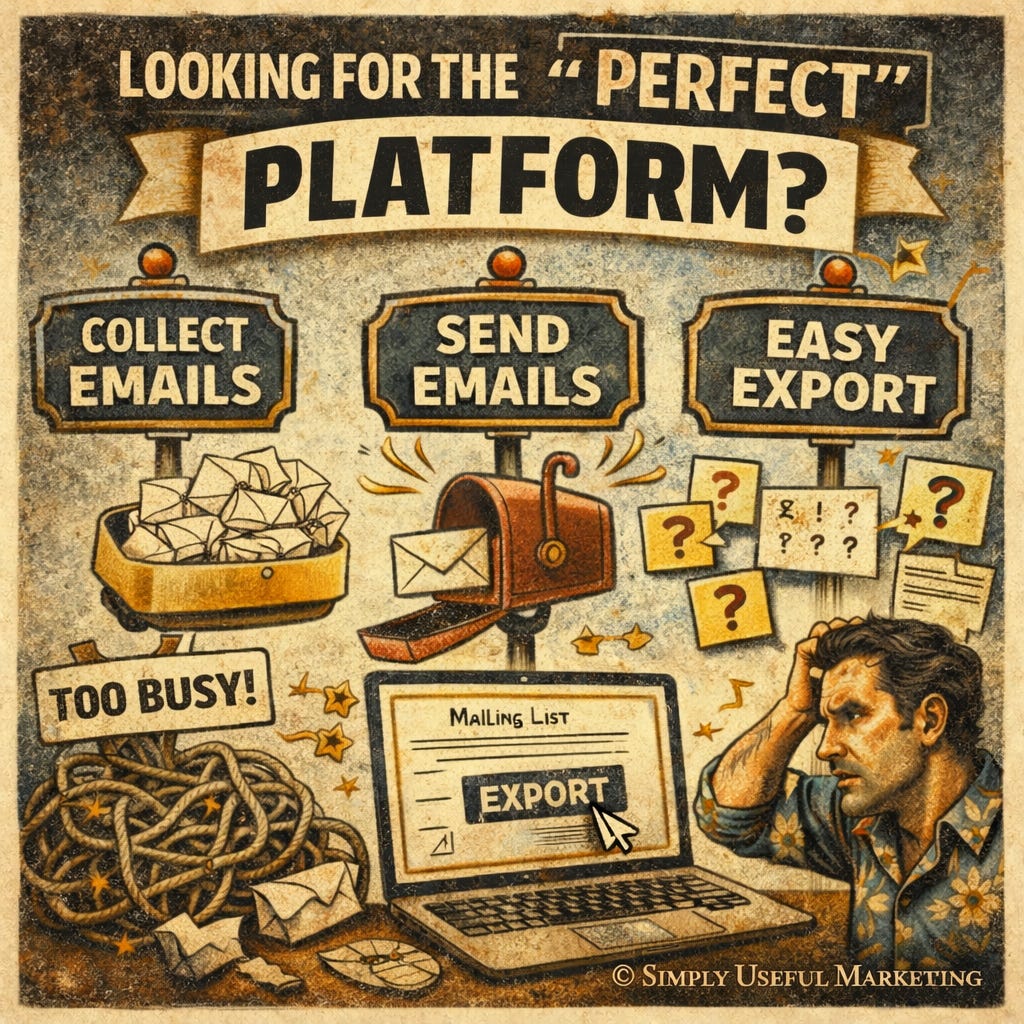
Tools don’t ship newsletters. People ship newsletters. Yes, as you grow, there are differences (pricing levels, email automations, forms, etc.) and they can be important. When you start that doesn’t matter because they all do the same thing – take your newsletter and place it into your customers’ and potential customers’ inboxes.
Do this instead: Pick a platform that can (1) collect emails, (2) send emails, and (3) allows you to export your content and subscriber list easily. Done.
7. Overthinking the Subject Line.
Subject lines ARE important. But you will never know what works with your audience until you start sending. Start (and likely end) by focusing on telling ‘em what you’re gonna tell ‘em in the subject line and then tell ‘em in the email body.
Do this instead: Subject line: “Quick tip for [problem]” or “One thing to know about [topic].” An effective first subject line can be as simple as “Welcome to our new newsletter.”
8. Waiting Until You Have “Enough” Subscribers.
Let’s say you have zero customer emails. Start collecting them today. Now. This moment. At some point, everyone starts from zero. The threshold to start a newsletter is zero subscribers.
Do this instead: Start with whatever you have — from none to eleventy bajillion. Build from there.
9. Worrying About Month 12 Before Writing Issue 1.
That’s avoidance; not planning.
Do this instead: Plan the next 3 issues. You’ll learn more by sending than brainstorming.
10. Obsessing Over Frequency Before You’ve Published One
You don’t know what the right frequency is until you have A frequency. Start monthly (twice/month if possible). Stick to it. You can try for more (or not) once you’ve created a consistent publishing rhythm.
Do this instead: Pick one frequency you can sustain for 3 months.
11. Trying to Perfect Your “Brand Voice.”
Your brand voice is “a human who helps.”
Do this instead: Write like you talk to a customer you actually like. Develop a style guide over time, better to start without one than to never start.
12. But I Need a Lead Magnet.
You know what’s a great lead magnet? A newsletter worth reading.
Do this instead: Publish 6 issues first. Then turn the best one (or combine them) into a downloadable asset.
13. But I Don’t Know What to Write About.
Do you have customers? Do they ask questions? Congrats — you have content.
Do this instead: Keep a running list of FAQs and answer one per issue. Bonus: Read They Ask, You Answer by Marcus Sheridan for endless tips, ideas, and strategies to never run out of things to write about.
14. Fear of Sounding Like a Used Car Salesman.
Being helpful isn’t salesy. Making offers isn’t immoral, especially when you solve a problem for customers.
Do this instead: Focus on being useful, but include offers in your newsletter. And be clear about who the offer is for. Over time and as your list grows, use focused sales emails to turn subscribers into customers.
15. A Newsletter + LinkedIn + YouTube, Oh My!
I struggle sometimes to manage multiple platforms and I’ve been doing this years. You aren’t a content octopus. You’re a person trying to help their customers.
Do this instead: Pick newsletter as the home base. Learn how to repurpose and re-use content AFTER you consistently ship your newsletter. You need to be able to roll-over before you can sit up, much less walk or, eventually, run.
16. Thinking You Need “News” to Have a Newsletter.
You don’t need news. You need usefulness. A newsletter is just the label we use to describe a regular, useful communication with your audience. Something useful that your readers don’t already know will be “news” to them.
Do this instead: Focus on sharing useful information your customers can use to improve their lives. I’ve read too many vendor newsletters that were press release puffery. Boring.
17. Worrying About Unsubscribes.
Unsubscribes are not a personal attack. They’re list hygiene. There isn’t a person on the planet who appeals to everyone. Neither will you.
Do this instead: Focus on the people who stay — those are your people.
18. What If No One Reads It/What If No One Likes It?
What if they do? These are two variations of the same pointless fear. Let me burst this bubble for you now – there are some people who will despise what you write. That’s fine. They aren’t going to buy anything from you anyway, are they?
Do this instead: Create something so useful it can’t be ignored and focus on the people who like what you’re doing.
A Tiny Challenge For You
Here’s a quick way to get unstuck. You should be able to do this in 10 to 15 minutes; don’t overthink it. Do it today.
Pick one customer question you get all the time.
Write 5 bullet points answering it.
Add one line: “If you want help with this, reply and tell me what you’re dealing with.”
That’s your first issue.
See? It doesn’t need to be complicated.
If you’d rather not do this alone…
I help businesses start newsletters — and keep them going.
If you want a newsletter that’s useful, consistent, and not a regular panic attack, reply to this email with:
what kind of business you run
who you want to reach
and whether you prefer done-with-you or done-for-you
I’ll tell you what I’d do in your situation — and what it would take to make it sustainable - bryant@simplyusefulmarketing.co.
It's ironic how we can get so caught up in the trivial stuff that we forget the most important action is just starting. You're right, a newsletter doesn’t need to be a masterpiece; it just needs to be sent out into the world. - Great post, Bryant.
Ugh #15. Then I freeze and write nothing.