

We love email.
We also love to bitch about email.
Too much of it. Too many notifications. Too many people who reply all when they absolutely should not reply all (and don’t get me started on the genAI-generated replies!).
Yet email is the spine of a remarkable amount of modern life.
Work. Receipts. Travel confirmations. Password resets. Invitations. Bills. News. Offers. Plans with friends. That meme someone absolutely had to send you. Sign up for an app? Email. Buy something online? Email. Forgot your password? Email.
It’s useful. It’s ubiquitous. And despite past predictions of its death, it remains very much alive.
So maybe we should start thinking about the inbox a little differently.
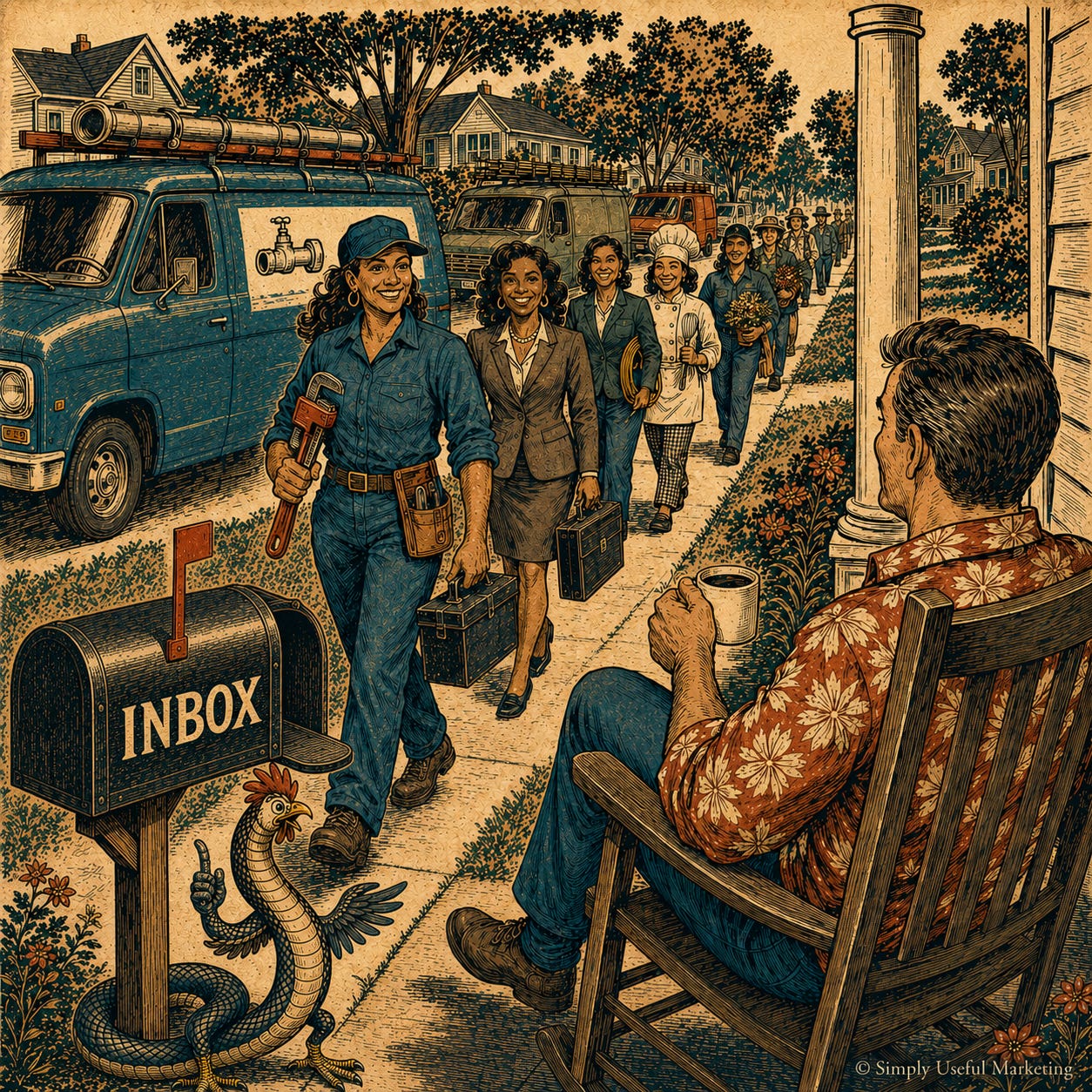
Your customer’s inbox is their homepage.
I don’t mean your website doesn’t matter. Of course it does. It is your online storefront and “proof of business life” so to speak.
But there’s an important difference between the two — a website is essentially transactional; an email is a link in the relationship chain.
Someone has to decide to visit your website. They find you in search, click a link, see something on LinkedIn, remember your URL — somehow, they have to come to you.
The inbox works the other way.
Once someone gives you permission to email them, you get to go to them.
That’s a very different relationship.
People Are Already There
I’m not just dreaming this up from my imagination and too much tea.
Ninety-three percent of respondents to ZeroBounce’s 2026 email research said they use email every day. Forty-two percent check their inbox three to five times a day. Thirty-five percent said they spend between two and five hours a day in email.
More importantly for businesses, people actually want you there.
In Optimove’s 2026 consumer research, 60% chose email as their preferred digital channel for hearing from brands, compared with 50% for social media ads, 37% for push notifications, and 34% for text.
Newsletters give you a particularly useful reason to show up.

Omeda analyzed nearly 2 billion newsletter sends during the first half of 2026 and found a median open rate of 31.6%. Open rates are imperfect — privacy protections and automated opens have made them squishier than they once were — but people are clearly still opening and engaging with newsletters.
Omeda’s second-quarter research goes a step further: newsletters were its strongest email category for engagement.
Which is why, if you want to get into your customers’ inboxes, I think a useful newsletter is one of the best ways to do it.
If “start a newsletter” has been sitting on your marketing list for months, that’s usually not because you don’t see the value. It’s because somebody has to actually build the damn thing. I can help with that.
See how Newsletter-in-a-Box works.
Your Website Still Matters
AI is changing search and is the cause of a new constellation of acronyms around getting your content discovered, cited, summarized, or turned into “the answer” by ChatGPT, Google, and the rest.
I’ll leave that particular acronym safari for another day.
The point is that you should still be creating useful content on your website. Search engines and AI systems need something to discover.
A newsletter simply furthers your reach without duplicating the work.
Publish the useful article on your website and it can be discovered by a new audience.
Send it to your email list and it gets delivered to your existing audience.
Website or inbox, in this context they’re really two different mechanisms: discovery and delivery.
Delivery has one enormous, obvious advantage: You already know somebody wants to hear from you.
That’s a Gift. Treat It Like One.
This is the part businesses seem determined to screw up.
Someone gives you permission to enter one of the most heavily used communication spaces in their life, and too many businesses’ first instinct is:
EXCELLENT. SEND THEM MORE COUPONS.
The same Optimove study that found email was consumers’ preferred marketing channel also found that 55% considered it the most overwhelming channel during high-volume shopping periods.
People like email.
They don’t necessarily like what businesses do to it.
So use the access you’ve been given.
Send a useful newsletter.
Welcome someone when they sign up.
Thank them when they buy something.
Let them know when you have something genuinely useful or interesting to offer.
Stay in touch.
Just remember that an email address isn’t simply another field you successfully added to your CRM:
It’s permission to continue the conversation.
That permission is incredibly valuable because the Web is often transactional. Someone searches, visits, reads, buys — or doesn’t — and leaves.
Email gives you the opportunity for there to be a next time.
And another one after that.
You’ll never own this homepage. You don’t need to. You just need to keep earning your place in it.
Thanks for reading. Comments, criticisms, and witticisms welcomed.
If you’d like a newsletter that gives people a reason to keep letting you into their inbox, let’s have a short conversation: bryant@simplyusefulmarketing.co.
And don’t worry, I don’t pitchslap or hard sell. I’m looking for an honest conversation about what you’re trying to do, what’s getting in the way, and whether I can help.
Musical Coda
Stumbled across Tyler Childers about 2 years ago. Love his voice. One of my favorite love songs; not quite as perfect as “In Spite of Ourselves” by John Prine and Alice Dement though.
I laughed at the coupon part because yes. Someone gives you access to one of the most crowded places in their life, and the response is immediately: GREAT, LET’S ABUSE IT.
There was this one time when NFTs were all the rage, and I watched this CEO subscribe to an NFT guru. I kid you not: seven to nine emails a day.
And most of them included selfies of this nerdy-looking fella.
The marketing worked, right? I still remember the guy four years later.
Just not in a particularly good way.
😂
Happy Friday Bryant
Uh-huh- this "We love email.
We also love to bitch about email"