

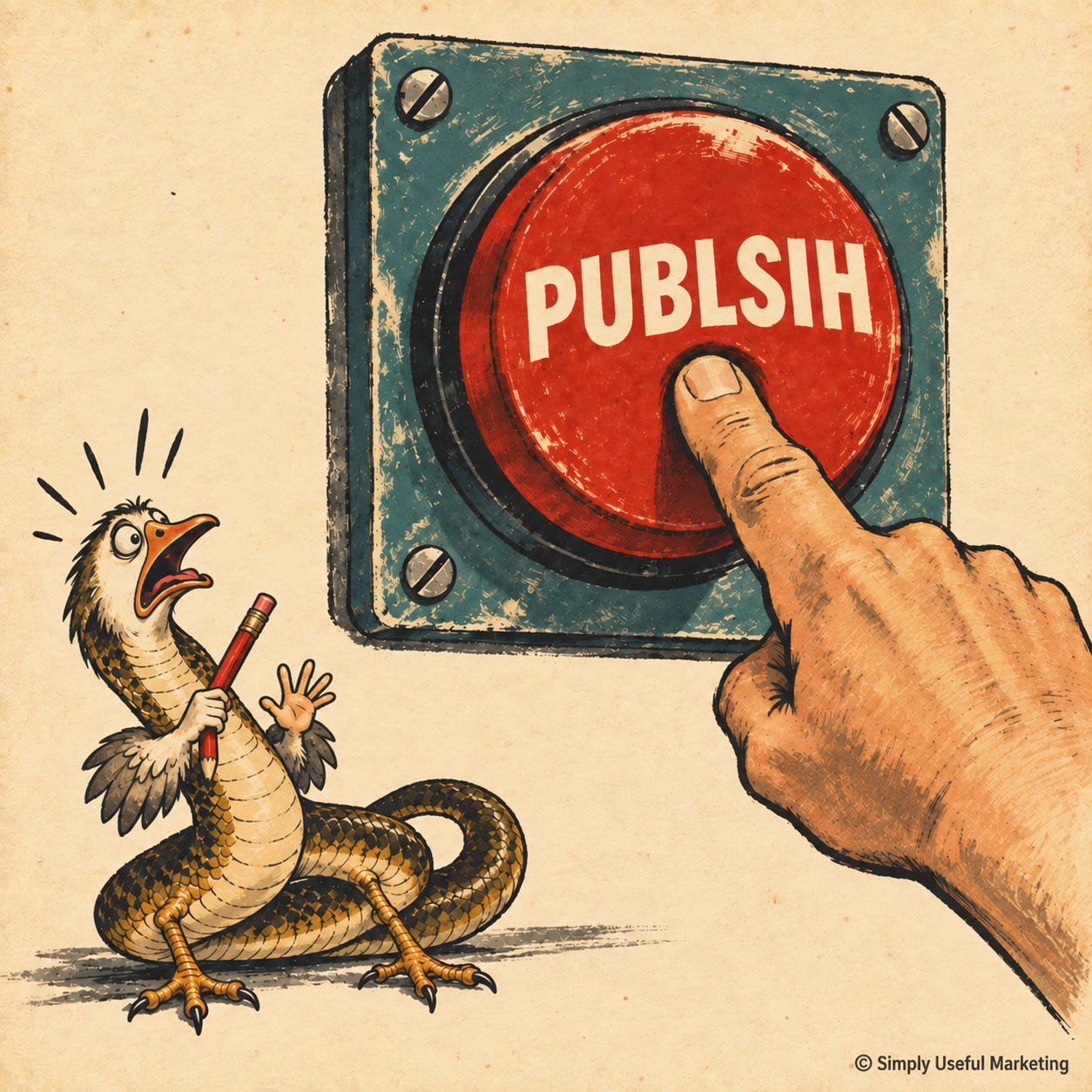
I’ve lived in fear of mistyping “dong” for “doing” since I took over as editor for a magazine in 1997.
Why?
Because when I see that word, I think of an appendage, not the second half of “ding.”
Everyone who writes has some . . . let’s just go with quirks around writing. I use spaces after and before an em dash because I started doing that to prevent widowed lines in print (adding a space was easier and much faster than rewriting at the layout or, worse, blueline stage of editing).
Depending on the style manual, it’s incorrect. Though I did stumble across a style guide after my time as editor ended that pointed out it’s a common practice in printing. Even when I thought I was being grammatically incorrect, I didn’t much care because it doesn’t get in the way of how I use an em dash – to set aside an aside. More on saying “to hell with the rules” later.
High Writing Anxiety
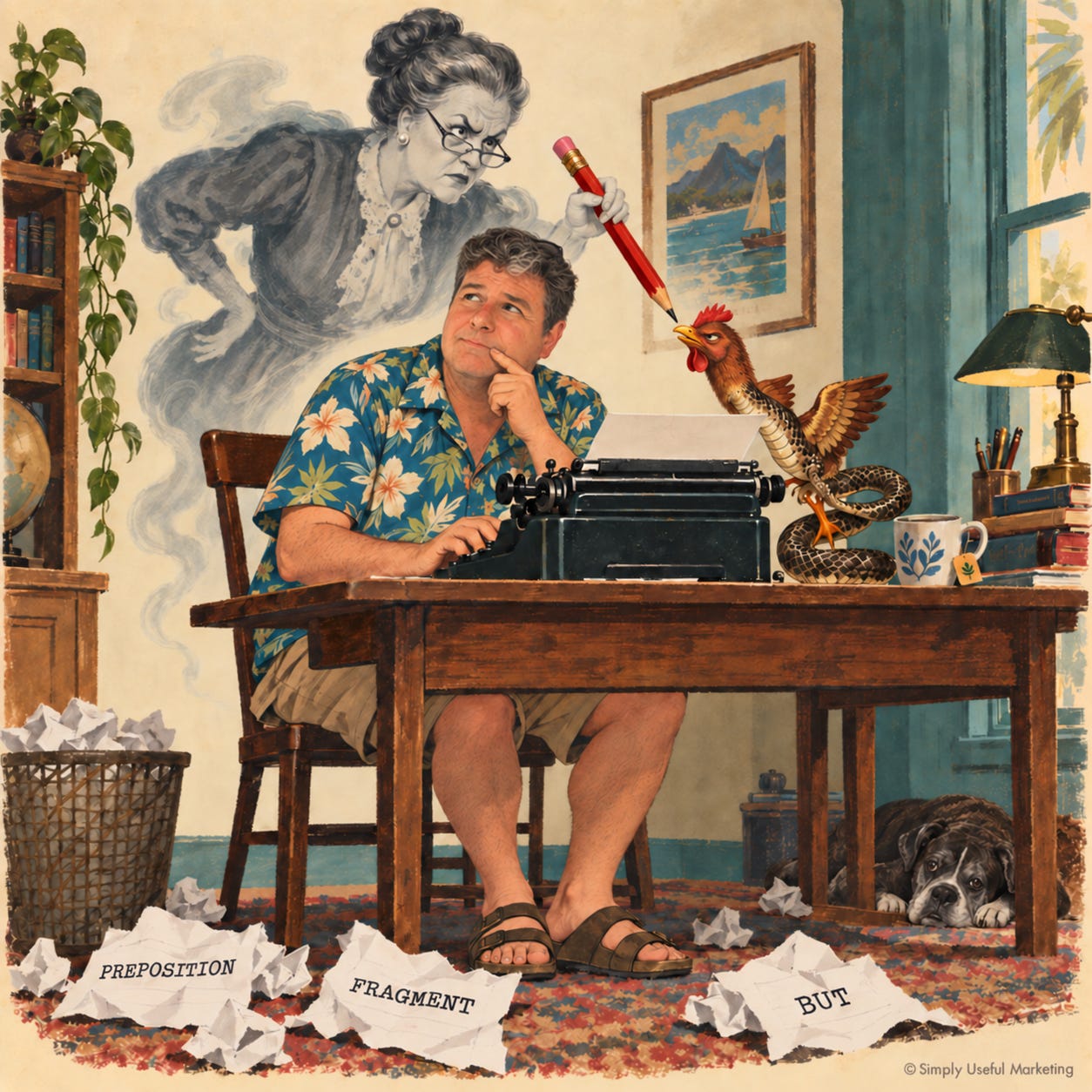
Too many potentially great writers hold themselves back or are unsure because they have their 6th grade English teacher hovering over their left shoulder shouting about not ending a sentence with a preposition.
Or writing single-line paragraphs.
And never to use but or and to start a sentence.
The irony is that ending a sentence with a preposition has NEVER BEEN WRONG.
That anxiety about writing is real. For years, I tried to entice, convince, and if I could’ve thought of how, coerce a guy who had created and ran a document scanning department for a regional bank to contribute to an online community. He had forgotten more about how to do that well than most would ever know. He kept saying that he didn’t know what to write about and that he just wasn’t a good writer.
Sigh. To this day, it’s a regret because my readers would have benefited so much from his knowledge. But it’s hard to overcome writing anxiety.
Because it’s real. Researchers have been studying “writing apprehension” since at least 1975, including fear of having your work judged and avoiding writing altogether. Daly and Miller developed a questionnaire to measure it.
And those rules hovering over your shoulder? In a small study of ten competent college writers, researcher Mike Rose found that the five struggling with writer’s block followed rules or planning strategies that got in their way. The five who weren’t blocked used rules more flexibly.
All ten could write. Five still struggled to get the words out.
Have useful things to share with your customers, but keep putting off the newsletter? Reply and tell me what’s getting in the way. We can see whether Newsletter-in-a-Box would help.
Grammar – It’s Just Rules of the Road
Equating writing with grammar hurts everyone. Now, grammar is absolutely a GOOD THING. The rules are there so that we have a better chance of understanding a writer’s meaning.
You should try to be grammatically correct. Use proper spelling. Even – horrors! – use the em dash. (Any moron who says that’s a “GenAI tell” is, in fact, a moron you can safely ignore.) And for the love of all that is good and holy, do not insert intentional typos into your work to appear “more human.”
For. Fuck’s. Sake. No.
The thing about grammar that it took me a while to understand (and repeated readings of Strunk and White’s Elements of Style – a book I believe everyone who writes should read and have handy) is that the rules of grammar are there as guardrails to raise the chances that your written words will be understood by others.
The clue is in the title. It’s Elements of STYLE, not grammar.
My style could be: Andsmushed up sentences, with randm; punctionat where it doesn’t – really (belong) that run on and: on and on without end repeating the same thing over and over, again and again; doesnot help with clear komunication.
But that wouldn’t help me communicate (or be a good style to stick with).
So learn the rules. Use them to write in your own style, which you can’t develop without writing!
And then don’t be slavishly constrained by the rules when they get in the way of meaning.
“It is an old observation that the best writers sometimes disregard the rules of rhetoric.” — William Strunk Jr., The Elements of Style, Introduction.
So, Typos
Sometimes it feels like I’ve never published anything longer than a tweet (and sometimes those) without either a typo or one grammar mistake. Hell, I’ve had a typo in a one-word text.
I’ve been making this joke for 30 years because it’s largely true – everything I learned about grammar I got from watching Schoolhouse Rock. Who doesn’t love a little Conjunction Junction, what’s your function. Or Lolly and his adverbs.
There will always be a pedantic asshole pointing out some minor grammatical error in your work when you become read widely enough.
Fuck ‘em.
Seriously.
Unless the error or word choice hurt what you were trying to say, it doesn’t matter.
Most typos are harmless. Annoying to the ego (I hate when I have typos, even in text messages), but most readers care shitnot.
However.
IBM and “Messege”
Again, check your work for grammar and spelling, but accept that sometimes you’ll miss things. I no longer feel bad about this because I find typos in books and there’s almost always a note in a 2nd edition about correcting typos and sometimes grammar.
Sometimes a typo can be damaging. As Assistant Editor, the Editor wouldn’t let me review blue lines (that’s the final, physical or digital proof of a magazine before it goes to the printer). Obviously, it’s the last step to catch anything.
For the 1997 AIIM Show Issue, IBM bought a split cover ad. The cover was perforated down the center and opened to a 2-page spread. A box on the cover directed readers to “Open for a messege from IBM.”
When the boxes came from the printer, I was the first to open them. I laughed so loud co-workers popped up like gophers around our cube farm. And then I waited. About 20 minutes after Bob (the editor) walked in, I heard what I expected from Priscilla’s office around the corner: BOB, COME HERE!
I can still feel that delicious feeling of schadenfreude.
I can’t recall every detail, but it was a costly typo. IBM was NOT HAPPY. I believe we ended up giving them a full page ad (worth $15k or so) as a make-good.
So pay extra special attention where it’s important. And have at least another set of eyeballs review your work whenever possible. Just because you shouldn’t beat yourself up for a typo, you should still do your best to prevent them.
Perfection Is a Fool’s Errand
I do my best to be perfect with my spelling. Both because it’s good for the reader and, being honest, my ego. I’m less caring about grammar. I know I write well enough to communicate my ideas. If I miss a comma on a dependent clause . . . fine. Sue me.
Perfection in your writing isn’t a requirement. Honest effort and your own viewpoint is. When you focus on that, over time your control of grammar and spelling will both improve.
And then you’ll still make mistakes. Just keep going.
[As I was about to publish this, I got a text from a friend about a typo in my last article. One last lesson: this isn’t ink on dead trees so fix your typos and grammar booboos as you find them (or have them pointed out to you).]
Comments, criticisms, and witticisms welcomed.
If you want to turn what you know into a useful newsletter for your customers, I can help you get started.
Newsletter-in-a-Box gives you the strategy, structure, platform setup, and 12 starting topics, plus training to keep it going.
Let’s have a short conversation about what you need and whether I can help. No pitchslap: bryant@simplyusefulmarketing.co.
Musical Coda
There is NO other choice for music than Schoolhouse Rock. Here’s the grammar playlist, leading off with the most tuneful of all grammar songs: Conjunction Junction.