

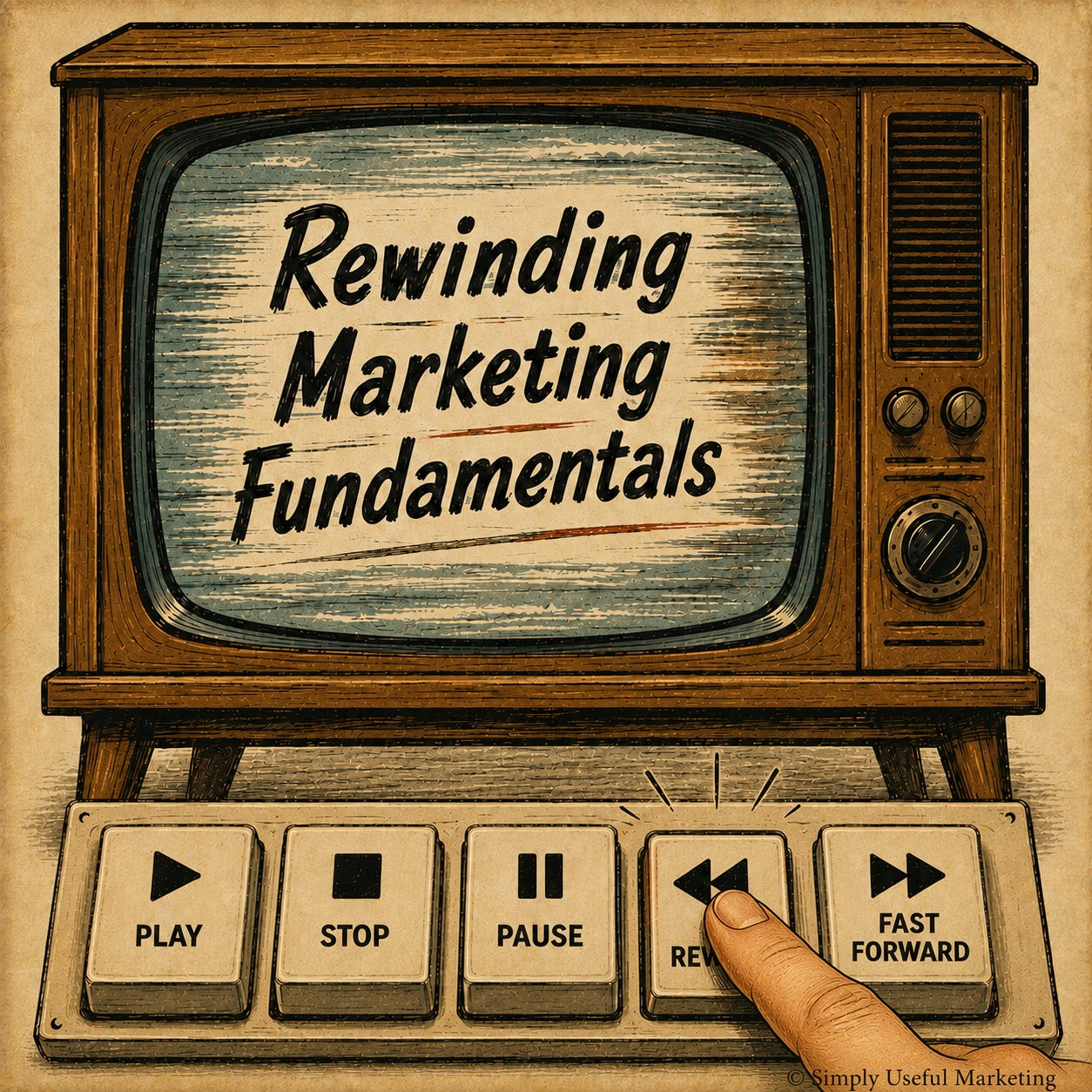
When I say the basics don’t change, the basics don’t change.
I wrote the original version of this piece in 2020. And even then, much of it was based on things I’d already been doing and talking about for years. I may have written an even earlier version a few years before 2020.
I reread it this week expecting to find a bunch of advice that had been rendered obsolete by six years of new platforms, new technology, AI, algorithm changes, and whatever marketing bright and shiny thing we’re all supposed to be chasing this week.
Nope.
Some of the mechanics have changed. I wouldn’t talk about blogging and newsletters as completely separate things anymore. Search has changed dramatically. There are new tools and new ways to distribute what you create – Hello, there, Substack!
Note: like most of the basics, this isn’t rocket science. Much like losing weight advice boils down to “eat less, do more,” these fundamental tactics can become a content marketing foundation anyone can win more business with.
1. Publish Useful Content Consistently — Make the Newsletter the Hub
In 2020, I treated blogging and newsletters as separate tactics. I’ve rolled them together here. For most small businesses today, there’s little reason to treat them as separate activities. If you’re publishing useful content online, add an email signup and send it directly to people who want to hear from you.
Whatever the hell you call it — a blog, a newsletter, an article, this thing I’m writing, a piece of content — creating and sharing useful information consistently is one of the simplest (though not easy) tactics any business can use to attract new leads and customers.
Share information and ideas that address your customers’ points of pain. Answer their questions and keep doing that.
Why publish? Because useful content gives people a reason to find you, pay attention to you, remember you, and eventually trust you.
A newsletter is the most direct trust-building tool you own. It isn’t an email. Email is how you deliver it, whether that’s via Substack, HubSpot, Kit, or whatever platform you happen to use. Those are plumbing.
Social media can introduce people to you. Search can help them find you. Your website gives them somewhere to learn more. But once someone subscribes, you can communicate with that person directly without depending on an algorithm to decide whether they see what you published.
The list is yours. More importantly, the relationship is yours.
And the newsletter itself can be the content. An article like this can be the newsletter. It can also live on your website, become several LinkedIn posts, provide ideas for videos, or be repurposed in whatever ways make sense.
Create one useful thing. Send it directly to the people who asked to hear from you. Then use the other channels to help more people discover it.
What should you write about? Marcus Sheridan built his pool business using a wonderfully simple idea that eventually became They Ask, You Answer: answer every single one of your customers’ questions honestly and openly.
Repeat.
That’s it.
The format matters far less than whether what you send is useful. A newsletter can be 100 words or 2,000. It can be one article, several short items, curated links, video, or some combination of all of them.
Once you have someone’s attention, don’t squander it. Show up regularly. Be useful. Earn the next open.

2. Personas
Who’s your ideal customer? Research and identify your ideal customer(s) and create a persona for each, complete with name, photo, and a bio.
Then focus your efforts on providing those people the information they actually need, delivered in the ways they’re most likely to consume it — email, video, social media, articles, or whatever else makes sense.
You don’t have to turn this into a six-week research project. You do need to know who you’re trying to help.
3. Useful Content; Various Formats
The customers of the company across the street may have customers who hate to read, but will watch hours of videos. Yours might love articles and newsletters and skip over video. Persona research will help you determine the method you use to deliver content — video, ebook, infographic, etc.
The content must be useful to be effective.
Create informative ebooks (which can be compilations of your existing content), infographics, videos, podcasts, case studies, how-to guides, presentations (like webinars), and more that you can use as lead magnets.
Don’t confuse “more content” with “better marketing.” One useful piece that answers a real customer question beats five pieces created simply because somebody told you that you need to post five times a week.
Pro Tip: To stay on schedule, the best thing is to be at least a week ahead. When you aren’t (howdy) yet still want to keep your posting schedule (howdy again), having a cluster of 5 to 10 half-written posts and/or a few pieces that are old, but still valuable with a light revision, will help you stay on track.
The more half-written ideas you have (I probably have at least 100 snippets, drafts, outlines, and braindumps in my ideas file); the more likely when you’re in “Oh, shit, I wanted to get something out this week, but I need to do it quickly” mode that you’ll find one that ignites your imagination and that you can knock out in an hour or two.
4. Social Media
Used well, social media is like pouring gas on a fire. Use social media to only push your product, and it’s like dumping cold, wet sand on your efforts.
The first and most important thing to keep in mind is that there’s no single “perfect” social media plan applicable for everyone. Your audience might be on Facebook and hate Instagram. Others might love Pinterest. And there will always be another app and social site.
Use social media to share useful information — yours and other people’s. I’m less interested today in rigid formulas about how many posts should be yours versus somebody else’s. Be useful. Be interesting. Participate.
Use social media to meet your customers. Social media is both one-to-one and one-to-many. When you answer a customer’s question in a social media space, you’re creating a relationship with that customer. Because of the public nature of social media, you’re also showing yourself as a helpful partner rather than a company just interested in selling to everyone else.
Develop a social media presence where your ideal customers congregate. Learn the rules for that particular channel. Then become a member of the community. Share good information. Be human. Don’t make a hard sell.
And remember what social is especially good at: distribution. It can introduce people to your thinking. Whenever possible, give those people a path toward a relationship you can continue outside the platform.

5. Email Nurture Campaigns
Email remains the backbone of many great marketing strategies. There are dozens of ways to use email to nurture leads into becoming customers and to provide excellent customer service. A short list includes:
Cart abandons. When someone goes to an action landing page (to register for a webinar, make a purchase, etc.) but doesn’t complete the desired action, create a short email sequence to nudge them to completion. If you’ve ever put a product in your cart and then not bought it, you’ve gotten one of these.
New customer welcome. Create a sequence of emails over a few weeks to welcome a new customer, provide advice on how to get the most out of their purchase, invite them to join an online community (if you have one), and even upsell.
Educational nurture. When a lead downloads an information asset (an ebook, for example) or attends an event (like a webinar), create an email sequence to share related articles, other content assets like infographics, and even third-party information that educates your lead. Gently insert offers later in the sequence to invite them for a call, a free trial, a discount offer, etc.
Help people. Follow up. Stay useful. Make an appropriate offer when the time is right.
And if you have a customer or prospect list sitting there mostly unused because you don’t have the time, system, or content to stay in touch consistently, you probably don’t need another marketing channel. You need to start using the audience you already have. If that sounds familiar, reply (bryant@simplyusefulmarketing.co) and tell me what’s getting in the way.
6. SEO — Search Engine Optimization
Search looks very different than it did in 2020. Traditional Google results now compete with AI-generated answers, social search, video, Reddit, AI assistants, and other ways people look for information.
But the useful part of the old advice survives: people still have questions, and you still want your business to be one of the places they find good answers.
SEO is a vast topic and an industry/profession of its own. But you don’t need to be an expert to take advantage of practical advice:
Write for people first. Make the thing genuinely useful.
Make it easy for search engines — and increasingly AI systems — to understand what the thing is about. That means using headings as well as having a sitemap for your website.
Pay attention to the actual words and questions your customers use.
Then stop trying to trick algorithms and go make something worth finding.
Get Going
The sooner you begin, the sooner you’ll begin to see success. Don’t overthink, but take the time to think through your objectives and create a strategy. Decide which marketing tactic you’ll begin with given time and/or budget constraints and go.
Six years after writing the original, I’d add one more thing.
Don’t let the number of things you could be doing prevent you from consistently doing a few useful things well.
You do not need every channel. You do not need every tactic. And you definitely do not need to rebuild your marketing every time somebody announces that everything has changed.
Because they haven’t.
Comments, criticisms, and witticisms welcomed.
Love to hear your thoughts!
If your problem isn’t knowing that you should be marketing but finding the time, consistency, or extra pair of hands to actually get it done, that’s the kind of problem I help solve.
Reply to me, bryant@simplyusefulmarketing.co, and tell me what keeps falling off your marketing to-do list. If there’s a sensible way I can help, I’ll tell you. If there isn’t, I’ll tell you that too.
MUSICAL CODA
Edited while listening to one of Tom Petty’s best albums.
Six years of AI, algorithm panic and shiny new platforms later, and the advice is still be useful, know who you’re talking to, and don’t disappear for six months.
Easy peasy Bryant.
Happy Monday!
Oooooo, I like!