

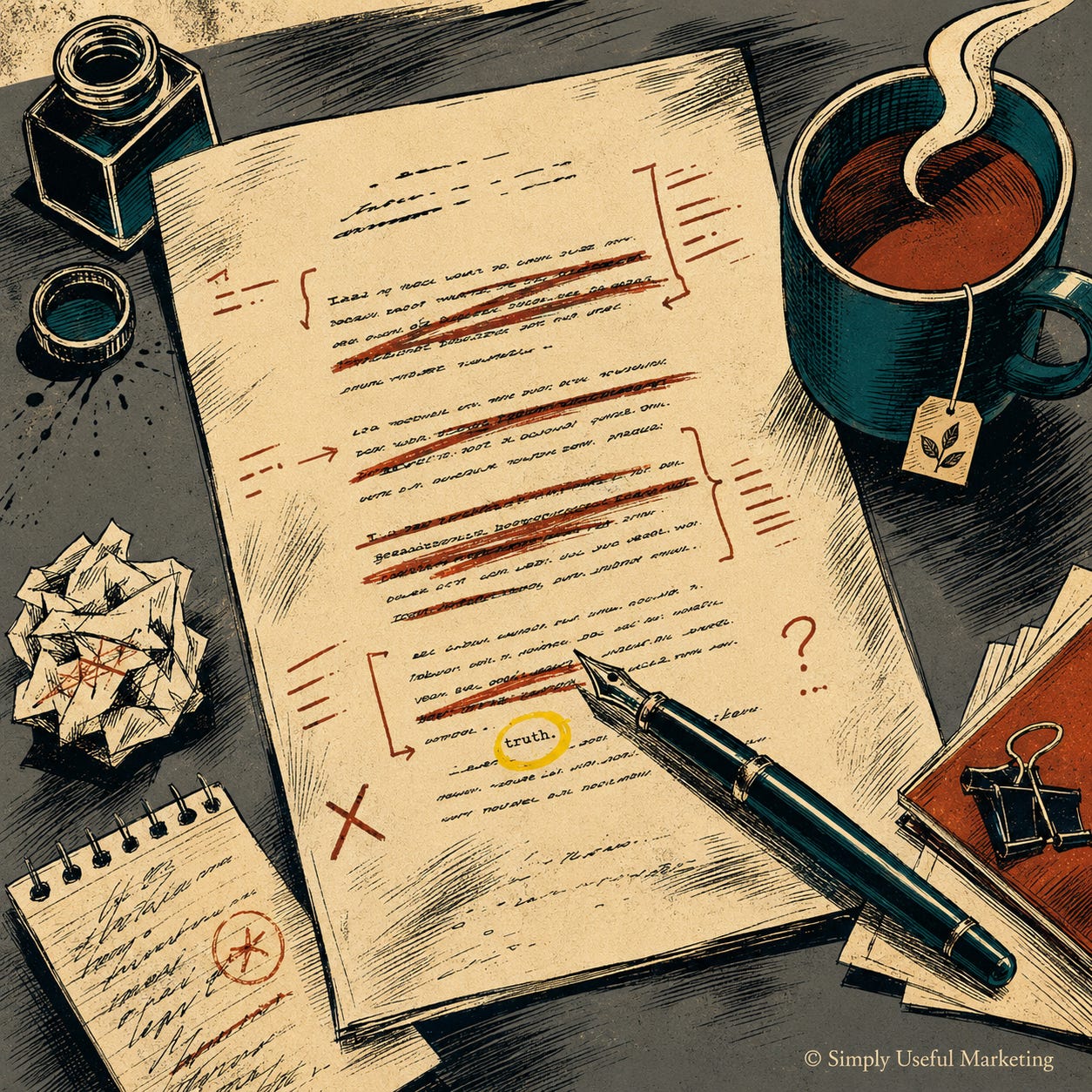
I have an editing and writing process. I rarely think about it. But I did last Friday.
Last Thursday I published Wyatt Earp on Gunfighting: 6 Marketing Lessons.
I was (and am) happy with it. The idea behind it was simple: my hamster was still spinning his wheel slowly. I needed a quick, easy idea to ease me back into thinking after 3 weeks of creeping crud. It’s sometimes easier to react to an idea than to create one out of nothing, so as I skimmed my list o’ “these should be quick” ideas; gunfighting advice screamed “pick me, pick me.”
I work with Michael Kaye, The Business Coach, who has done yeoman’s work steadily helping me reverse some business-related cranial-rectal inversion. (Check him out, he’s awesome. Full disclosure: I help him with his newsletter.)
So Michael calls me Friday as I’m just beginning my drive down to Sulphur, Louisiana. “Bryant, read the latest article – Enjoyed it! I was a huge Wyatt Earp fan growing up! But . . .”
I knew that “but” was coming.
“I almost didn’t read it at 13 minutes and did you need to lead with the negativity of him being anything other than a hero?”
After a little back and forth, I said something awkward that lead to this post: I know I could’ve strengthened it by making it shorter, but I didn’t have time.
Which Michael rightly pointed out as a contradiction.
Between dodging 3 accidents that had me taking detours; I started writing this (it’s a long drive, my throat gets sore singing over 19 hours, not much to do but think). Like a grain of sand in an oyster, my response to Michael kept aggravating me. Now, I don’t know that what follows is a pearl, but here’s a look at how this editor/writer made writing and editing decisions on his newsletter piece
Topic Selection
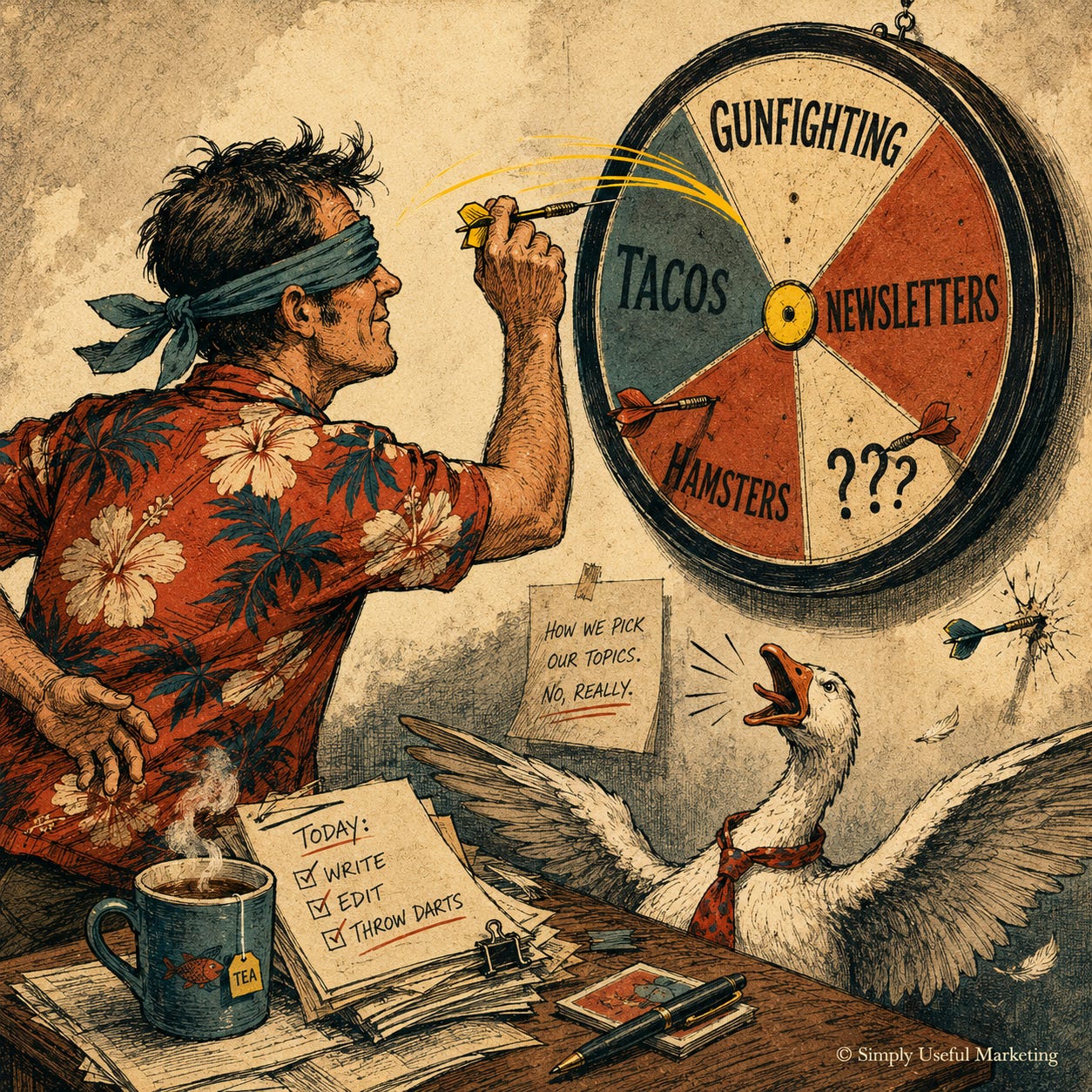
I believe in structured, but open, planning on topics. I transitioned into a content marketing role a year after over a decade editing a magazine (the year in the middle was online content/building AIIM’s online community from scratch).
Planning and scheduling content is natural to me. It also helps you stay on schedule.
But slavish devotion to a list of topics can cause you to get stuck. While there’s a lot to be said about “just freaking write it” (especially when deadlines are involved), sometimes you just get stuck on a post or you look at the next two topics and your brain rebels.
Or, like for this one, you just need something fairly easy to write.
That’s when you’ll want to:
Skip ahead.
Look at the draft topics you haven’t added to the calendar yet (keep an idea journal – an actual journal, notebook, index cards, document, etc. – to pull from when you’re stuck).
Work on the random, fun idea you just had yesterday that you’re excited about writing.
And then go back to your list, you created it for a reason. Do the work.
I have a list of topics (adding deadlines this week, finally). I ignored it for an idea I really wanted to write about and that would be easy.
First Draft
To get the ideas flowing, I started off by listening to a YouTube video of Earp’s advice being read as I made tea. Tea in hand, pulled up the PDF of the advice and started typing in headers, along with quick brain dumps of what I was thinking, marketing lesson-wise.
I tried to use as many quotes as I could, but that didn’t always work, so started light rewrites of the advice for the headers.
Realized that looked . . . odd to me, so went back and changed some of the headers so it would be a “quote/marketing lesson.”
I wrote the intro and then bounced between the lessons until I was happy-ish.
Parked it for an hour.

Review – Enter the GenAI
For a longer piece, I’ll reread and jot down where I think it’s weak, what I want to change. For this one, I did that in my head — it’s tight here, weak there, this seems out of order.
I have a standard review process in Claude, so popped the first draft into a new chat in “My Work” project (all my writing is in there) and prompted the review.
Claude flagged the same things I had (seems to run about 50/50 — half the time it’s reinforcing my thoughts; even after prompts to “not give me what I want to hear”; the other half, I’ll get an “oh, I shoulda noticed that/damn, I’m not sure I would’ve noticed that” suggestion/insight).
It was long.
It lead with the weakest section.
Headers were inconsistent.
Quotes and lessons that were dupes or reaching for what wasn’t there.
From here, there are two basic choices:
Rewrite yourself.
Use your genAI tool of choice.
Too many things needed to be changed for me to be comfortable with a genAI edit. If the piece had just needed some slight smoothing, I would’ve had Claude rewrite while tracking changes (to keep, ignore, change).
Second Draft – Rewrite
Here are the revisions I made:
Trimmed the intro by 150ish words.
I had a “5 Rounds Chambered” lesson that was redundant with the “Two Pistols” subhead.
Killed the “5 rounds” section and moved a relevant paragraph to “Two Pistols.”
I had fallen in love with both pieces of gunfighting advice, but they just didn’t work independently.
Changed the headers so they all matched; marketing lesson/Earp quote or point (this was a flip from the quote/lesson order I had in the draft; I think it works better).
I was making two, contradictory points with “notched pistols.” Deleted the secondary point about still needing to shout and left it at the “focus on your customer” advice.
Moved “Take Marketing Seriously” from first to last and rewrote it entirely to serve as a solid close rather than a weak open.
“Substance Over Flash” is the best section, moved it from 2nd to last section to first.
I had a few asides within the piece that were distracting, including one about my hatred for Buc-ee’s, so changed the reference to Royal Farms. Though, yeah, I despise Buc-ee’s.
Tightened in general — cut 300 to 400 words.
One key point about using genAI as an editing assistant — they will often make assumptions about the goal of the article that are wrong. Now, you CAN avoid this by adding all of your context up front. I find this tedious and dull because I know what I want more often than not.
One of Claude’s main points was that the advice was basic. This I already knew and was the point of the post — make basic marketing points using an odd analogy. So I simply ignored this advice as irrelevant here.
GenAI is the tool. You make the decisions. Don’t. Get. That. Backwards.
Decisions and Michael’s Feedback
I could have taken the gunfighting article in multiple directions.
Added research. There is plenty of available research to support all of these points. Adding would have made this longer than I wanted. It felt like a clunky bolt-on rather than a smooth support to the simple points I wanted to make. I LOVE research-based posts; this one just wasn’t a fit. Even if I had been inclined, adding that detail would have taken more time than I had.
Streamlined about 20% word count by cutting the history. I could have deleted most of the explanatory history from each point and let the headers do the lifting for the analogy. I decided not to:
I thought folks might find it interesting.
I indulged my inner history nerd.
Mentioning the other aspects of Earp’s life in the deck. Unlike the famous line from Liberty Valence (another great movie, much less Western —Jimmy Stewart, John Wayne, Jack Palance), I find the nuanced, actual history more fascinating than “print the legend.” And I figured everyone would make the “OK Corral” association anyway, so why not add the more interesting nuance?
Regarding length, the final word count was 1,395 words. Long-ish? Maybe. Too long? Hard to say. Michael and I have gone back and forth over length for over a year now (I even wrote about it here: The Goldilocks Content Problem: What the Hell Is “Just Right”?)
He likes short and punchy. My response is always “you aren’t writing for you.” Fact is, no one knows what “too long” or “too short” is (I explain this in the “Goldilocks” article).
That said, for marketing newsletters like mine; I believe a mix is better than a one-tone-note. You’ll see a mix of short (500 to 800), long (2,000+), and medium from me over the rest of this year (and as long as I keep doing this).
Circling back to that “grain of sand” I mentioned about “not having time.”
There is a point where you start making changes to a post that are just changes. They aren’t better. Or worse. Just different. At some point, editing becomes wasting time. Perfection is the absolute enemy of the good (and published). Good enough IS good (and, barring a piece being truly awful, infinitely better than never published).
On the other hand, if I had wanted this piece to be different — longer, with more marketing lessons and/or supported by research; I would have taken the time.
And while I could have edited further for length, I intentionally made the decision to keep the gunfighting lessons background. Was it the right decision? I don’t know. But I enjoyed it and I didn’t receive fewer likes than normal, so at least it wasn’t an awful choice.
I knew all of these decisions and trade-offs I was making, but didn’t convey them well enough to Michael. Especially the length point, as I never explained the draft was about 500 words longer than the end result. This is a matter of perspective — I knew I had already cut it and it gets harder and harder to condense your own work as you do so (at least in my experience). Michael likes a sub-1,000 word read.
The upshot is this: The article does what I want it too by combining a, let’s face it, random topic to illustrate basic marketing principles. I could have condensed it, focusing entirely on the marketing points, but I chose not to.
And apologies to Michael for, I think, making a childhood hero human.
Final Edits
Once I finished my updates, I ran it quickly through Claude again to double-check I caught the mistakes and changes I wanted to make; as well as ensuring all of my headings were in the correct order (using genAI to check for this sort of consistency is very good thing).
Once I confirmed I had covered my bases, I did a final spell check in LibreOffice and then the last thing I do for everything I publish: a final pass to remove any double spaces.
I then used ChatGPT to create images, pasted into Substack, did a final line spacing and obvious typo scan, and published.
That Was Harder Than Expected
I have always been an intuitive writer. Usually when it feels right; I’ve been right.
Taking the time to think about and now write this out was harder than I thought it would be. I’ve said a variation of this before related to the “good enough” concept I mentioned earlier: at some point when you’re writing, you’ll just know — it’s too long, or too short, or needs something, or is off somehow, etc. — but to get to that point, you have to put in the time and write.
I might try to do more of this in the future — pulling out the specific thinking that I do intuitively. Until then, write, publish, repeat.
PS: If you’re having a hard time with that, I created my Newsletter-in-a-Box service (read about it here) for you. A newsletter remains the only controlled, one-to-one mass communication marketing vehicle you can own as a business. Everyone should be using newsletters to build customer trust because trust builds businesses. Let’s talk and see how I can help: bryant@simplyusefulmarketing.co.
The title is a play on George Jones’s Choices, which might be tied for White Lightning as my favorite George Jones song. Since Choices played while I was thinking about this on the road, it worked it’s way into the title.
Good idea to make final decisions with your own gut feeling.