

Marketing is, on one level, a seduction. How do I turn a stranger into a customer?
The marketing process for this is called a funnel. It’s a dull, boring word to describe the process of pulling new people into your world and nudging (nurturing is the marketing word) them to become a customer.
There’s nothing wrong or nefarious about this process. A few weeks ago I wrote about why funnels aren’t the enemy — why the folks telling you to “drop the funnel” all have one, they’re just calling it something else.
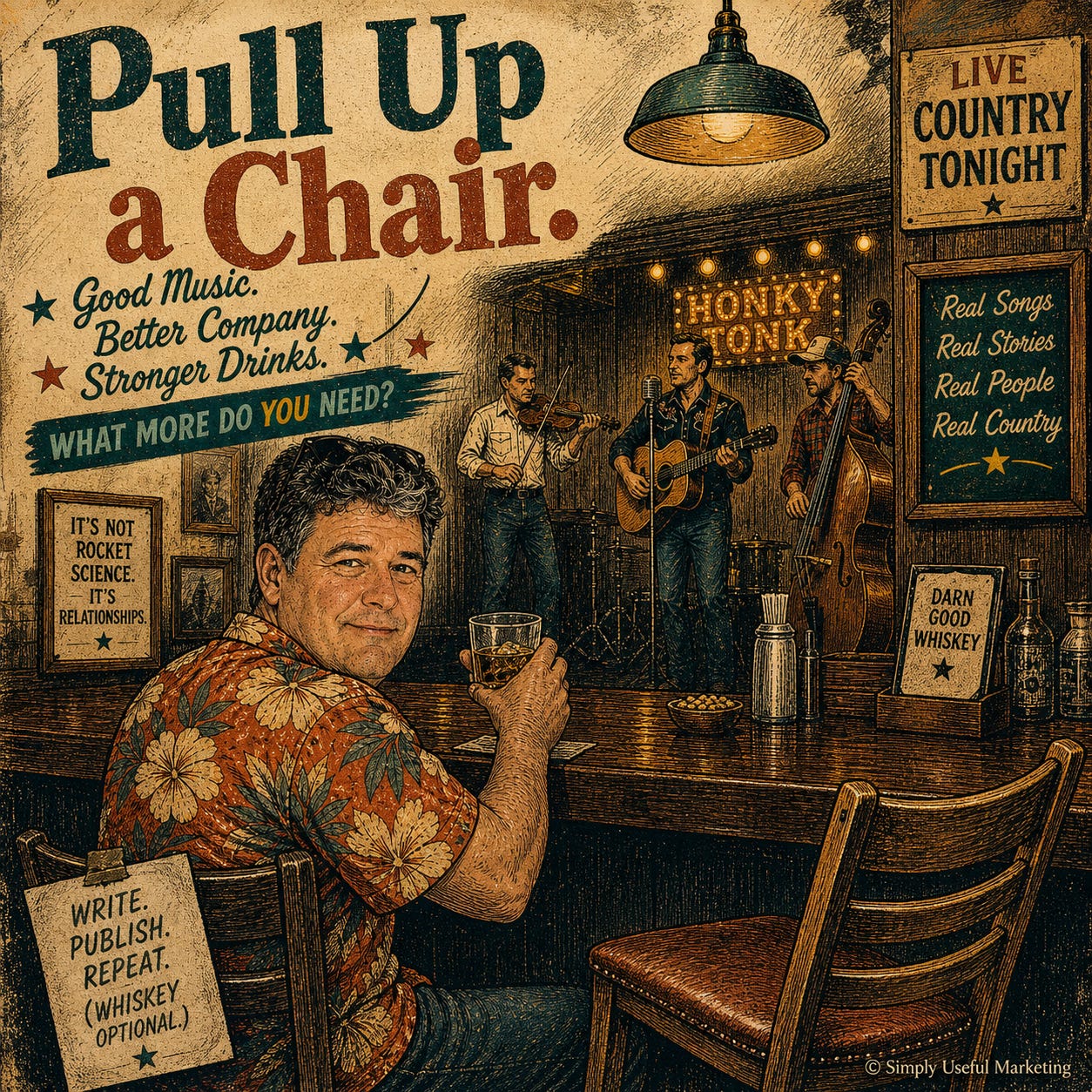
When I heard George Strait’s song, “The Chair” a few days ago, it struck me that he kinda sorta outlines the funnel process in a tight 2 and a half minutes.
The piece of content that sits at the top of your funnel can be whatever you want. Newsletter signup. Free guide. Educational email course. Webinar. A checklist. A demo. Free access to the product (especially apps/software). Doesn’t matter. Someone gives you their email because you offered them something useful. Then you build the relationship from there.
A funnel is a funnel is a funnel.
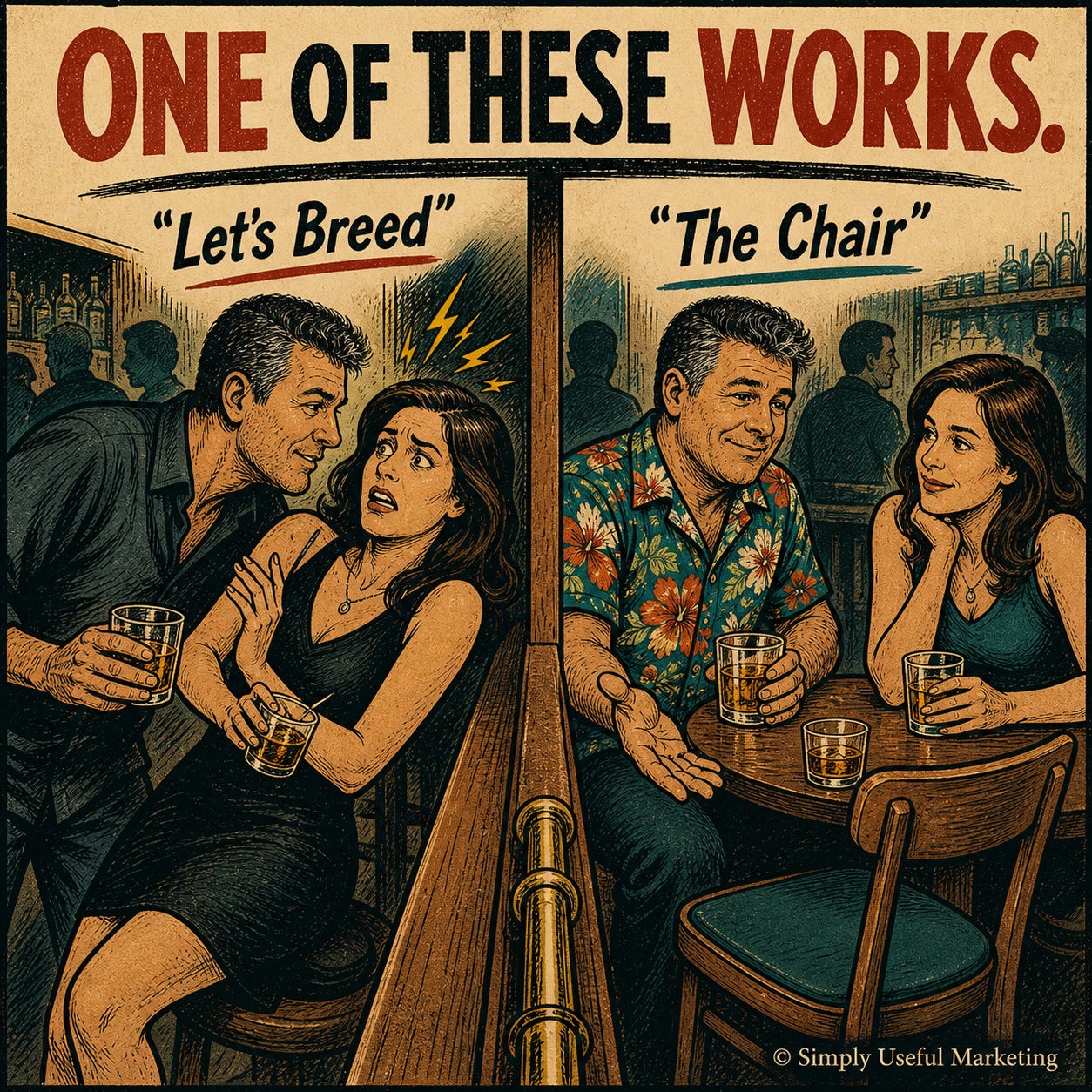
One of my favorite explanations of old-school, interruption marketing came from Gary V — back when his first few books were genuinely good and before he became whatever he is now. He described it as buying someone a drink in a bar and then asking them to go to bed with you immediately after.
A little more seduction is in order. Before getting to the song, here’s a quick explanation of what a funnel is and why they matter.
Funnel: Quick Explanation
A funnel is the path from “who are you?” to “shut up and take my money.” Wide at the top because lots of people kinda-sorta know you exist, narrower the further down you go because most of them peel off along the way.
Stages, in plain English: they notice you, they consider you, they buy (or don’t), they come back, they tell their friends. That’s it. The last two get skipped a lot, which is dumb — keeping a customer is cheaper than finding a new one. [FYI, MOFU, middle of funnel, is my favorite marketing acronym and never fails to crack me up.]
The point of the funnel isn’t the shape. It’s that it makes you count things. How many came in. How many made it to the next step. Where you’re leaking. Numbers instead of vibes.
Caveat: nobody actually moves through it in a straight line. People lurk for six months, ignore you, then buy on a Tuesday because their coworker mentioned you in Slack. This is the “messy middle,” or, as I like to call it, reality. The funnel is useful as a framework — just don’t mistake the diagram for how humans actually behave.
Alright, let’s learn from George!
The Chair
So here we go, an inbound/content marketing funnel explained via a country song.
“Well excuse me, but I think you’ve got my chair, No that one’s not taken, I don’t mind if you sit here, I’ll be glad to share.”
Ah, the website (your newsletter site here is a website) — your chair. A nice, inviting website that answers customer’s and potential customer’s questions will make strangers come in, have a seat, and look for the bartender.
“Yea it’s usually, packed here on Friday nights, Oh if you don’t mind could I talk you out of a light?”
At this point, most guys are “Woohoo! She half-smiled, I am a stud!” Settle down there, buckaroo. Start a conversation small and slowly, with a question that’s likely to get you a yes. Circling back to Gary V, “let’s fuck” probably isn’t going to work out for you — either in a bar or selling your service. (Usually, there’s a story at the end of this post.)
For content marketing, this could be useful/entertaining/valuable/interesting content that’s relevant to the person now on your website. Good information that’s just there and requires no commitment. Think of this as your blog content. Or your LinkedIn posts. Or your Substack Notes. Or your newsletter (if it’s for marketing and not the product itself). Whatever channel gets you in front of them.
“Well thank you, could I drink you a buy?”
We all stumble and make mistakes. You will have typos. You will create and use email subject lines or blog titles that suck. Don’t freak out. Just acknowledge the slip-up and move on.
“Oh listen to me, what I mean is can I buy you a drink? Anything you please.”
Here’s your landing page with something useful on the other side of an email address — a free guide, a checklist, a short email course, a newsletter signup, a webinar, whatever fits. It should be something they actually want and is useful.
“Oh you’re welcome, well I don’t think I caught your name, Are you waiting for someone to meet you here? Well that makes two of us, glad you came.”
They filled in your landing page form, downloaded the asset, and you know their name and email address.
Now say “Thank you.” Keep the conversation going with a thank-you page pointing to related, helpful content. And start using email to build the relationship — not to blast them with 14 reasons to buy from you right now.
“No I don’t know the name of the band but they’re good, Aren’t they, would you like to dance?”
Start to develop the relationship. This is a bit of a leap from the song lyric, but as you begin to understand their problems and where you can help, you can really begin to understand them and ease them through your funnel.
“Yea I like this song too, it reminds me of you and me baby Do you think there’s a chance? That later on, I could drive you home?”
It’s a 2-minute song, so George had to move quickly — faster than you need to. The buyer journey usually takes longer than this. Keep showing up with useful information. Keep earning the right to ask for a little more.
“No I don’t mind at all.”
And now you’ve got a customer.
That’s the whole flow — chair, light, drink, name, dance, drive home. If your version is missing a few of the middle steps — no real lead magnet, no landing page, nothing useful going out after someone signs up — that’s what Newsletter in a Box is for. Click here to ask me about it.
“Oh I like you too and to tell you the truth That wasn’t my chair after all.
I guess George just wasn’t thinking of me writing this post when he sang this back in 1985, so this is where the analogy ends. I’d never recommend faking it, lying, or even “shading the truth” when attracting customers (or a date). If you see someone in a bar, use whatever opening line you can think of that might let you sit down and attempt a conversation. Well, any line that’s not, “You must be tired because you’ve been running through my mind all night” or is an outright lie.
Definitely not that.
Also, if you’re humming Amarillo By Morning now, you’re welcome.
A True Bar Story
In the 80s and 90s, Miss Kitty’s was the main meat market in Lake Charles, La. South of town, so was . . . huh, kinda Roadhouse-ish now I think about it . . . with shitkickers from south of town (cattle, farms, horses, oil workers) and preppies from the “big city.” Probably went 20 or so times, pretty sure there was a fight each time.
Anyway, when I was in high school, remember talking to my buddy Clyde’s brother. Somehow or other the conversation turned to Kitty’s and he told us he had used this pickup line: Let’s breed.
He got slapped once.
It worked once. Every now and then a cold call or an immediate “gimme money” request will work. But it’s not a long-term strategy.
Pretty sure the success rate would have gone down if he hadn’t started dating his future wife shortly after using it. Given my vague memory of her and the fact that she wanted a dry reception after the wedding, 99.9% sure he didn’t try it on her. And the reception was dry, except for me and Clyde’s table.
P.S. The song ends when she says yes. That’s where the actual relationship starts — and where most newsletters quit. Newsletter in a Box is what you send on the second date. Click here to ask me about it.
Musical Coda
Egads. Truly horrible video. I do like the song though!
One of my all-time favorite songs. Had no idea there was an official video until just now.
Respectfully, the real lesson here is that George Strait could've run a hell of a content marketing agency hahahaha
The image "Let's breed" LOL