

I saw a post the other day I mostly agreed with — stop buying $500 courses from people who’ve never built anything, stop wrapping empty platitudes in authority, tell the truth.
Preach.
Then came the line that made my left eyelid twitch: “Drop the funnel.”
No.
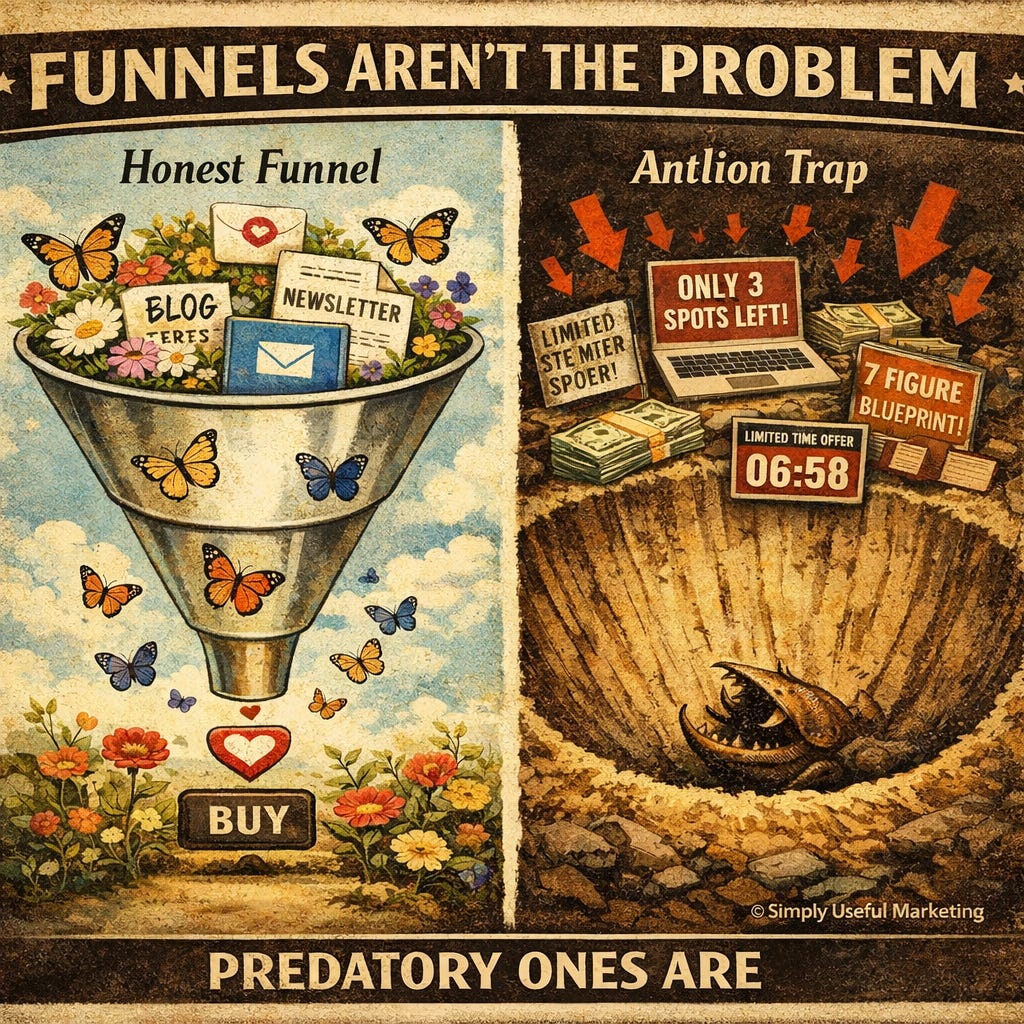
Drop the bullshit that’s been smeared all over funnels — the fake scarcity, the bait-and-switch webinars, fake countdown timers on offers that never actually expire. Drop that.
But don’t drop the funnel itself.
Because everyone making fun of funnels has one. They just call it something else — “ecosystem,” “customer journey,” “my process.” At some point, a stranger discovers you, decides you’re worth paying attention to, and eventually decides you’re worth paying. That mechanism is a funnel. Renaming it doesn’t change what it does.
The concept isn’t broken. What’s broken are the folks who use manipulation tactics to pull people into their funnels and products.
A funnel built on manipulation deserves scorn. A funnel built on being useful — showing up, earning trust, asking for the sale when you’ve earned the right — is just good business.
So don’t throw it out. Fix it.
And since “fix it” is vague advice that helps no one, let me show you what a simple, honest funnel looks like — and how to build one without spending a dime on some guru’s course.
What a Funnel Actually Is
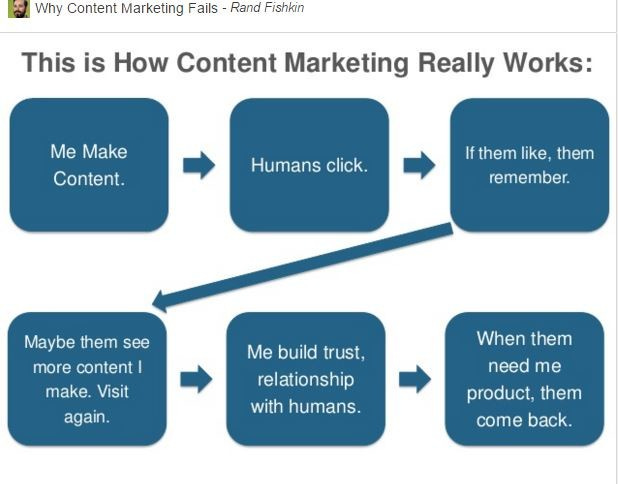
A funnel is three stages:
Someone finds you.
Someone starts to trust you.
Someone buys from you.
That’s it. That’s the whole thing.
The reality involves more touchpoints — lead scoring, nurture campaigns, SEO, digital ads — but the skeleton is always these three stages. Tactics are legion. The process is always similar.
This image from Rand Fishkin is the foundation for how I think of funnels (because it was one of the first things I read on the topic and it stuck).
I also imagine customers as butterflies. They are blown by the wind. They fly in zig zags. They alight on this flower, then another and another.
But, somehow, they can migrate all the way from Canada to Mexico.
Every business on earth has this whether they use the word “funnel” or not.
My funnel is very simple. Someone reads one of my LinkedIn posts or Substack Notes. They’re curious enough to click through to my newsletter. They read a few issues. Somewhere in there, they realize I know what I’m talking about and that I’m not trying to sell them something every five seconds. Eventually, they reply to one of my emails or book a call. Some of them become clients.
That’s a funnel. No countdown timer. No “only 3 spots left.” No 47-minute webinar that’s actually a hostage situation. Just useful content, consistency, and a clear offer when the time is right.
Why Most Funnels Feel Gross
The problem isn’t that funnels exist. The problem is that too many of them skip the middle.
The middle is the trust part. It’s the stage where someone goes from “who is this person/company?” to “I think this person/company might be able to help me.” That takes time. It takes showing up more than once. It takes giving people something useful without immediately asking for their credit card.
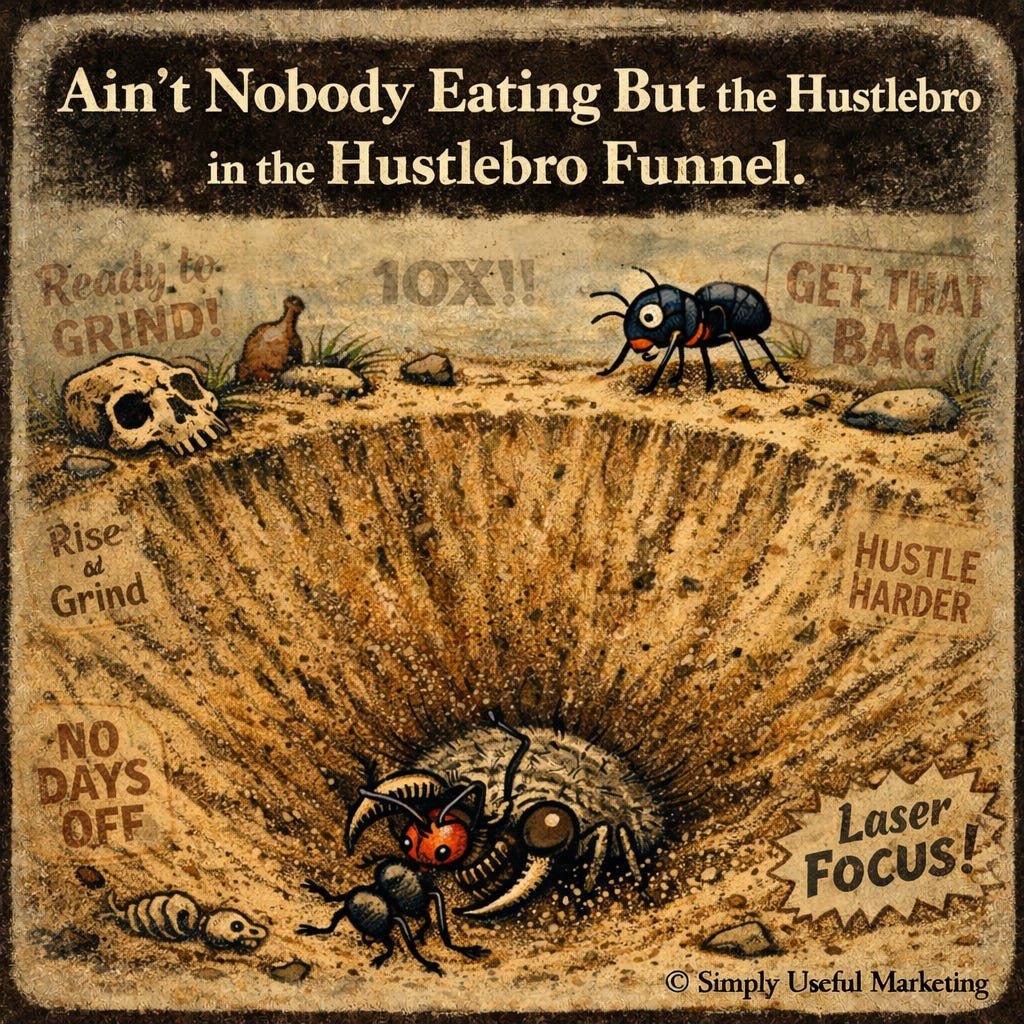
Hustlebro funnels jump from “stranger” to “buy my $997 thing” in 48 hours. They manufacture urgency because they haven’t earned attention. They use psychological pressure as a substitute for trust.
That’s more like one of those antlion traps — nobody is eating except the larvae at the bottom of the funnel.
An honest funnel gives the trust stage room to breathe. Weeks. Months. However long it takes for the person on the other end to decide — on their own terms — that you’re worth their money.
You can nudge. You should ask.
But there’s a world of difference between a clear offer and a manufactured crisis.
If you’re reading this and thinking “I know I need a system but I keep not building one” — that’s the exact problem Newsletter-in-a-Box solves. I’ll help you set up a simple, honest funnel that runs on useful content instead of pressure tactics. Reply or email me at bryant@simplyusefulmarketing.co and tell me where you’re stuck.
A Simple Funnel You Can Build This Week
Here’s what a basic, honest funnel looks like for a small business. No special software. No course required. No Goo-Roo required.
Top: They Find You
Pick one platform where your customers already spend time. LinkedIn. A local Facebook group. Substack Notes. Instagram. Wherever.
Post something useful 3 to 5 times a week. Not pitches. Not “exciting announcements.” Answer questions your customers actually ask you. Share something you learned. Offer a quick tip someone can use today.
This is how strangers become aware you exist. It’s not complicated. It’s also not optional — if you’re invisible, nobody’s buying anything.
Cost: free.
Middle: They Start to Trust You
Drive people from social to a newsletter. This is the one relationship you actually own. Social platforms can throttle your reach, change the algorithm, or disappear tomorrow. Your email list is yours.
Pick a platform: Substack, Mailchimp’s free tier, Kit (formerly ConvertKit) — they all do the same basic thing at the free level. Collect emails. Send emails.
Then send something useful on a regular schedule. Weekly is great. Twice a month is fine. The cadence matters less than the consistency. Show up when you say you will. Don’t waste their time. Don’t make every email a sales pitch.
This is where trust compounds. Every issue that helps someone is a small deposit. Over time, those deposits add up until you’re the person they think of when they need what you sell.
Cost: free.
Bottom: They Buy
Include a clear offer in every newsletter. Not a hard sell — a clear one. There’s a difference.
“If you need help with this, here’s what working with me looks like.”
“I wrote a short guide that goes deeper on this — it’s $7 on Gumroad.”
“Reply to this email and tell me what you’re dealing with.”
That’s it. A sentence or two. After you’ve delivered value, you’ve earned the right to say “hey, I also do this for a living.”
For digital products, Gumroad lets you sell PDFs and downloads with zero upfront cost — they take a small cut when something sells. For services, your email address is the most sophisticated sales tool you need at this stage.
If you want something a step up from an email address as your call to action, create a simple landing page. One page. One offer. One action. Substack does this natively for newsletter signups. For anything else — a free guide, a consultation booking, a product — Carrd ($19/year) or even a single page on your existing website works fine. The landing page doesn’t need to be beautiful. It needs to be clear: here’s what you get, here’s what to do next.
Cost: free until someone pays you, which is the whole point.
Follow Up Like a Human
When someone replies to your newsletter, respond. When someone comments on your LinkedIn post with a real question, answer it. When someone DMs you, have an actual conversation.
This is where services get sold — 14-email automation sequences DO have their place, but are often overkill. Sales boils down to one human being paying attention to another human being and providing a product or service they want/need. All of these online tech tools are delivery and infrastructure. Trust is built person to person.
I realize this sounds stupidly simple. That’s because it is. The execution is where it gets hard — showing up consistently, writing when you don’t feel like it, resisting the urge to pitch before you’ve earned it. But the structure? A child could draw it on a napkin.
Cost: free forever.
The Whole Toolbox, Zero Dollars
In case you skimmed the above and want the quick-reference version:
Newsletter platform — Substack, Mailchimp free tier, or Kit free tier. Pick one. Don’t agonize.
Digital product sales — Gumroad. Free to start, they take a percentage per sale.
Landing pages — Substack (built in for newsletter signups), Carrd ($19/year), or a single page on your existing site.
Content creation — Google Docs. Or whatever you already use to type words.
Images — Canva free tier. Or your phone.
Video — your phone, turned sideways. (I learned the sideways part the hard way at a conference in 2014. We live and hopefully learn. Note: upright recording works fine for TikTok, Instagram, and YouTube Shorts.)
Tracking — a spreadsheet. Name, date, what happened, what’s next. You don’t need a CRM until you have enough clients to justify one.
Total startup cost: $0.
Total ongoing cost: your time and your willingness to show up.
The Funnel Isn’t the Enemy
Dishonesty is the enemy. Impatience is the enemy. Treating people like conversion metrics instead of humans with problems — that’s the enemy.
The funnel is just the shape that commerce takes when it works. Someone finds you. Someone trusts you. Someone pays you. That’s been true since before the Internet existed and it’ll be true long after whatever platform we’re arguing about today is gone.
Build something simple. Make it useful. Stop apologizing for having a way to turn attention into revenue.
That’s running a business, not manipulation.
The people telling you to “drop the funnel” will keep selling to you through theirs. The difference between them and you is that you’ll be honest about it.
PS: If you read all of that and thought “I should really get my newsletter going” but you know you won’t do it alone — that’s exactly who I built Newsletter-in-a-Box for. One conversation and I can tell you what the lightest version looks like for your business. bryant@simplyusefulmarketing.co
A brilliant post. Thank you Bryant. Really appreciate how you cut through the BS and the inclusion of the HussleBro as Antlion was genius. 🤩
I remember a coaching call where I was explaining what funnels are and the thought came to me that the funnel is as old as people shouting about their wares in a crowded marketplace. It's just getting people to pay attention to you and what you have to offer, and letting them see the value so they can decide for themselves (or hard selling if you don't believe in your offer or trust your potential customers). I like your simplified funnel that focuses on creating value, building trust, and letting people decide for themselves when they're ready to buy.