

Marketing is simple. Not easy — but not as complicated as the people selling you solutions want you to believe.
I’ve spent 30 years in and around publishing, editing, and marketing. I’ve seen trends arrive with fanfare and then slink off into the underbrush. Beneath it all, the same handful of fundamentals keep helping smart businesses grow.
I’ve written about each of these eight fundamentals individually or within other posts. Here, I’m putting them all in one place and how they flow, connect, and support each other.
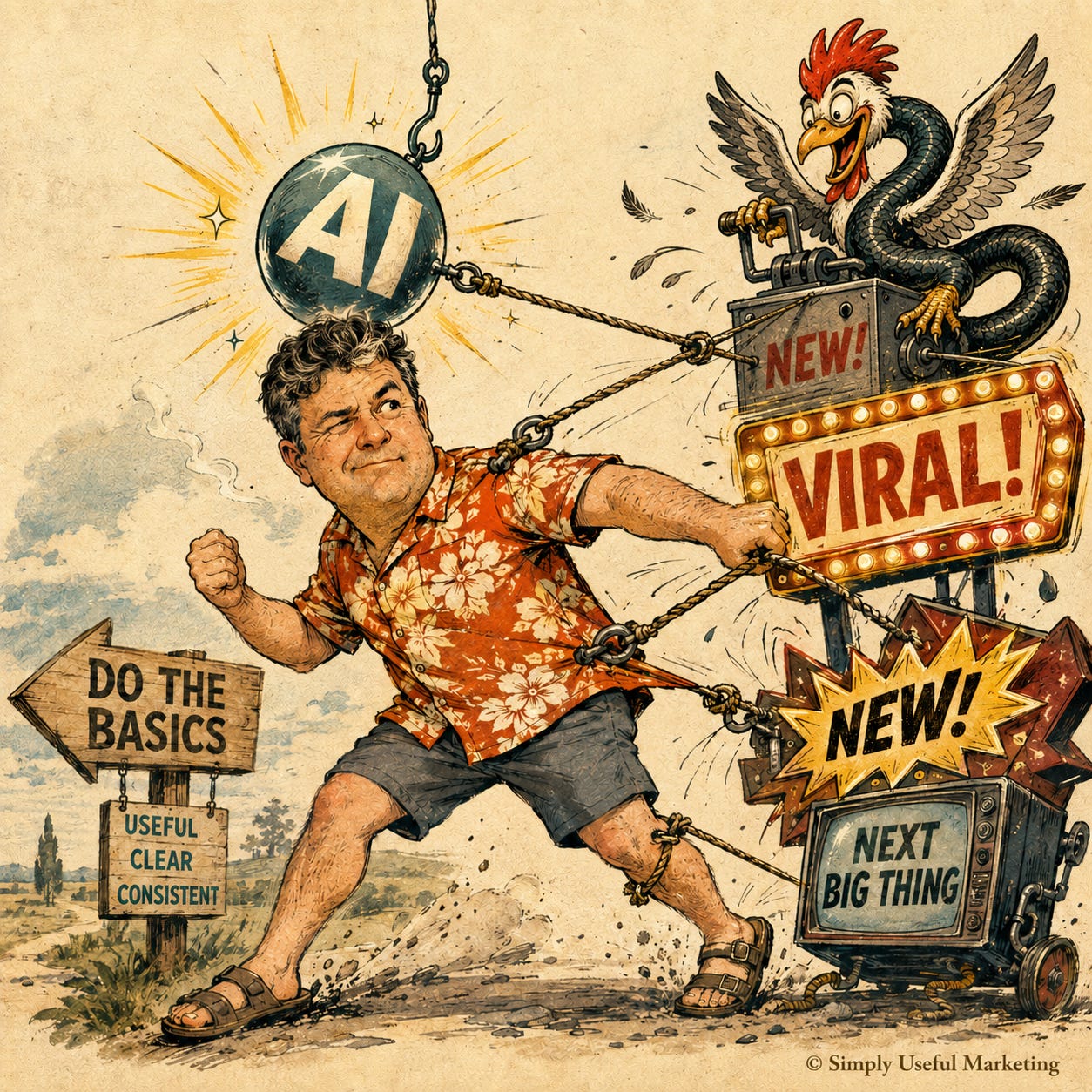
Before getting to these eight fundamentals, here’s a challenge marketers in every industry face — over-focusing on a hot new trend and leading with that rather than how what they do benefits their customer.
Every Industry Has Its Version of “The Cloud”
We often over-hype the new while ignoring the basics of what it is you actually do.
Back in the mid/late 90s, ASP (application service provider) was a topic I started covering. That morphed into software-as-a-service (SaaS) by the mid-2000s and we all know it as the cloud/apps today.
The problem isn’t this ongoing shift, which reflected real changes in the underlying technology. It was watching product marketing focus on the delivery method (which is, at root, what this is — the software sits on someone else’s servers rather than your own in-house infrastructure) rather than the benefits of the product they actually sold. I’d spend half of some product briefings listening to the cloud provisioning strategy before hearing anything about how the product helped the customer.
I thought that was stupid at the time. Since then, I’ve learned more about marketing and think it’s even dumber. Now, there are benefits to provisioning your IT stack differently and there were some vendors doing good market education around that.
But the general vibe was still “this is new and sexy so lets focus on that.”
Just about a decade ago, same thing happened with RPA (robotic process automation). It’s a genuinely useful functionality (that, honestly, I only vaguely understand), but limited. Industry vendors with products even tangentially connected to RPA slapped it all over their product marketing.
Today they’re doing the same thing with AI. New buzzword, same feature set.
Every industry has its version of “the cloud:” something shiny enough to distract you from the simple, consistent work that actually drives results. Yours does too. Maybe it’s a platform, a format, an algorithm change, whatever a guru tweeted this morning.
The cost of chasing the shiny thing isn’t only money. Every time you chase the new thing, you abandon the compounding you’d started somewhere else and go back to zero. Most new tactics aren’t new anyway — they’re either distractions or old lessons applied to new delivery methods. The fundamentals underneath haven’t changed: identify a customer problem, solve that problem, keep doing it.
The rest of this piece is those fundamentals, which are kinda boring. Not boring? Watching your business — and bank account — grow.
Nobody Cares About You
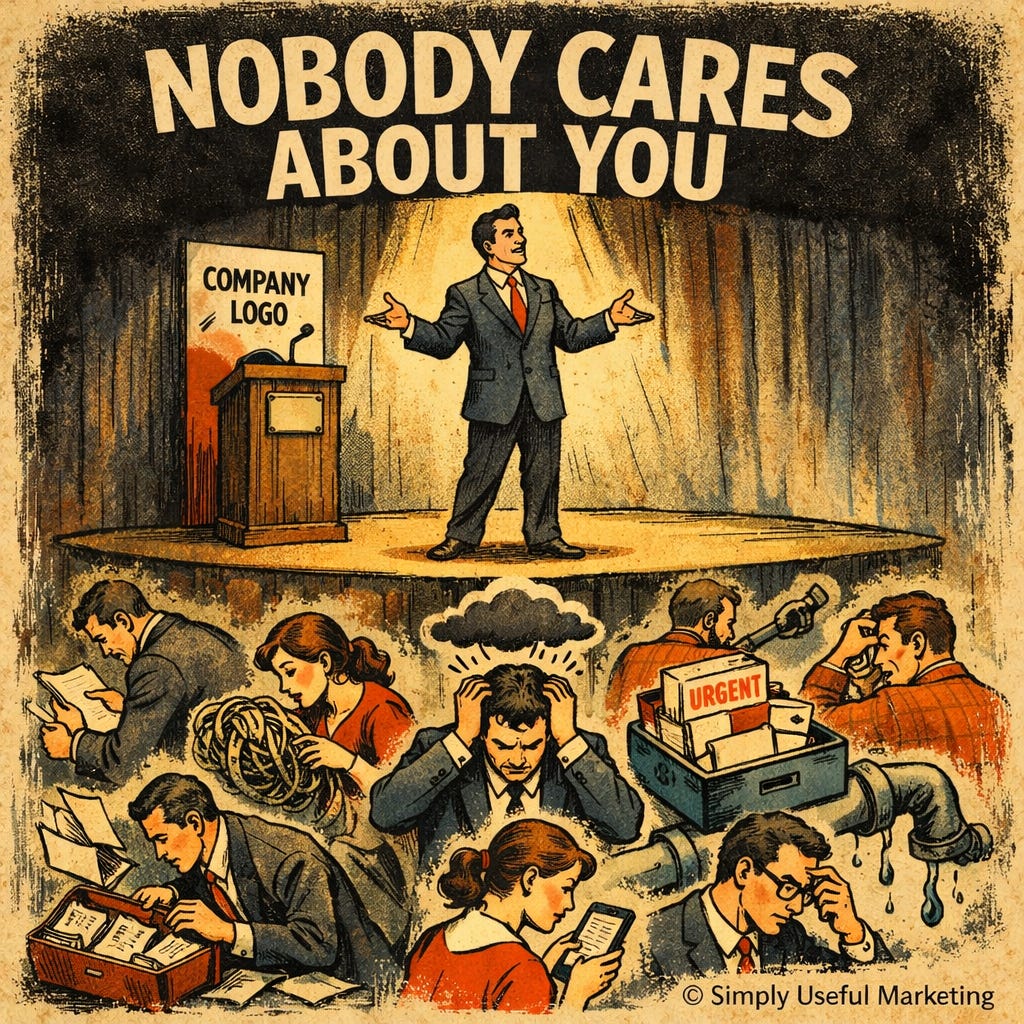
The first fundamental is the hardest one for most businesses to swallow: no one wakes up thinking about your company. We wake up staring at our own navels — worrying about our own problems, looking for answers to our own questions, trying to get through the day with fewer hassles.
That’s not bad news. It’s liberating.
In the late 2000s I co-created a sponsored webinar program that’s still running today. My job was to host, recruit an expert speaker, and prep the sponsor — who got five minutes and a shot at the Q&A. I gave “the talk” to 60 or so sponsors over five years. One of my regular speakers named it that over beers at a conference, and it stuck.
The talk went like this: No one cares about you. Nobody registered to hear how wonderful your product is — your logo is already on the registration page; they know you sell something. They’re here to understand a problem they have. Lead with useful information, not speeds n’ feeds.
Most sponsors listened. About 20% didn’t.
We surveyed every attendee as each webinar closed. As best I remember the numbers, overall event approval ran about 4.5 out of 5. Sponsors who followed the talk landed slightly under that. Sponsors who ignored me and did their usual song and dance? Ratings tanked, with comments like “awful sales pitch at the start.”
Same stage. Same audience. Same amount of speaking time. The only variable was whether they made themselves the hero or the customer the hero.
Every word of your marketing does one or the other. Choose the customer. The irony is, when you stop shouting about yourself, people usually start listening.
Shut Up and Listen
If nobody cares about you, the obvious question is: what do they care about? And the answer isn’t in a brainstorm. It’s not in a competitor’s blog. It’s in your customers’ mouths, and too many businesses never bother to pay more than lip service to listening.
The most popular post for one of my copier clients wasn’t written by a me or my team. It was written by one of their repair techs, about formatting tips in Word for better copies. It wasn’t an idea I ever would have thought of. He could — because he spoke to customers daily and knew this was a real challenge for them. That one post led to a string of sales opportunities.
That’s what listening gets you (including me listening to MY client). The questions your customers actually ask — the ones your techs, your support staff, your salespeople hear every single day — are your content strategy, sitting right there, free. The experts are already in your office. The problems are already in your inbox. You don’t have to guess what to write; you have to stop guessing and start paying attention.
Listening also hands you the customer’s language. Not your industry’s word salad — the words they use to describe their own problem. Use their words back to them and something happens that no amount of clever copy can fake: they feel understood. The company that stands out is the one making the customer feel understood.
Everything downstream of this — what you write, how you say it, what you offer — is only as good as what you heard first.
Write Like a Human
Once you know what the customer’s problem actually is, the next question is how you talk about it. And here’s where smart people sabotage themselves: they reach for clever.
I’ve spent the first 20 years of my career around people who are brilliant but terrified to sound unprofessional — like if they use “use” instead of “utilize,” the business gods will smite them. So they default to jargon, buzzwords, and meaningless platitudes, and end up sounding exactly like everyone else.
Clever feels safer than clear. Clear language is specific, and specific pins you down. “We help small B2B firms get more repeat customers from their existing list” is measurable — someone can come back in six months and ask whether it happened. “Empowering digital transformation through next-generation solutions” is slippery. Nobody knows what it means, which means nobody can hold you to it. That’s the appeal. Jargon isn’t a vocabulary problem, it’s a hiding place.
Clever is writing to impress. Clear is writing to be understood.
I wasn’t immune either. For years I curated an ECM newsletter for a professional association, and I’d periodically swap the plain, “here’s what’s inside” subject line for a clever one that made me giggle. Got my teeth kicked in nearly every time. Opens down. Shares down. Click-throughs down. And like a goldfish bumping its nose on the other side of the bowl, a month or two later I’d think “THIS time it’ll be different.” Never was. I was trying to show how smart I was instead of helping my readers.
It’s not just me. Mailchimp’s analysis of 40-plus million emails found the highest open rates went to the dry, descriptive stuff — the “{Company} January Newsletter” type of subject line. Plain-language research points the same direction: rewrite copy in plain English and comprehension and retention both climb. My giggle-inducing subject lines were losing to the most boring construction available.
Clarity is credibility — if you need to look up a word before putting it in your marketing, your customer will too, and that friction kills decisions.
I do my best to write at an 8th grade level because it’s easy to digest.
Write like yourself. Focus on being useful over being great because great can cause you to freeze up while useful feels like swapping stories over beers.
Plus, this isn’t 8th grade English class. Nobody’s grading your prose or grammar. They’re asking, “did this help me?”
Consistency Compounds
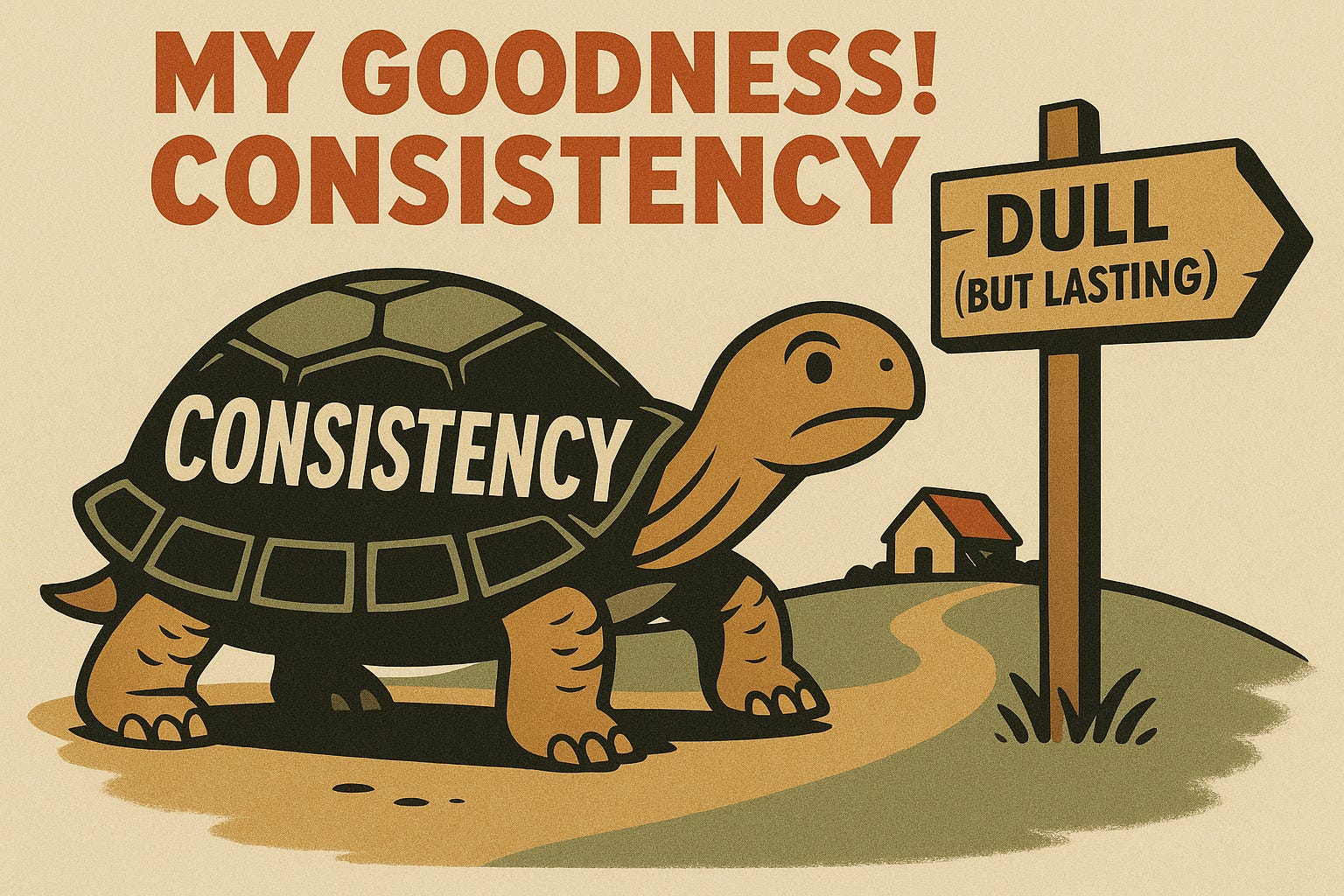
So you’re solving the customer’s problem, in plain language, based on what they actually told you. Now you have to keep doing it. This is where most marketing dies.
“Making money IS sexy. It’s never boring.”
That’s Baron Gemmer, who owns an ECM consultancy, answering me at an AIIM conference 13 years ago when I complained that the industry’s marketers chased sexy over the boring stuff that works. His line has stuck with me ever since, because it reframes the whole thing: the work is boring, but the results never are.
One post doesn’t change anything. A hundred posts do. Do the things. Do them again. Repeat. If there’s a secret sauce, that’s it.
There’s psychology underneath this, not just grit. Familiarity drives preference. When the stakes are high, people don’t hunt for novelty — they choose what feels known. Familiarity lowers perceived risk and makes decisions easier, especially when no option feels perfect. Repetition builds recognition. Recognition becomes comfort. And comfort is what people reach for when it’s time to choose.
And consistency compounds in a second way: the content itself is an asset. Two blog posts I wrote for copier clients — about how to remove a black line from a copy — sat at the top of Google’s results for years. Neither was clever. Neither was optimized by some SEO sorcerer. They answered a question real customers were asking repair techs, and they generated traffic and leads for a decade. That’s what you miss when you’re always eyeing the next tactic.
Look at any platform. Big launch, heat and noise, then a steady decline to a dribble. How many Substacks have 3 or 14 or 20 posts and then... nothing? People quit before boring pays off.
You don’t need to go viral. You need to stay visible.
Trust Is the Conversion Strategy
Here’s what all that consistency is actually building. Show up, be useful, repeat — and familiarity becomes trust. Trust becomes the reason people remember you when they’re finally ready to buy.
That always felt a little squishy to me — linking trust to revenue. So I went looking for the research. Turns out the numbers aren’t subtle.
PwC (2024): 46% of consumers purchased more from companies they trust; 28% paid a premium; roughly 40% walked away after trust broke. BCG’s Henderson Institute found the 100 most trusted companies delivered about 25% compound annual shareholder return from 2019–22 — against 10% for the global index. That’s 2.5x.
And it’s not just an enterprise phenomenon. Datamax Texas, a former client, is a copier company — an industry often trusted at roughly used-car-dealer levels. They focus on creating “Raving Fans,” measure it relentlessly, and have averaged a 93.2 on their NPS-style score since 2012. Nine out of ten customers willing to recommend a copier company, because they do the basics: communicate, fix issues, train their people. They bake trust into their business model.
Trust isn’t a fuzzy halo. It’s measurable, and it’s a multiplier. Customers spend more. The market forgives mistakes faster.
Executives consistently overestimate how much of it they have, by the way — PwC found 84–95% of executives believe customers highly trust them, while only 27–52% of customers agree. Don’t delude yourself. Trust has to be earned, day after day after day after day.
If you’re nodding along but thinking, “Yeah, and who the hell has time to do all this every week?” — that may not be a strategy problem. It may be a capacity problem.
You already have the expertise. Your customers are already giving you the questions. If turning all of that into useful, consistent content is the part that keeps slipping, I can take that off your plate: bryant@simplyusefulmarketing.co.
Don’t Build on Rented Land
If trust is the asset, the next question is where you keep it. And here’s one of the truths of today’s Internet: everything you build on a social platform, you build on rented land.
You don’t own your audience on LinkedIn, Facebook, Instagram, TikTok, or here on Substack. You borrow them. One algorithm “improvement,” one policy change, one throttled reach, and the attention you spent years earning evaporates. Google’s doing its version too — using everyone’s content to answer queries on the results page so nobody has to visit the site that created it. You. Are. Not. In. Control.
Use the rented land — it’s a great place to meet people and amplify what you do. But you want to own the relationship, and the only digital relationship you own is the email address someone hands you. It’s direct, one-to-one, and permission-based. You decide when to send. They decide when to read. No middleman, no panic when the platform moves the goalposts.
This is why I’m annoying about newsletters. Not because newsletters are magical. A newsletter isn’t one tactic among many. It’s what owning the relationship looks like in practice — the place you show up consistently, being useful in plain language, about what you actually heard from your customers, until familiarity becomes trust, in a channel nobody can take away from you.
As I was editing this, I realized that last line is overblown a little bit. To send emails, we all rely on one of the various email delivery platforms. If you repeatedly send spammy content, email as a channel can be taken away from you. However, you aren’t spammy, right? So not a problem for you.
Ask for the Sale
Marketing needs to help deliver revenue. While educating the customer is foremost, we all need revenue to stay in business.
So: ask for the money.
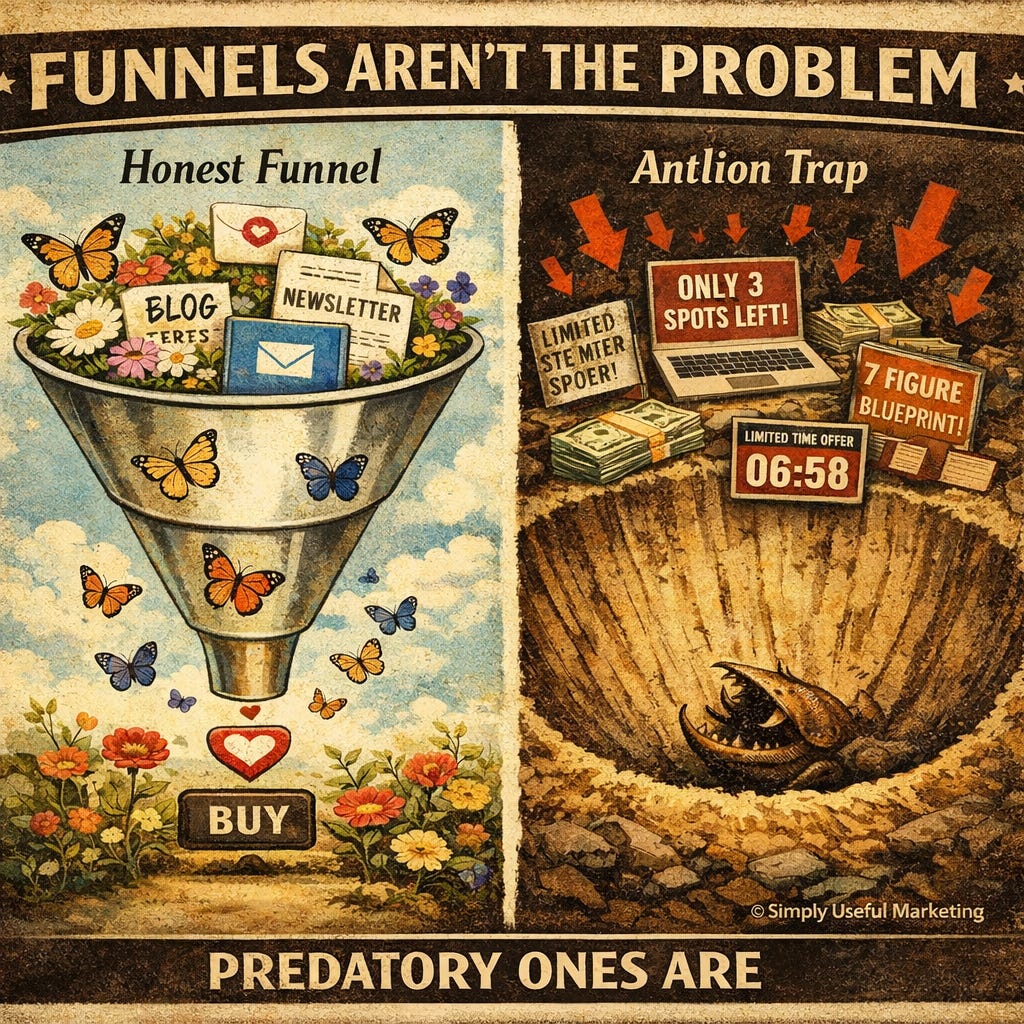
I saw a post recently that I mostly agreed with — stop buying $500 courses from people who’ve never built anything, tell the truth — right up until the line “drop the funnel.” No. Drop the bullshit smeared all over funnels — the fake scarcity, the countdown timers on offers that never expire, the 47-minute webinar that’s the online version of a 70s Tupperware dinner party. But everyone making fun of funnels has one. They just call it “ecosystem” or “customer journey.”
At some point a stranger discovers you, decides you’re worth paying attention to, and decides you’re worth paying. That mechanism is a funnel. Renaming it doesn’t change what it does.
A funnel is three stages: someone finds you, someone starts to trust you, someone buys from you. The problem with the gross ones is they skip the middle — the trust part — and substitute psychological pressure for it. Stranger to “buy my $997 thing” in 48 hours.
But if you’ve done everything above — listened, shown up, been useful, earned trust over months — a clear offer is just the next thing that happens. Not a hard sell. A clear one. “If you need help with this, here’s what working with me looks like.” A sentence or two. After you’ve spent months being useful, saying “I also do this for a living” isn’t manipulation. It’s running a business.
A funnel built on manipulation deserves scorn. A funnel built on being useful is just commerce working the way it always has.
Play the Long Game
Last fundamental, and it’s the one that decides whether any of the others get a chance to work: time.
Content marketing usually starts showing results in about 9 months from when you begin. Sometimes sooner, sometimes later, but 9 months is the sweet spot — based on research and my own experience with clients. That’s not dragging out a retainer but how trust-building actually works.
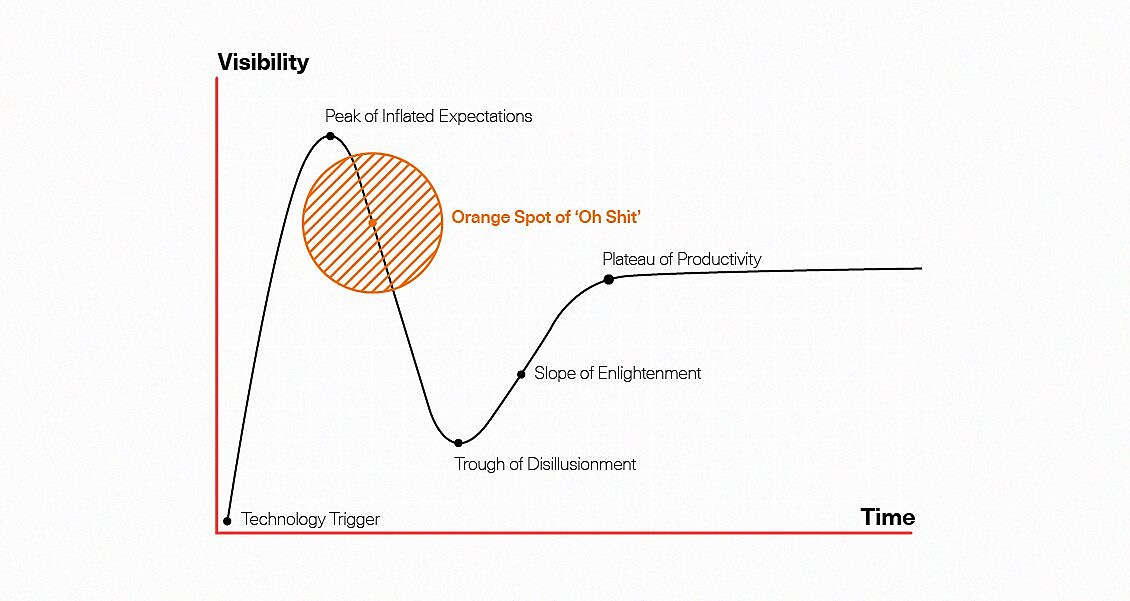
Back in 2015, as content marketing slid down Gartner’s Hype Cycle, Velocity Partners dubbed the Trough of Disillusionment the “Orange Spot of Oh Shit” — that moment when all the hype collided with the reality that this stuff was harder than it looked. Early excitement gives way to frustration before long-term results kick in — and most companies give up in that dip. Which is precisely when they should double down. The folks who succeed are still showing up at month nine. The ones who quit at month three are now doing the same thing on TikTok and complaining nothing works.
Then there’s the ongoing efforts that makes 9 months look like nothing.
John Deere published the first issue of The Furrow in 1895. A farming magazine, from a tractor company. It’s still going. Five years later, Michelin started handing out a guide to good restaurants — because if people drove further to eat well, they’d wear out more tires. The Michelin Guide is now the global signal of excellence in cooking, and it’s still running too. Neither one was a campaign. Neither one was clever. Both were built on the same premise: help your customer with something they actually care about, and keep doing it.
You don’t need a century. Marcus Sheridan saved his pool company during the 2008 crash by answering customer questions on his blog — including the one every competitor refused to touch, what a pool costs. He traced $2 million in sales to that single post.
Same fundamental, three different centuries.
Patience isn’t passive. It’s the discipline to keep going when the numbers say you shouldn’t. And it’s only sane if you believe the underlying premise: that helping people is the way to earn their business. If you don’t believe that, none of this works — the moment marketing asks you to choose between being helpful and being impressive, you’ll choose you, and the whole thing collapses.
Nobody’s going to hand you permission to start. There’s no better month, no cleaner quarter, no timeline where this suddenly gets easy.
There’s just the next thing you publish, and whether it helps somebody.
Marketing is a promise you keep — over and over — until people believe you.
Do the work. Be worthy of the belief.
Nine months from now, you can still be meaning to get consistent with your marketing — or you can have nine months of useful content, an audience that knows you, and an email list you own behind you.
If you want the second version without adding another recurring job to your week, that’s what Newsletter-in-a-Box is for. I’ll help you turn what you already know into a useful newsletter and get it out the door consistently.
Learn about Newsletter-in-a-Box here or email me at bryant@simplyusefulmarketing.co.
I think your last line says it all, Bryant. Marketing works when there is some alignment between what you say repeatedly and what people experience repeatedly. That takes time, which is inconvenient in a culture obsessed with hacks, virality, and instant gratification.
Happy Friday to you.
How are you?