

Got annoyed last week.
Every now and then, I’ll see a post or podcast talking about the demise of content marketing.
Why does this poke my buttons? It’s not just because of the obvious clickbait labeling, but that every one I’ve bothered to check out says “naw, just joshing, but I sucked ya in with that headline!” and/or “yet it survives in this brand-new consulting service we just launched combining [insert trend du jour here] and content.”
Reminds me of all the social apps in 2000 saying that “we’re going to kill email” while relying on email to verify users and log-in to those very same apps.
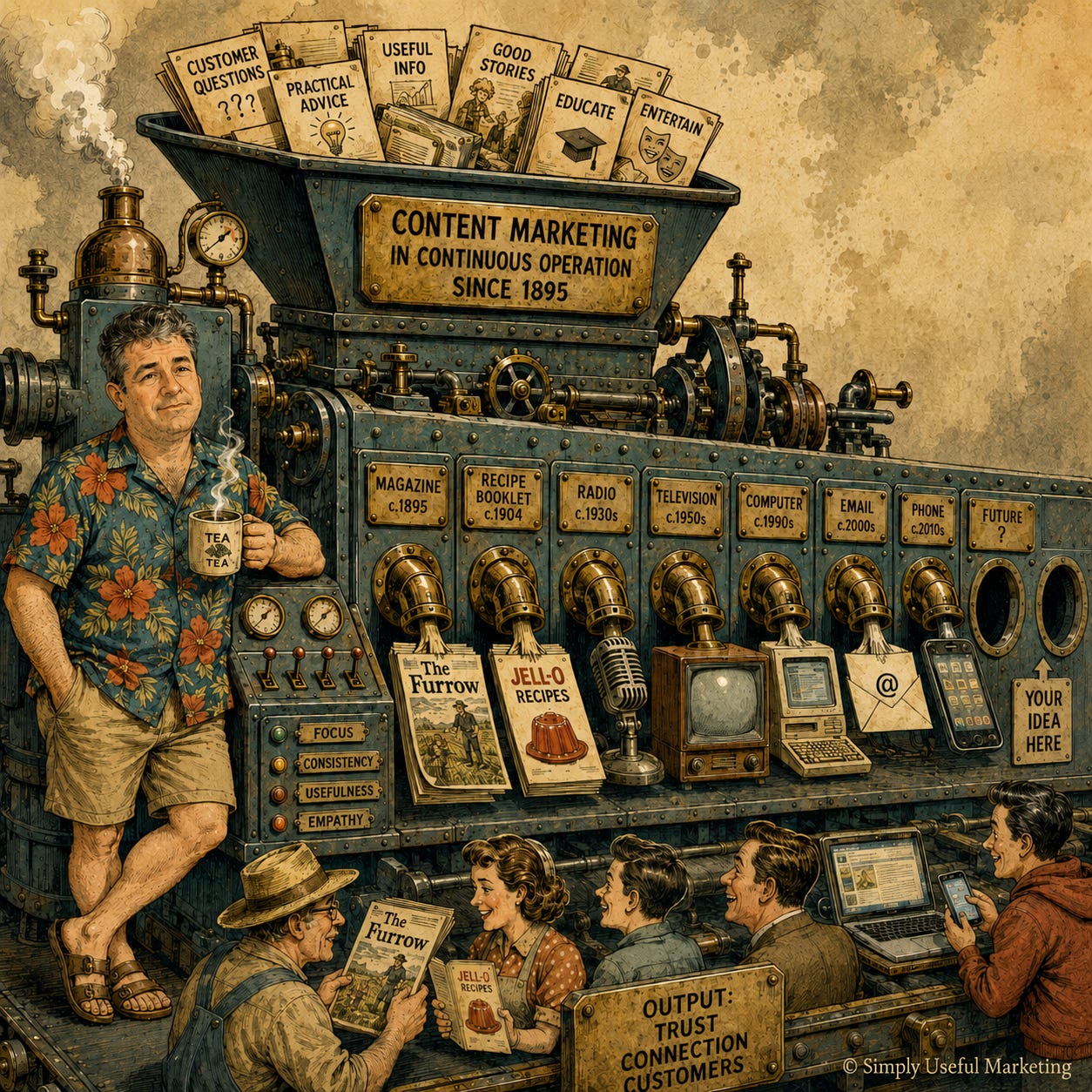
Like most hot takes; this one is always wrong. Content marketing has been building trust and informing audiences across at least three centuries; 130 years (at least) – and counting – of effective marketing.
While I believe newsletters are a critical, must-have content marketing pillar for businesses, I don’t want to mislead that they’re the only vehicle. So I had the thought of compiling a quick list (which then led to a second list about newsletters) of how content marketing delivery platforms have changed over the years while the basic strategy remains.
Here’s the timeline. Note/mini-AI-use example, I used Claude to compile this list based on my initial thoughts – I missed soap operas, Guinness, and Red Bull. This list is lightly edited because a total rewrite doesn’t change the information.
1895 — The Furrow. John Deere launches a magazine that teaches farmers how to farm better. Actual useful information for the people they wanted as customers. It’s still publishing today. The Furrow has outlived radio’s golden age, broadcast TV’s dominance, AOL, MySpace, and whatever platform died while you were reading this sentence. Ink on dead trees remains a viable way to reach an audience (of course, especially when deliver is also pixels on a screen). Hell, you can squint and look at a newsletter as a single feature delivered via (most often) email.
1900 — The Michelin Guide. A French tire company publishes a free guide to restaurants and hotels. Why? So people would drive more. Driving wears out tires. That’s the origin of the stars chefs aspire to claim. A century later, the content is more famous than the product — chefs weep over Michelin stars, and most of them probably don’t know a Michelin from a Firestone tire.
1904 — Jell-O recipe books. Jell-O was a flop. So salesmen went door to door handing out free recipe books — here’s what you make with it. Jell-O became a household staple because somebody answered the question “okay, but what do I DO with this?”
1921 — Betty Crocker. General Mills’ predecessor invents a woman. Betty Crocker answered baking questions by mail, then on the radio, for decades. She wasn’t real, but the trust was. Millions of American home cooks had a relationship with a fictional person because the advice was good.
1930s — Soap operas. Procter & Gamble funds radio dramas to sell Oxydol soap to housewives. Shows like Ma Perkins worked so well that we named an entire genre of entertainment after the sponsor’s product. I sometimes think this teeters on the edge of advertising, but I love this story too much to drop it.
1955 — The Guinness Book of Records. The managing director of Guinness gets into a bar argument about the fastest game bird in Europe and realizes there’s no reference book to settle it. So the beer company makes one — a promotional item to spark pub debates and keep people in the pub. The giveaway became a global institution that’s outsold nearly everything except the Bible. So the next time you’re enjoying bar trivia night, raise a pint to Sir Hugh Beaver’s argumentative nature.
1983–84 — Afternoon Cartoons. He-Man, G.I. Joe, Transformers — 22-minute toy commercials disguised as entertainment. G.I. Joe even ended every episode with a little PSA — “Now you know. And knowing is half the battle.” A toy ad, teaching kids not to play with downed power lines. Content marketing with a merit badge – and huge sales.
2002 — Seth Godin starts blogging daily. One post. Every day. For 24 years and counting. No hacks, no funnels, no growth loops. Just showing up. That consistency has made Godin, for folks like me, hugely influential and a trusted authority on marketing.
2012 — Red Bull Stratos. An energy drink company puts a man in a capsule, lifts him to the edge of space, and he jumps. Millions watch live. Red Bull isn’t a beverage company that does marketing — it’s a media company that sells caffeine. The content IS the brand. I still kinda regret not checking out Flugtag when it was in Baltimore in 2006.
2014 — The LEGO Movie. Basically a two-hour toy commercial that made hundreds of millions of dollars. AND boosted LEGO sales and profits over multiple years.
2009 — Marcus Sheridan’s pool post. I saved this one for last even though it’s out of order, because it’s the one you can actually copy. After the 2008 crash gutted his pool business, Sheridan wrote a blog post answering the one question every customer asked and every competitor dodged: “How much does a fiberglass pool cost?” One honest answer. That single post generated over $2 million in tracked sales within a few years — Sheridan says the lifetime number is far higher. It saved his company.
Notice nothing on this list so far required going viral. A recipe book. A reference book for bar arguments. If a beer company can build an institution out of settling pub debates, your business can build one out of answering customer questions — that's exactly what Newsletter-in-a-Box does, minus the door-to-door salesmen.
But, Uh, What About Newsletters?
Fair question. This is a newsletter, written by a guy who builds newsletters for a living. You’d think I’d have led with them.
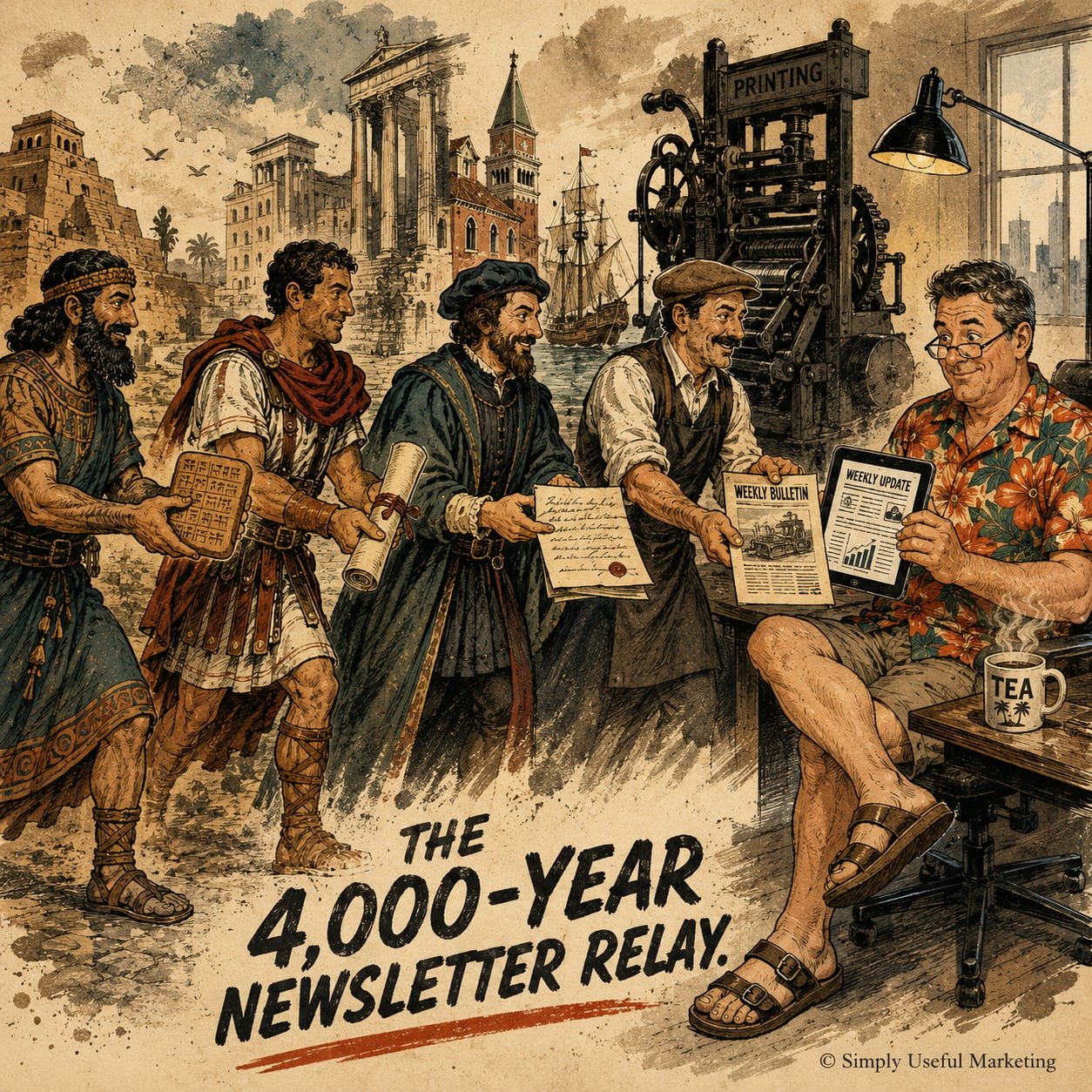
Here’s why I didn’t: newsletters are OLD. We thrive on information, newsletters (and proto-newsletters) having been helping us separate noise from signal for 4,000 years; give or take a few. I also used Claude to compile this list, while I had a suspicion proto-newsletters existed before I started writing and delivering DOC.1 via fax in 1996, I had no idea how far back the history went.
~1900 BC — The Kanesh tablets. Assyrian merchants running trade routes across what’s now Turkey left behind 23,000 clay tablets — much of it business correspondence. Prices. Shipments. Warnings about the market in the next city over. Four thousand years ago, somebody was pressing “what’s the tin market doing?” into wet clay.
51 BC — Cicero’s news feed. When Cicero got shipped off to govern a Roman province, he set up his buddy Caelius to send him regular dispatches from Rome. The first delivery promised “the Senate’s decrees, the edicts, the gossip, the rumors.” A subscription newsletter wrapped in a toga.
876 AD — The dibao (and its Indian cousins). Imperial China ran court newsletters for over a thousand years — edicts, promotions, palace news — hand-copied and couriered to officials across the empire. The oldest surviving issue on the planet, from 876 AD, sits in a library in Paris right now. Various empires in India did the same thing for nobles and provincial governors. Two empires basically sending out an internal company newsletter.
Mid-1400s — Venice. Now it’s a newsletter you’d recognize: paying subscribers, handwritten letters twice a week, merchants tracking exchange rates and business news. [CLAUDE – what was the name of this]
1704 — The Boston News-Letter. America’s first. Ran 72 years, then became a newspaper. Which is what newsletters kept doing, by the way. The newspaper is the newsletter’s kid. Not the other way around.
1904 / 1923 — Babson and Kiplinger. The paid expertise newsletter becomes a modern business model. The Kiplinger Letter is still publishing a century later (there are now four of them).
1990s — Enter Email. The examples you need here are in your inbox.
We desire information. For 4,000 years, people have gone to serious effort for newsletters. For at least the past 500 years, they’ve rewarded that effort with cash.
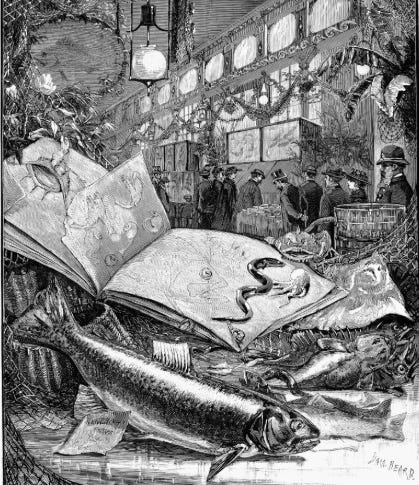
While I’m not convinced Edison was first, it’s the first example I can find without a DEEP dive into the Internet rabbit hole. In 1882 The Edison Electric Light Co. Bulletin decided to give away their newsletter. It was content marketing, complete with testimonials, reports from neutral observers about the company’s efforts, and, my favorite as a fish aquarium fan, a story about lighting (under water) the trout tanks at a Fulton Market fish stall.
I’d almost bet money the folks at John Deere paid attention.
Educate or Entertain
Look at the list again. A farm magazine, a restaurant guide, recipe books, a fake woman, radio dramas, a bar-bet settler, cartoons, a blog, a space jump, a movie, a pool post.
Three centuries. Different media. Same thing: figure out what your customer actually wants/needs to know or be entertained by, give it to them, and then keep doing that until it’s no longer effective.
Delivery methods die, to lean in to our John Deere example, fields go fallow over time; the strategy doesn’t. Print circulation collapsed. Radio drama died. Blogs were declared dead a decade ago (which I continue to find hilarious given this site is a blog site with built-in distribution).
The content marketing strategy isn’t about the medium. It’s about answering real questions and delivering real value so people trust you (and buy your product/service; it’s equally important to remember this isn’t entirely altruistic).
That’s the 130-year lesson for content marketing, supported by 3,900 years of “we need our newsletters” too. Be useful. Be consistent. Own the connection.
I’ll take a 4,000-ish year track record of success over the bleatings of pundits grasping at relevance.
And now you know. And knowing is half the battle.
Comments, criticisms, and witticisms welcomed.
P.S. — Michelin made a restaurant guide to sell tires. You just have to make a newsletter to sell what you already sell. Considerably easier. I'll build it with you. See how here or skip it and let’s see how I can help you (bryant@simplyusefulmarketing.co).
If you’ve never had to suffer through a G.I. Joe episode; my brother and cousin LOVED it; that was the tagline of their end-of-episode PSA. It got burned into my brain so deeply during my high school years, I STILL say it.
And now to pass the pain, er, knowledge on to you. Here’s all of them if you’d like to torture yourself.
When I stopped worrying about platforms and focused on creating content that truly adds value, everything clicked. Wrestling with how to serve people through my writing on yoga and meditation has ultimately forced me to master my own craft in the process!
Happy Thursday Bryant
The internet has a fascinating habit of killing things that are still making money. Blogs are dead. Email is dead. Newsletters are dead. So fucking exhausting. But if you look at my inbox, it is somehow still the place companies are fighting hardest to reach me.