

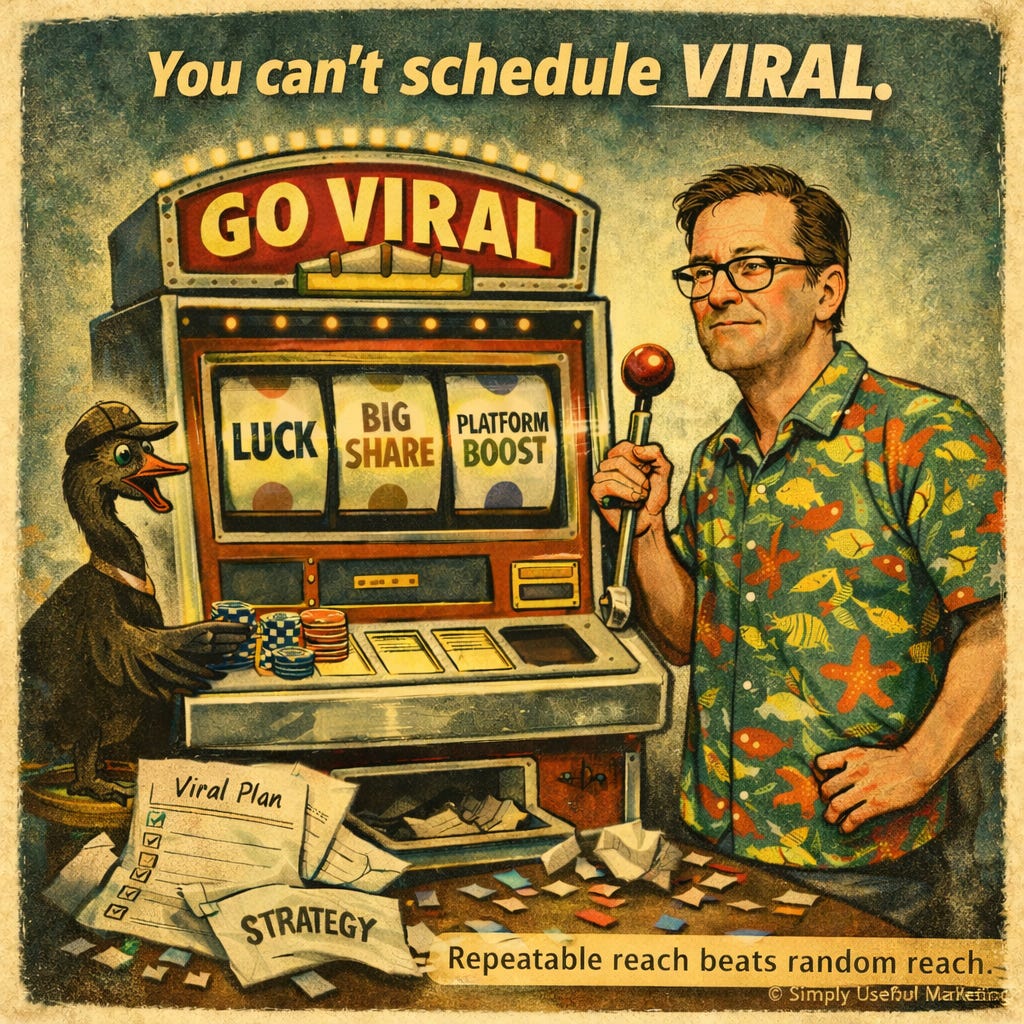
Focusing on “going viral” is a sucker’s game. I’ll explain why, but first, a story about why I despise with the heat of a thousand dying suns trying to “go viral.”
“We need rock stars so we can go viral.”
“Oh, FFS,” I thought. “Here we go with this crap.”
This was 2010. The association I worked for had canned the magazine but kept me on to build an online community. Leadership was convinced the way to grow was to recruit “rock star” bloggers.
I made the boring argument — backed by a decade’s worth of reader surveys from my editor days — that we’d grow by publishing a steady flow of useful content for the people we served.
“NO! WE NEED ROCK STARS!”
I did manage to recruit a few. Most dropped off within a year, because we couldn’t offer anything beyond “exposure,” and rock stars don’t need exposure. We would’ve been smarter to recruit homegrown experts and turn them into rock stars over time (which is what I did on the down low, though no one hit “rock star” status).
We did manage to “go viral” once.
I read the post before it went live and thought, “Good piece. We’ll get our usual 600 to 700 views.”
Nope.
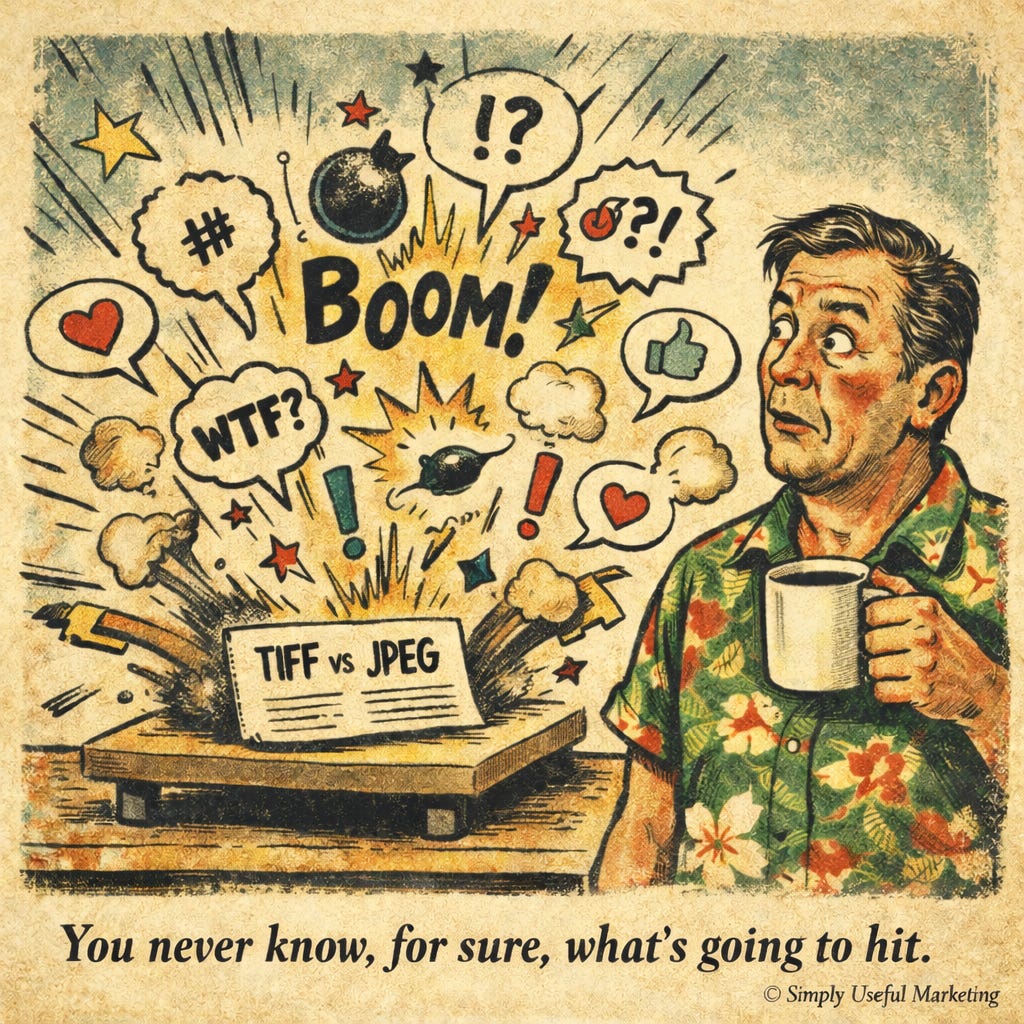
The topic was TIFF v. JPEG as the better format for image output in a document scanning implementation. It became the most-read post in the program, racked up ~75 comments, pulled hundreds of thousands of views per year, and people stayed on the page for around 10 minutes.
Which is exactly why “let’s go viral” is not a strategy.
Because you just never freaking know what’s going to hit.
“Let’s Go Viral”
Here’s the most useful translation of what people mean when they say this:
“a sudden spike in reach outside our normal audience.”
That’s it. Not “steady growth.” Not “qualified leads.” Not “trust.” A spike. Which they mistakenly believe will magically turn into growth, leads, and trust.
And yes, before anyone asks: people still ask for this. Look around and you’ll marketing agencies and platforms churning out “how to go viral” toolkits and playbooks — because there’s still a market for the fantasy.
If you want a quick reality-check on why the request won’t die: 58% of consumers say they “believe the hype when a product goes viral,” and almost half say they’ve purchased a product based on an influencer recommendation.1
Not captured in that survey data is the pain and effort of trying to force “viral content” into existence like you’re smacking the bottom of a glass ketchup bottle, hoping something, anything splurts out.
So let’s talk about what’s actually happening when something “goes viral,” especially when you’re a smaller account.
What Does “Viral” Mean? It’s Slippery
“Viral” doesn’t have one agreed-upon definition. People use it to mean any of these:
a post gets shared far beyond your usual audience
a larger account (or a few) amplifies it
the platform surfaces it (recommendations / For You / suggested posts)
a post hits a big number, even if it doesn’t lead to anything durable
So when someone says “we want to go viral,” the most important follow-up question is:
“Viral in what way — and what do we want to happen after the spike?”
“Viral” Is a Distribution Event
Most “viral” moments aren’t engineered because the content was so inherently brilliant it escaped the gravity well of the platform algorithm on pure merit.
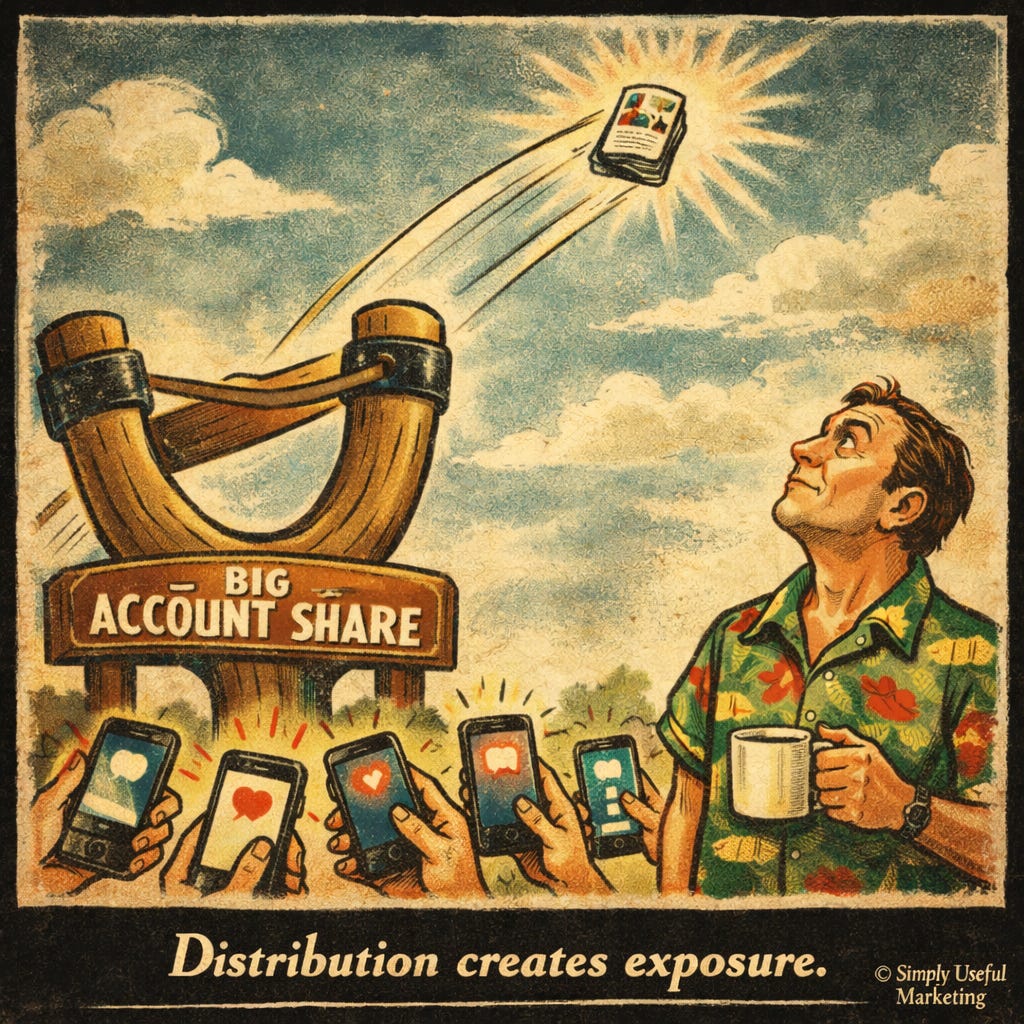
They happen because distribution happens.
A bigger account shares it. A few people with reach pile on. The platform surfaces it. Someone reacts to it. Suddenly your post is in a room you weren’t invited into.
It’s amplification — not your genius — that turns “a post” into “a viral post.” BuzzSumo notes that if just five influencers share something it can cause it to explode.2
That matches what most of us have seen with our own eyeballs.
A small account posts something solid. It does… fine.
Then a larger account quotes it, reframes it, reacts to it — and suddenly it’s “viral.”
So if you’re running a small brand and you’re wondering why your great post didn’t immediately set the Internet on fire…
It’s because quality alone is not a distribution strategy.
Content Matters, But That’s Just Turning the Key in the Ignition
The content matters — but often after distribution happens.
Here’s the simplest way I think of it:
Distribution creates exposure.
Quality determines what happens next.
Quality is what turns exposure into something durable: people staying, subscribing, trusting, buying later.
But quality doesn’t guarantee distribution.
And distribution doesn’t guarantee business results, either.
A “viral” spike can be the wrong audience, the wrong attention, the wrong expectations. It’s like eating empty calories — that bag of Starburst was great, but you still need to eat a healthy meal.
One reason this is so hard to control: sharing is social. Seeing other people share something makes you more likely to share it too — and to do it sooner.3
So no, I’m not telling you “to hell with content.”
I’m telling you content is not the lever people think it is when they say “make it go viral.”
My Favorite Example of Why Content Stickiness Matters
Here’s what gets left out of most “viral” analysis:
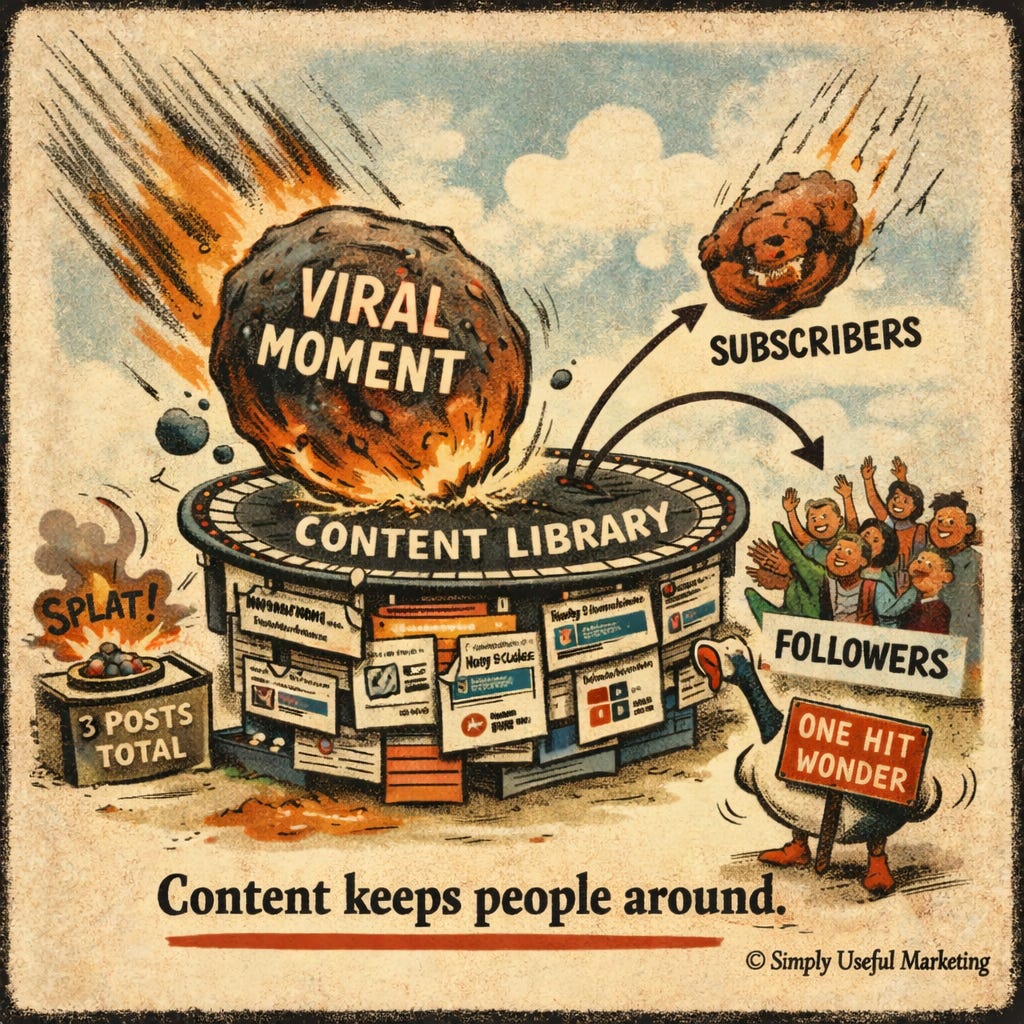
Even when a single piece of content does explode, the creator only benefits if there’s something there to catch people when they land.
Early YouTube beauty is a perfect example.
Michelle Phan posted makeup tutorials in the early days of YouTube. And at some point, one video hit big enough that it got the attention of Lancôme — in her telling, Lancôme’s head of PR found her video while searching YouTube; it had about 500,000 views, and that led to them reaching out.
But the “viral moment” isn’t the whole story.
The reason that moment mattered is because she didn’t have one video. She had a body of work. People could watch the viral one… then binge another… then another… then subscribe — because there was already a little universe to step into.
If she’d had three videos total, that spike could’ve been a sugar high: exciting, then gone.
That’s the point:
The content doesn’t cause virality most of the time.
But when virality happens — by luck, amplification, timing, whatever — content is what keeps people around.
It’s the difference between:
“Wow, that was a neat video,” and
“Wait, this person has 40 more like this… I’m sticking around.”
A Quick Nuance So Nobody Gets Cute in the Comments
If you’re the kind of person who enjoys arguing about edge cases (I see you) — yes, not every big cascade is caused by “influencers.”
Large diffusion events can come from lots of ordinary people under the right conditions.4
Which is true.
And it changes nothing about the practical takeaway:
You can’t schedule virality.
You can’t build your marketing plan on “maybe the right person sees it and shares it.”
That’s not a plan. That’s playing the marketing lottery.
Also: many “viral” events aren’t beautiful multi-generation share chains anyway. A huge share of diffusion is shallow — closer to broadcast than contagion.5
Translation: most “viral” moments are one big shove, not a predictable chain reaction.
Why “Go Viral” Thinking Poisons Your Marketing
Look, going viral isn’t a bad thing. It’s awesome when it happens. Sugar highs don’t last, but they do feel good. Nothing wrong with that.
The problem is what it does to your behavior.
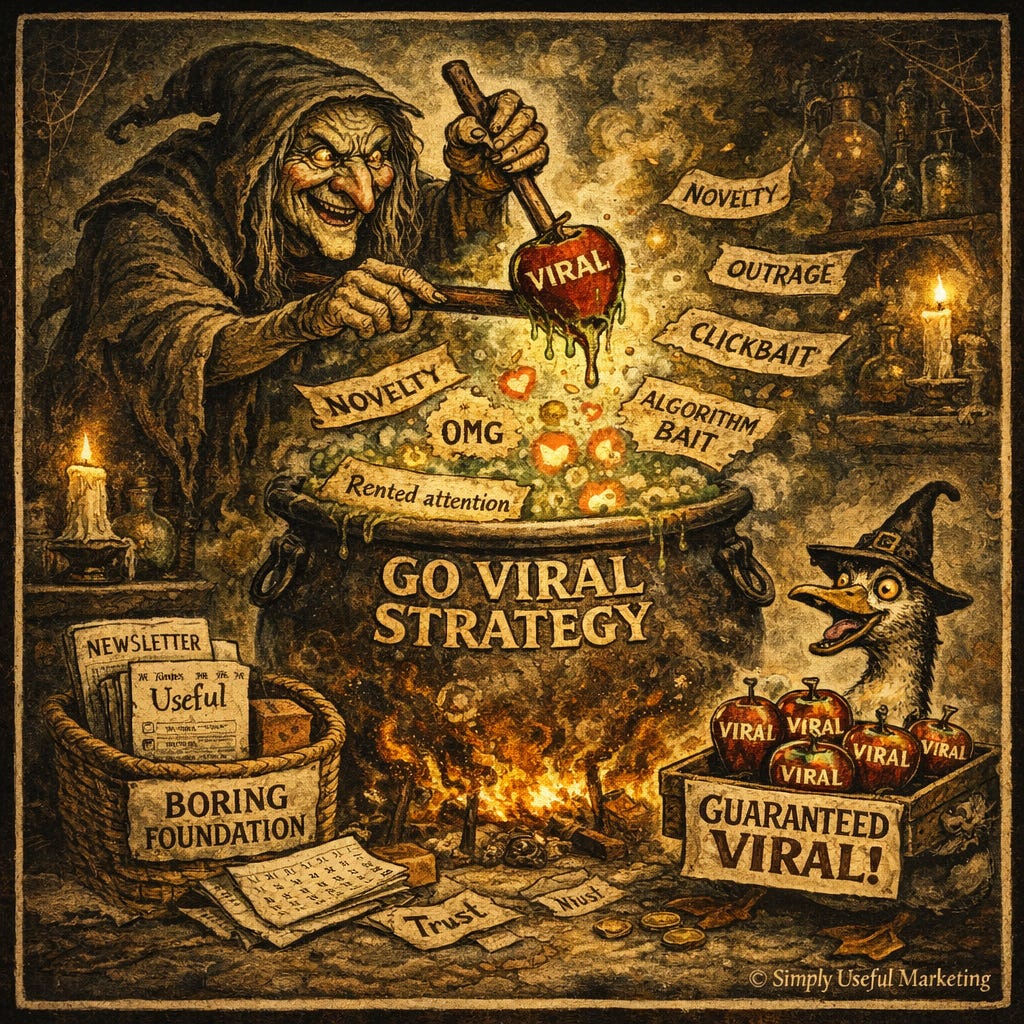
When you chase “viral,” you can start optimizing for:
novelty over usefulness
reaction over clarity
spikes over compounding
rented attention over owned attention
You start treating your work like it’s only valuable if it explodes.
And then you accidentally build a system where you’re either:
“winning” (a spike happened), or
“wasting time” (a spike didn’t happen)
That mindset will fry your brain.
And it pushes you toward content that feels like marketing — but doesn’t actually help anyone make a better decision.
Build Repeatable Reach Instead
If you want a goal that’s ambitious and sane, steal this:
Aim for repeatable reach, not random reach.
Repeatable reach looks like:
a message you can say more than once without hating yourself
a format you can produce consistently
a network of humans who recognize your name
an owned audience you can reach without begging an algorithm for table scraps (reminder that an email list is the one-to-one digital reach you control)
Yes, you can still try for “big” moments. But build the boring foundation underneath it.
Here are a few ways to do that without becoming a hustlebro gremlin:
1) Make your work easy for other people to share.
Short, clear, one idea. If someone has to translate it to pass it along, they won’t. Though don’t be afraid to write long either, comprehensive guides and reports can do well.
2) Build actual distribution relationships.
Not “DM me BRO” nonsense. Real relationships: partners, customers, peers, communities you contribute to. People share the work of people they recognize and trust.
3) Turn one good idea into a series.
Stop acting like every useful idea must be brand new. If something helps people, turn it into a series. Then repurpose it — a LinkedIn post, a carousel, a short video, a short ebook. Just because it isn’t sexy doesn’t mean it won’t work.
4) Put your best stuff on land you own.
Don’t build on rented land. If the platform changes, your reach shouldn’t disappear overnight.
This is why I’m annoying about newsletters. Not because newsletters are magical.
Because you own the relationship with your subscribers — not Google, not social algorithms, not whatever the platforms decide to feature this week.
My Fervent Wish
If you ask me to “make it go viral,” what I hear is:
“I don’t have the patience to play the long game. I want a quick result over the hard work of repetition.”
I get it. I’d like faster results too. I’m an impatient guy.
But the truth is simple:
We can increase the odds of going viral. It can’t be scheduled.
If you want growth you can keep, build something that compounds.
If you want a moment that makes you feel alive for 48 hours, you can chase that too.
Just don’t confuse the two.
If you’re tired of hearing “let’s go viral” like it’s something you can order off a menu — you don’t need another content brainstorm.
You need a repeatable reach system.
That’s what Newsletter-in-a-Box (NIB) is: a practical setup + operating plan that builds over time.
Newsletter-in-a-Box
Build the one marketing channel you can actually count on.
Why NIB? Because:
You can’t schedule virality — but you can schedule a newsletter.
You sidestep the algorithms that restrict your reach on every platform.
Trust grows because people see you helping them over time, not shouting at them once.
Your list is yours because subscribers opted in to hear from you — and nobody can “throttle” that relationship.
With NIB, you get the structure: what to send, how often, what to say, what to ignore, and how to keep it sustainable without turning into a full-time content goblin (I can be your content goblin).
If you want marketing you can keep — not just spikes you can screenshot — let’s have a conversation: bryant@simplyusefulmarketing.co.
State of Marketing 2025 — surveymonkey.com
How To Go Viral: 14 Lessons From The Most Shared Content — buzzsumo.com
Influentials, Networks, and Public Opinion Formation — Journal of Consumer Research
The Structural Virality of Online Diffusion — cs.stanford.edu