

Without a strong cultural foundation of a maniacal focus on what’s best for the customer, your marketing efforts will never be as effective as they could be.
Before Christmas last year, I did a “Marketing Advent Calendar.” It was 25 days of short statements that I believe are fundamental to any successful marketing. (Here’s a link to all of them.)
While each statement could be a post (or even a book to themselves – one of them even is), I decided to take a little time before the year accelerates to expand on each of these.
For anyone who wants to work with me, these are the marketing fundamentals my approach to marketing comes from. Even if you don’t want to work with me (I’ll be over there in the corner, rocking back and forth to sooth myself), I think these should form the bedrock of your marketing efforts too.
Without further ado, off we go.
1. Marketing Helps. It Doesn’t Manipulate.
The difference between propaganda and marketing is intent. Functionally, the tactics are identical.
Marketing designed to trick someone into buying is just propaganda tied to someone’s bonus.
Marketing designed to help someone understand a problem — and decide on an answer to that problem (of course hopefully by choosing you) — is a service.
If you actually give a damn about your customers and deliver something that helps them succeed, you don’t need manipulation.
2. Write for People; Not Algorithms.
Google search isn’t about search – it has always been an answer machine. Marketers have been trying to trick search algorithms from the beginning (remember keyword stuffing?) into directing people to their sites.
Google, along with the various social platforms, continually tweak their algorithms to get their users (that’d be us) to an answer/things we’re interested in as quickly as possible (and to shovel money into their pockets, but that’s a different post).
One core job of marketing is to explain something clearly to a human being.
When you write for an algorithm first, you end up sounding like everyone else. If you’re online often, you’ll notice when the various Internet gurus think they’ve found another way to trick the algorithm when post formatting and flow suddenly changes.
You do need to be aware of the algorithms – ignoring them entirely is dumb. But, people first; always.
3. Marketing Works Best When You Give a Damn.
You can fake expertise for a while. You can’t fake caring. It shows up immediately — in what you choose to explain, what you skip, and how patient you are with the reader.
Most bad marketing isn’t bad because it’s intentionally manipulative.
Most bad marketing is bad because the lack of care about the customer comes through in the boring, indifferent, and undifferentiated marketing crap they churn out (or pay a content mill to churn out).
If you care about your customers, show them by helping them with your marketing content.
4. Always Be Human.
If your marketing sounds like it was written by a committee with a thesaurus addiction, change it. Humans trust humans, not mission statements.
Write like you’d explain it to a friend over coffee. If you wouldn’t say it out loud, don’t publish it.
Have a personality – your real one, don’t fake one. Human kindness and empathy can be the umami in your marketing.
5. Be Useful.
I’ve said this repeatedly because it keeps being true: stop trying to be great and focus on being useful. Useful moves people forward even if the prose isn’t perfect.
“Great” freezes people. Useful ships.
I’m biased to “useful” given my background. My career began in a professional organization as editorial intern, and became the editor a few years later. All content was centered around giving members information they could use to do their job better. Of course, had a little fun along the way, but I often told people “Ain’t nobody reading this for fun; it has to help them.”
Over time, my concept of useful has expanded to include whatever your goals happen to be. So “useful” could be making someone laugh, making someone feel, or making someone think. Come to think of it, laughter is always useful.

6. Everyone Is Guessing.
Marketing decisions all boil down to educated guesswork. Do your research to identify where your customers are, what they are interested in, and so on; but you never know for sure if an idea is going to work until you try it.
So within the bounds of time, try new things. Its not quite throwing spaghetti at a wall to see what sticks, but . . . maybe a little bit. Because anyone who tells you they’ve cracked marketing is either lying or delusional. Markets change. Platforms move the goalposts. Everyone is testing in public.
The honest brokers and experts aren’t the ones with the most certainty — they’re the ones comfortable swimming in an ocean of uncertainty.
7. Content Is King. Distribution Is Emperor.
If a newsletter only exists in one place and is never read, does it exist?
Content without distribution is a diary. Distribution without substance is spam. You need both, but they’re not the same job.
Make something worth sharing first. Then do the boring work of sharing it more than once and in more than one place.
There’s a misconception that you’ll “annoy” people if you share the same thing multiple times. There is a “too-much” threshold. What is it? That varies by audience, goals, your ability to create, etc.; but you don’t know until you get there.
But – and maybe sit down for this next line if you’re reading this on your phone at the kitchen counter – people aren’t paying attention to you 24/7. Will some people see everything you share? Maybe. But most will see your post tomorrow. Then get busy and not read anything from you for three weeks; then see everything for a week. And so on.
So make the things and then share the shit out of the things. Don’t assume you’ll annoy people with frequent sharing, but when enough folks start mentioning it THAT’s when it’s time to dial it back a bit.
8. Don’t Build on Rented Land.
We are the products on social media (Google Search is essentially an ad platform). They don’t care about you; they care about their bottom line.
The various social platforms are useful. They are also not yours.
Email is the one connection you actually control. Use the platforms to build an email list of people who want to hear from you.

9. Answer Customer Questions.
Marcus Sheridan wrote a great book on this – They Ask, You Answer (highly recommend it). Not sure what to share in your newsletter or blog? Talk to every customer-facing employee to find the questions customers are asking them. didn’t invent this — he just named it. Customers ask questions because they’re trying to decide.
Pricing. Comparisons. Risks. “What happens if…” Answer them honestly, publicly, and more than once.
And, yes, talk to customers when you get a chance to — listen in on sales calls to see where sticking points are, read the customer service inbox, trade shows (where those still exist), etc.
I found reader surveys to be a goldmine of ideas. Every year, I would simply go through the “suggestions” answers and have 20 solid feature articles, webinar topics, and online blog ideas to cover. I did have to ignore the occasional "that Duhon guy sucks” comment though (actual comment).
10. Repeat Yourself. Again. And Again.
You are bored of your message long before anyone else has even noticed it.
Just about when you’re absolutely sick and tired of your messaging is just about when folks start paying attention to it. People miss emails. They skim posts. They take a break from being online to focus on work.
Once upon a time, I would share the same tweet 3-4 each day for a few days before tapering off because the half-life of a tweet was something like 10 seconds.
Repetition isn’t laziness. It’s how you build familiarity and trust.
11. Clarity Beats Clever.
If someone has to reread a sentence to understand it, you’ve introduced friction. Friction kills decisions.
Plain language isn’t dumbing things down. It’s respecting the reader’s time.
Don’t use a dollar word when a dime will do.
12. Be Yourself.
Being authentic doesn’t mean oversharing or turning your work into a diary. It means there’s no whiplash between who you are in real life and how you show up on the page. The voice people hear in your writing should sound like the one they’d hear over coffee (or an adult beverage).
Sand down your edges and you disappear into the pile of competent, forgettable noise. Keep them, and something else happens: the right people recognize you. They lean in because it feels familiar. Human. Trustworthy.
Not everyone will like it. That’s fine. You’re not writing for everyone.
13. No One Cares About You.
No one wakes up thinking about your company, your product, or your “exciting announcement.” They wake up thinking about their problems.
The moment you stop trying to make people care about you and start showing how you care about their problem, everything changes.
Come sit on grandpa’s knee for a story. When I was an editor, I also created, hosted, and ran the content side of a sponsored webinar program. I gave every webinar sponsor the talk. Some version of:
No one cares about you. They didn’t register to hear your company history, your product pitch, or how awesome you think you are. They are here to learn about the topic and get help to solve a problem. Address the problem, don’t talk about the ever-lasting glory of your product – they know you have a product already because you’re a sponsor.
Most listened. Some didn’t. The sponsors who listened were well-rated and had more successful follow-up emails than the smaller portion who didn’t.
This was true 20 years ago. It’s true today. It’ll be true 20 years from today.
14. You Aren’t for Everybody.
I’ve used the Howard Stern theory for years.
Stern didn’t succeed by trying to be universally liked. He succeeded because the people who connected with him really connected. He was unmistakable. You always knew what you were getting, and that clarity created loyalty.
Marketing works the same way. When you try to appeal to everyone, you soften your message until it blends into the background. When you’re clear about who your work is for — and how you think — the right people recognize themselves in it.
15. Customer Attention Is a Finite Resource. Respect It.
Every email, post, or video is an ask.
An ask for at least attention, at most a purchase. We are all pressed by a bajillion distractions daily – treat your customers’ attention like the precious gift it is. And keep earning it.
When people trust you not to waste their time, they keep giving you more of it.
16. Be Nice.
As my Meme always said, “It’s easier to attract flies with sugar than vinegar.”
You don’t need to be sweet, but you should just be nice. It’s also a better way to go through life than being a stressed out ball of rage.
Default to assuming misunderstanding before malice. Of course, there will always be trolls who delight in malice. Ignore them. Or better yet, turn their negativity into a joke in your favor.
17. Trust Is a Conversion Strategy.
Trust is a force multiplier.
When customers trust you, they buy more often, stay longer, forgive mistakes faster, and tell other people about you. They’re also more willing to pay a premium — not because you’re cheaper or louder, but because working with you feels lower-risk.
Trust turns attention into preference, and preference into revenue.
It compounds quietly over time — while everyone else is busy chasing the next burst of visibility that disappears a week later.
18. There Is No Secret Sauce.
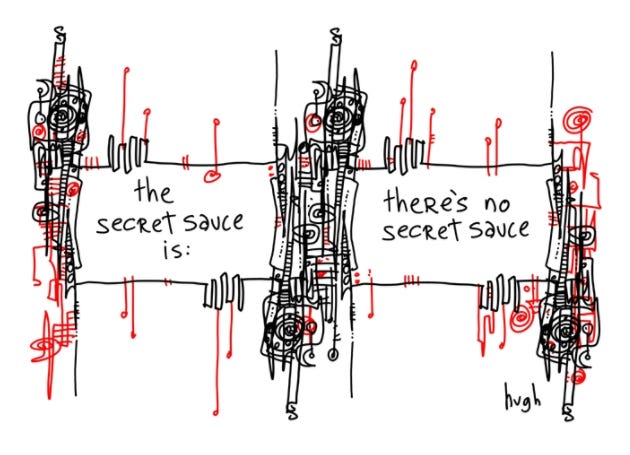
Do the work. Do it again. Repeat. That’s it.
We all know this. Stop looking for shortcuts. Put your head down. Put in the time it takes to be good.
I’ve had this image from The Gaping Void in my office for about 15 years now to remind me to remain patient as I tackle something new.
19. It’s Not a “Click.” It’s a Person Looking for an Answer.
Dashboards are useful, but abstract. They compress real behavior into numbers so we can make the educated guesses needed to market our businesses.
But behind every click, visit, open, etc. is a person – someone trying to figure something out. Someone comparing options. Someone looking for a new direction. Someone looking for reassurance they’re not about to screw up.
That “click” is a signal that you are at least doing something right. That you got someone to pause and consider you. Write for that person.
20. Don’t Chase Shiny Objects.
There is always something new to try yet the basics of marketing haven’t changed – identify a customer problem and solve that problem.
There’s a lot guru nonsense online at the moment around solopreneurship. Every single one of them is using content marketing as a strategy. They frown on words like “funnel” even as they use funnels to acquire leads.
Don’t mistake shiny new tactics and tools as shifts in the fundamentals. You should try new tactics over time. But boring consistency beats clever novelty every time.
21. Consistency Compounds.
One post doesn’t change anything. A hundred posts do.
Do the things.
Do them again.
Repeat.
If there’s a “secret sauce,” that’s it.
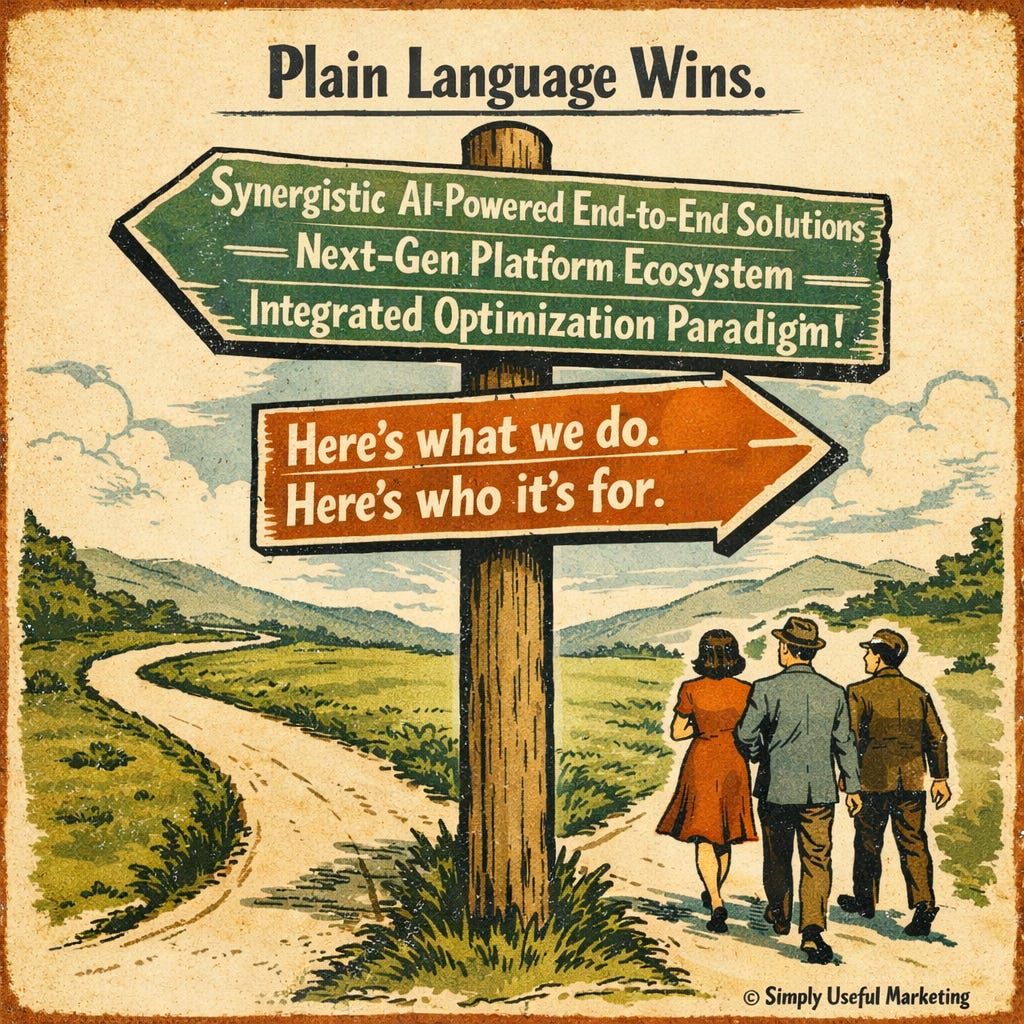
22. Plain Language Wins. Drop the Insider Jargon.
If you need a glossary, you’ve already lost them. Jargon signals insecurity, not expertise. I’ve lost count of the vendor websites I’ve hit where I couldn’t tell what they did without rereading the homepage three times — and even then, I wasn’t sure. That’s failure.
Jargon doesn’t signal expertise; it signals insecurity and lazy thinking.
Clear language isn’t dumbing things down. Clarity is credibility.
23. Marketing Isn’t a One-and-Done Campaign.
Being a marketer is a bit like being Sisyphus – you keep rolling that boulder but you never quite get to the top of the hill.
Marketing doesn’t stop. You have campaigns, within marketing, but your overall marketing effort should be inseparable from your sales and overall business strategy. It’s essential. It never ends.
Though, unlike Sisyphus, you DO get to roll the boulder to the top and down the slope of a hill with successful campaigns. Then you find the next hill. Your marketing should never stop.
24. Familiarity Drives Preference.
When the stakes are high, people don’t go hunting for novelty. They choose what feels known. Familiarity lowers perceived risk and makes decisions easier — especially when no option feels perfect.
That’s why showing up matters more than being clever. Repetition builds recognition. Recognition becomes comfort. And comfort is what people reach for when it’s time to choose.
25. Marketing Is Simple. Not Easy.
The ideas are basic. The execution is hard because it requires patience, repetition, and restraint.
Do the simple things. Keep doing them. That’s how you build a successful marketing program.
You can download the original version of these, Advent-calendar style, below.

If this sounds like how you already think about marketing — we’ll probably get along. If you want help building something durable instead of noisy, let’s talk: bryant@simplyusefulmarketing.co.
'There is no secret sauce. Do the work. Do it again. Repeat.' - The amount of money people spend trying to find the shortcut around this is staggering.
Every 'guru' selling a course on 'the one weird trick' is literally just repackaging 'show up consistently with useful information' in new language. Which is fine! Repackaging is valid! But let's be honest about what we're selling. What's up, Bryant!