


Let’s start off with the title.
Not write.
Not create.
Generate.
Not in the “create” or “beget” sense of the word; that implies originality.
In the more straightforward “produce” way.
There are already too many people already using generative AI as a crutch and shortcut. That’s a bad idea for a multitude of reasons:
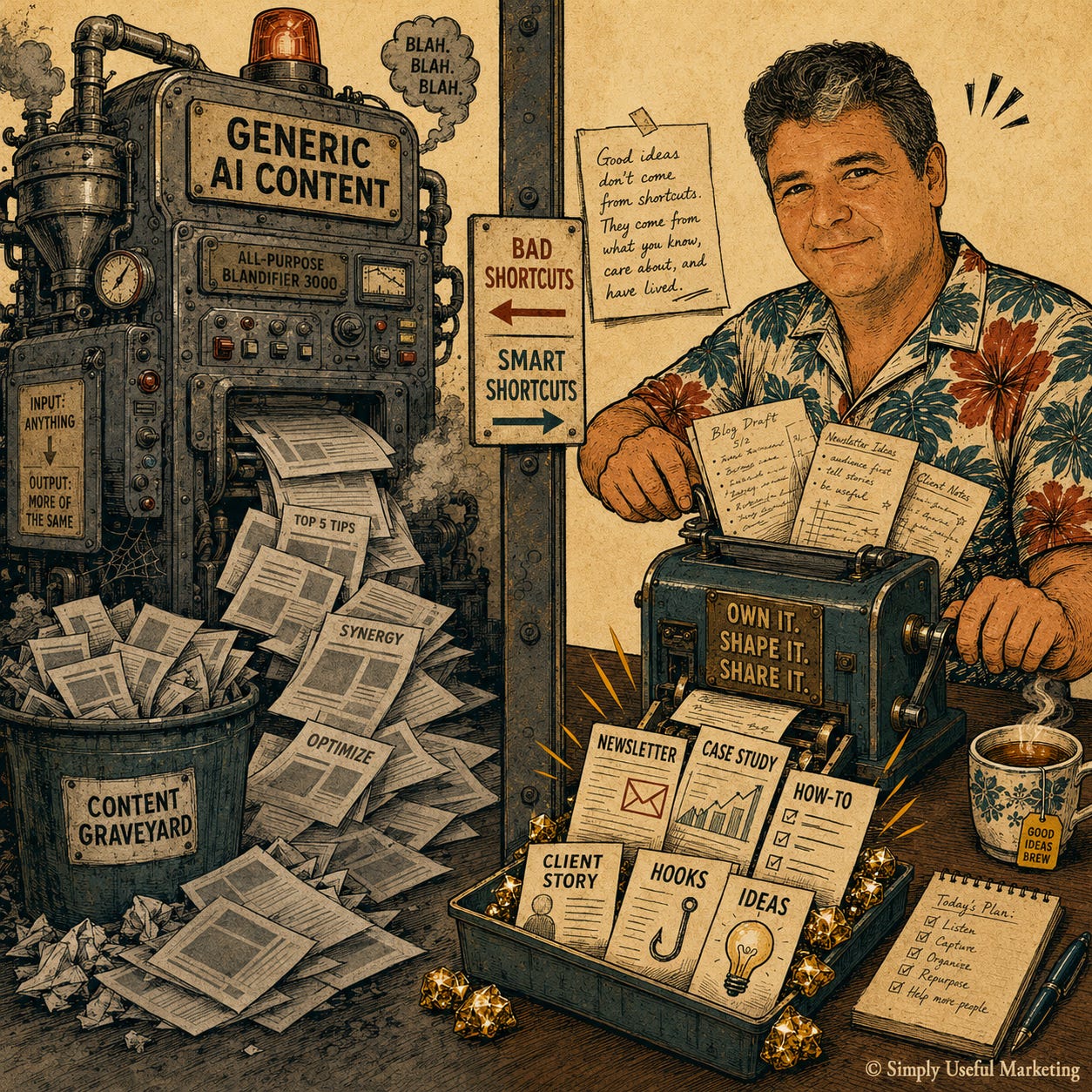
Writing is thinking. When you don’t struggle through the false steps, deleting 500 words only to realize about 200 of them worked, trying to find just the right word to say what you want to say; you’re cheating yourself. And, if you care, your audience. Also, everyone says this because it’s true.
“Writing” with genAI isn’t original. All you’re doing is recombining what already exists. These aren’t thinking engines; they’re prediction machines.
By all means, use AI to edit and spellcheck (what do you think Grammarly is?). Use it to outline. Use it to point out logic holes and gaps in your reasoning AFTER you write. Use it as a research assistant to find research (for you to read) to support your arguments.
Don’t use it to write your original content. It is impossible for a generative AI tool, which “writes” by predicting which word goes next based on your prompt and relying on the massive volume of content hoovered up by the genAI engine to pull the next word from, to create something original.
It’s a gigantic plagiarism machine.
Now, that said. Generating content from genAI is a different animal – but one with the same frenetic energy and all-out-drumming of The Muppet’s Animal.

When you turn Claude or ChatGPT loose on your own body of work, you can find a goldmine of extra content, insights hidden in plain sight, and, occasionally, a reflection of your thinking back to you that makes you think either “Damn, I’m smart” or “How the hell did I miss that!”
You can’t plagiarize yourself.
You can repurpose the hell out of your own content.
Take a seat on grandpa’s knee and let me tell you a quick story. Way back in the olden days of social media (LinkedIn 2003, Facebook 2004, and Twitter 2006), marketers, as they do, took to the new platforms to drive traffic back to their websites.
While it was blessedly easy back then to simply paste in a title and then the link and you’d have a good chance of boosting people visiting your website (”Web traffic” in marketing terms); most of us were manually and laboriously cracking open our various blogs, whitepapers, webinars, ebooks, and infographics to extract interesting nuggets to share.
I would have shivved my Mama for access to genAI back then (well, maybe not my Mama, but definitely a random stranger . . . fine, maybe given someone a rude shove).
GenAI takes this process from hours to minutes. It’s wonderful. Anyone who tells you different is a Luddite or doesn’t know what they’re talking about.
Here’s why. The tool is looking for patterns. The prediction aspect of genAI is predicated on the fact that the underlying engines are also pattern matching entities. So when you turn your genAI tool loose on your content, asking it to find patterns and common themes across your work, you’re asking it to do what it’s designed for — look for potential trends across huge volumes of data/information.
I will admit that the first few times I did this it felt like cheating.
Like somehow I wasn’t “doing the work.”
It took some time and self-reflection to get to the point of understanding that I had ALREADY done the work. And, as mentioned already, all I’m doing is automating a process I was doing manually before in a fraction of the time.
Is it 100% as good as what I would pull myself?
No, not always.
But 95% of as-good as I could do myself, but it took 15 minutes (including editing and posting time) rather than 2 hours?
I’ll take that exchange every damn time. You should too. Plus, now and then, the 1s and 0s rub themselves and deliver up an angle that you hadn’t considered before.
Before we get into how I’ve used it, a quick thought on terminology because I think it matters.
Why I Use “GenAI” Rather Than AI
Because “artificial intelligence” doesn’t exist.
At least in the sense of what the majority of folks who hear “AI” default to — an autonomous machine capable of independent thought.
Here’s a basic explanation of artificial intelligence.
The 4 types by capability — what it can do:
Reactive — responds to inputs, no memory, no learning. Chess computers.
Limited Memory — learns from past data to make better decisions. Everything you use today.
Theory of Mind — understands human emotions and intent. Doesn’t exist yet.
Self-Aware — has consciousness and a sense of self. Science fiction for now.
The 3 levels by scope — how broadly it can think:
Narrow AI / ANI — does one thing well. Every AI product on the market.
General AI / AGI — thinks and reasons like a human across any task. Not here yet.
Super AI / ASI — smarter than all humans at everything. Theoretical.
Put bluntly: there’s no such thing as artificial general intelligence. We’re still at the first level — a dumb prediction engine rubbing ones and zeros together really, really, really fast that gives the illusion of intelligence. It’s extremely useful, as limited as it is. But it doesn’t — and can’t — think for you. It’s a server in a rack . . . somewhere.
Repurposing Yourself for Fun and Profit
Here’s what that actually looks like in practice. Every one of these started (and starts) with content I’d already made.
Condense long into short. A 1,500-word newsletter becomes five LinkedIn posts and a half-dozen Substack Notes. Going in the other direction hasn’t worked as well for me.
Combine pieces into something new. Ask Claude or GPT to analyze multiple pieces of content to look for common ideas and themes; then pull those into standalone pieces for LinkedIn or Notes. Please note: YOU HAVE TO EDIT THESE, but edit time is still less than doing this from scratch time.
Pull the threads out of a brain dump. I dumped 30 years of stories into a chat — jobs, marriages, life, the webinar program I built that grossed millions and the $2,000 bonus I got for it. What came back was a through-line I’d never said out loud: I’d spent three decades building for everyone but myself. I didn’t write that sentence, but it smacked me straight in the face.
I literally grunted and sat back in my chair after reading that, along with a few of the half-obscured and half-felt linkages Kim Doyal’s genius series of prompts unveiled: You’re Sitting on a Lifetime of Stories (And a Blank Page Keeps Proving It).
Turn old posts into a sellable PDF. I have . . . a bunch of articles, blog posts, and draft ideas. A hefty chunk of this stuff is evergreen advice. All of my most recent pieces are in Claude. The first two PDFs for sale I created were largely pulled from existing content. Both were all there, spread across multiple published newsletters (and emails I had sent). I simply used Claude to pull MY content into a single piece, made slight edits, then used Designrr.io to make the PDFs.
You can buy either/both ebooks here:
Mine the archive for beliefs. Twenty-five marketing beliefs. Five marketing truths I can’t stop harping on. None of it was new thinking. It was already scattered across years of posts — I just needed it gathered in one place.
Repurpose one idea into every format. A newsletter becomes a LinkedIn post, a carousel, a 60-second video script, a chapter in an ebook. One idea, several avenues to spread the idea.
Generate titles and decks on demand. I sporadically practice writing 10 titles each day. It is truly a great habit that will improve your writing. Still. Titles are hard. I get stuck. Asking for five to 10 title options in ten seconds gets me unstuck. Extra tip: I’ve been honing titles with Sharethrough for at least a decade. It’s a great, free tool. Give it a look.
Write CTAs. Mid-story hook and a PS. I think of these as my mini house ads. I know the structure cold; but I get stuck (yes, I get stuck often). Having a line to respond to is infinitely better than spinning your wheels for 30 minutes. Now, yeah, I know, you can read this as slightly contradictory to the “writing is thinking” I opened with. But, there’s also reality and deadlines and only 24 hours in a day. Sometimes you need the jump start.
Draft the sales and outreach copy. Landing pages, launch posts, the first ugly version of a cold email. The core of what I want to say exists in my current writing in these cases, but often scattered. I rewrite all of it in my voice. But a bad first draft I can fix beats a blank page I can’t.
When I do outreach to someone entirely new or in a new industry, I dump out an ugly first draft, then massage with genAI.
Newsletter/Blog post. I generated The AI Revolution Has a Foundation Problem from a 2014 ebook I compiled, multiple Claude and GPT chats, back and forth prompting, and, of course, a bit of editing. I explained how I put it together, follow the link above and scroll to the end (the article itself is looooongg).
So, Whaddya Do?
Look, do what you want — use genAI, don’t use AI; that’s a decision you need to make for yourself.
Obviously, I encourage you to use it. Not as a crutch or to write for you, but as another tool that allows you to create supporting marketing content, help you with ideas, strategic direction, and so much more.
There are really only two reasons to say no.
One: you’ve got a legitimate concern about the output — quality, accuracy, whatever. That’s a real problem, and it’s a fixable one. Edits and rewrites. Try it. And if the output still isn’t good enough after that, fine — give it a skip.
Two: you don’t want to use it because . . . well, because. It feels icky. Or like cheating. Or a bastardization of your life’s work. I get it. I felt it too. But this isn’t original analysis. It’s marketing — marketing that recombines YOUR existing words and insights into something useful. If that’s the concern, well . . . get over yourselves.
Use the tool. Get more done. Or get the same amount done faster and then go outside and touch grass, or stay inside and touch yourself, or, consensually, someone else.
P.S. You can't repurpose what you never made. If you're looking at an empty folder instead of a full one, that's the front-end problem — and it's what Newsletter-in-a-Box is built for. Reply "NIB" (bryant@simplyusefulmarketing.co) and I'll send the details.
Musical Interlude
Finished and edited to one of my favorite feel-good soundtracks, Curious George.
Why doesn't this article have more engagement?
So many golden nuggets here.
This is where I land.
Using AI to replace thinking = dilution
Using AI to accelerate after thinking = leverage
Using AI to interrogate thinking = interesting territory
That last category I use the most and is the one I think we’re still under-exploring.
Not necessarily “write this for me,” but -
“What assumptions am I making that I can’t see?”
Blind spots.
Happy Monday, Bryant.
I set this one to restack at 5 pm my time :)
I am trying not to spam people with my restacks lol