

It’s Cinco de Mayo. In the US., that mostly translates to “drink a margarita.” Fine by me.
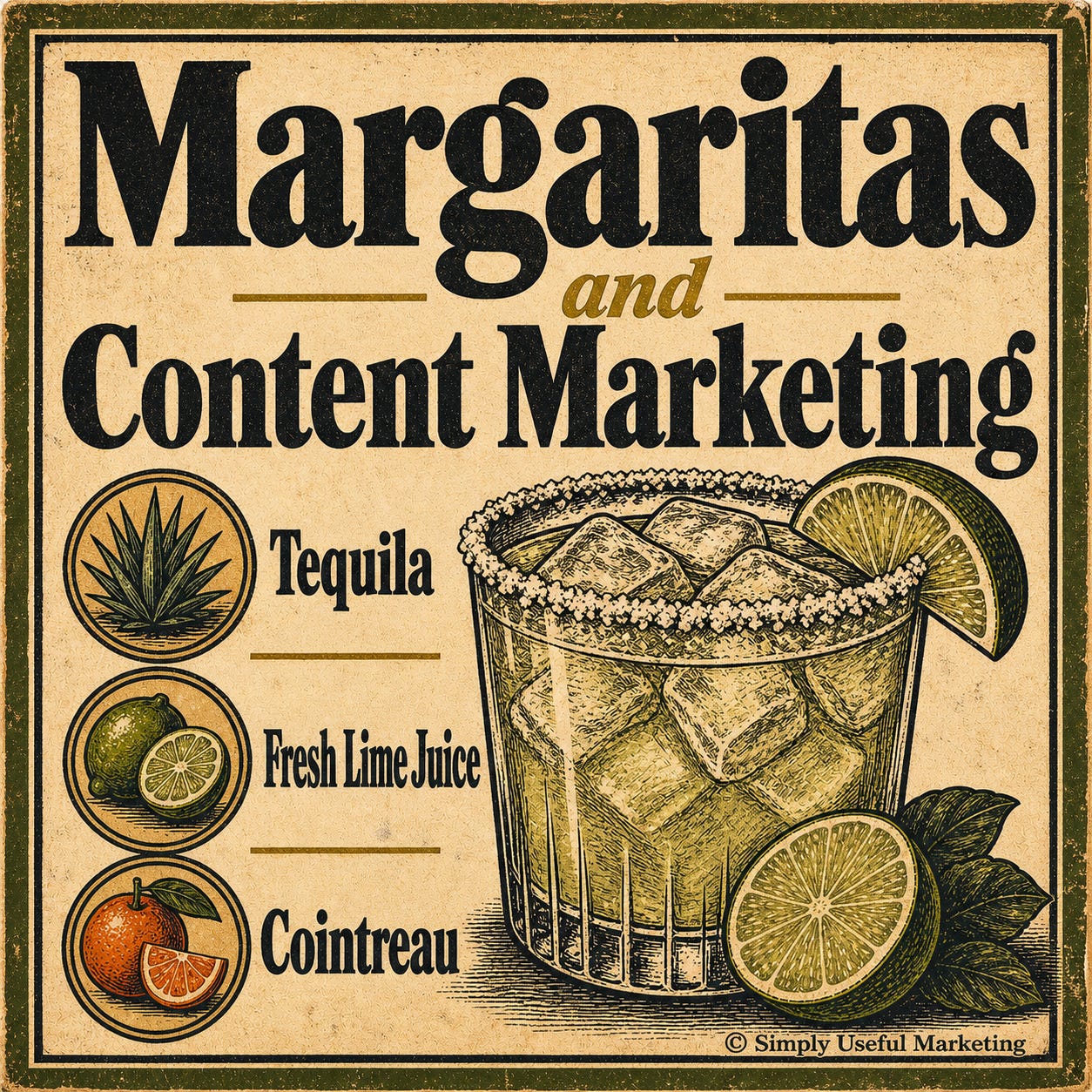
Most of us slurp margaritas poured from the slushie machine behind the bar at our local Mexican joint. Sugar, ice, and a vague rumor of tequila. It’s easy to forget that a real margarita needs only 3 ingredients:
Good tequila
Fresh-squeezed lime juice
Cointreau, fresh orange juice, or agave nectar (there’s a spirited — ha — debate about which. Some recipes call for both. Research is the only way to know. Recipes at the end. Salud.)
That’s it.
If you’ve ever had a real, 3-ingredient margarita, you know it’s a simple yet elegant cocktail that blows the doors off of the slushie version.
What’s this got to do with content marketing?
A lot of content marketing is the slushie. Sweet, easy to drink, hopefully you get a little tequila. Empty calories that resemble the real thing in name only.
Real content marketing — the kind that builds a business — has three ingredients.
3 Ingredients of Content Marketing That Actually Works
Tools aren’t ingredients. Substack, Mailchimp, Canva, LinkedIn, ChatGPT, whatever you’re using this week — they make life easier. They don’t make the marketing.
Your marketing needs a soul.
Here’s the recipe:
2 ounces of patience
1 ounce of belief
1 ounce of trust
Shake with a little TLC. Pour.
Tequila: Patience
Content marketing takes time. I write about this constantly because people keep refusing to hear it.
Months. Not weeks. Here’s what the work actually looks like:
You figure out who you’re writing for. Not “small business owners” — an actual person, with an actual problem, who you can name. You talk to a few of them. You listen.
Then you build a strategy — what you’re going to write about, how often, where it lives, what it leads to. Then you write. Then you write again. Then you write a third thing because the first two weren’t as good as you thought.
Then Google has to index it. Your audience has to find it. Some of them have to read it. A smaller number have to subscribe. A smaller number than that have to keep opening. A smaller number than THAT have to eventually buy.
Meanwhile you’re building landing pages, writing the welcome sequence, figuring out what your offer actually is and/or how best to frame it, learning how to talk about it without sounding like every other vendor in your space, and cleaning your email list because half the people who signed up six months ago aren’t opening anything.
Expect 6 to 12 months before things start clicking. That’s not me dragging out a retainer. That’s how it actually works. [Yes, I know there are a few “instant successes” here on Substack, which almost always involves bringing an existing audience from elsewhere into this new platform.]
The folks who succeed are still showing up at month nine. The ones who quit at month three are now doing the same thing on TikTok and complaining nothing works.
Patience isn’t passive. It’s the discipline to keep going when the numbers say you shouldn’t.
Lime: Belief
Content marketing is both a strategy and tactics. Most importantly, it needs to be based on a belief system.
The belief? You have to believe that helping people is the way to earn their business. That answering their actual questions matters more than shouting your features. That doing the work of being useful — over and over, for months, years, decades (John Deere has been producing The Furrow since 1895 for content marketing) — pays off.
If you don’t believe that, content marketing won’t work for you. Not because it’s broken. Because the moment it asks you to choose between being helpful and sharing how wonderful you are, you’ll choose you (not your customers), and the whole thing collapses.
While the various hustlebros are annoying; they also believe in content marketing. All of them have a variation of a traditional content/inbound marketing funnel — an asset to grab an email address, nurturing email workflows, landing pages, blogs, etc. Now, I don’t think most of them give a shit about their customers, but that’s a different post.
Look at what they actually publish. The “I used to be broke, sleeping on my mom’s couch, eating ramen” origin story — recycled monthly, sometimes weekly, by the same guy who’s now selling a $2,000 course on how you can escape the couch too. The fake vulnerability post that’s actually a flex. The screenshot of a Stripe notification. The “most people won’t read this but” hook that 40,000 people read. There’s no belief underneath it — just mechanics. They’re using the vocabulary of help while running the same old school interruption playbook in a longer format.
That’s why their audiences eventually tune them out. The mechanics work for a while. Then people figure out there’s nobody home.
Belief is what keeps you writing the post that helps a customer make a decision — even when the decision is “not yet” or “not you.” A “not yet” who trusts you is worth ten “right nows” who don’t.
Cointreau: Trust
Trust is the flip side of belief. Belief is what you bring. Trust is what they give back, eventually, if you do the work long enough to earn it.
Trust compounds. One useful piece doesn’t move the needle. A hundred useful pieces, over 6 months or 2 years, builds something competitors can’t copy.
Reach goes up and down with whatever the algorithm is doing this week. Trust just keeps building. It’s what makes someone open your email when they don’t have time. It’s what makes them tell a colleague to subscribe. It’s the engine running underneath everything else you do.
Trust is also fragile. Once you have it, every piece you publish either reinforces it or undermines it.
And TLC
One more thing, that little something extra – lagniappe as we say at home in SW Louisiana. A little tender loving care. To be blunt: Give a damn about your customer beyond the revenue line.
Content marketing is about leads and sales. Of course it is. It’s also about being useful to people who will never buy from you, and being useful to the ones who will.
If you don’t actually care, your customers will sniff it out over time; you can’t fake it forever. They’ve been marketed to their entire life. They know what insincere “helpful” content looks like. It looks like 90% of LinkedIn.
If you don’t give a damn about they, your customers won’t give a damn about you either.
Patience is the ingredient most small businesses run out of first. Not because they don't believe in the work — because the writing, the schedule, the offer, the list, the welcome sequence, the everything-else piles up and the newsletter slides off the calendar. That's what Newsletter-in-a-Box is built to fix. I run the system so you can show up at month nine instead of quitting at month three. Hit me at bryant@simplyusefulmarketing.co.
And the Recipes
I don’t often make margaritas — I’ve been more of a whiskey guy the past few years — but when I do, I use one of these two recipes.
1. My Favorite
Ingredients
2 oz blanco tequila
1 oz fresh lime juice
½ oz orange liqueur
½ oz agave syrup
Salt rim, optional
Lime wheel
Method
Shake hard with ice and strain over fresh ice.
2. Original Cointreau margarita
Use this when you want a dead-simple 2:1:1 formula. Easy to remember. Hard to screw up.
Ingredients
2 oz blanco tequila
1 oz Cointreau
1 oz fresh lime juice
Ice
Salt, optional
Orange slice, optional
Method
Shake with ice and strain into a salt-rimmed glass over ice.
Notes: Either version is great straight up in a martini glass. If you like ice, go for bigger blocks — less dilution, more nummy margarita flavor longer while staying chilled. For on the rocks, I like a small glass tumbler (or plastic if outside).
Salud.
And, of course:
Awesome analogy! NEVER drank a margarita but if it's anything like content marketing... maybe I'll try 😉