

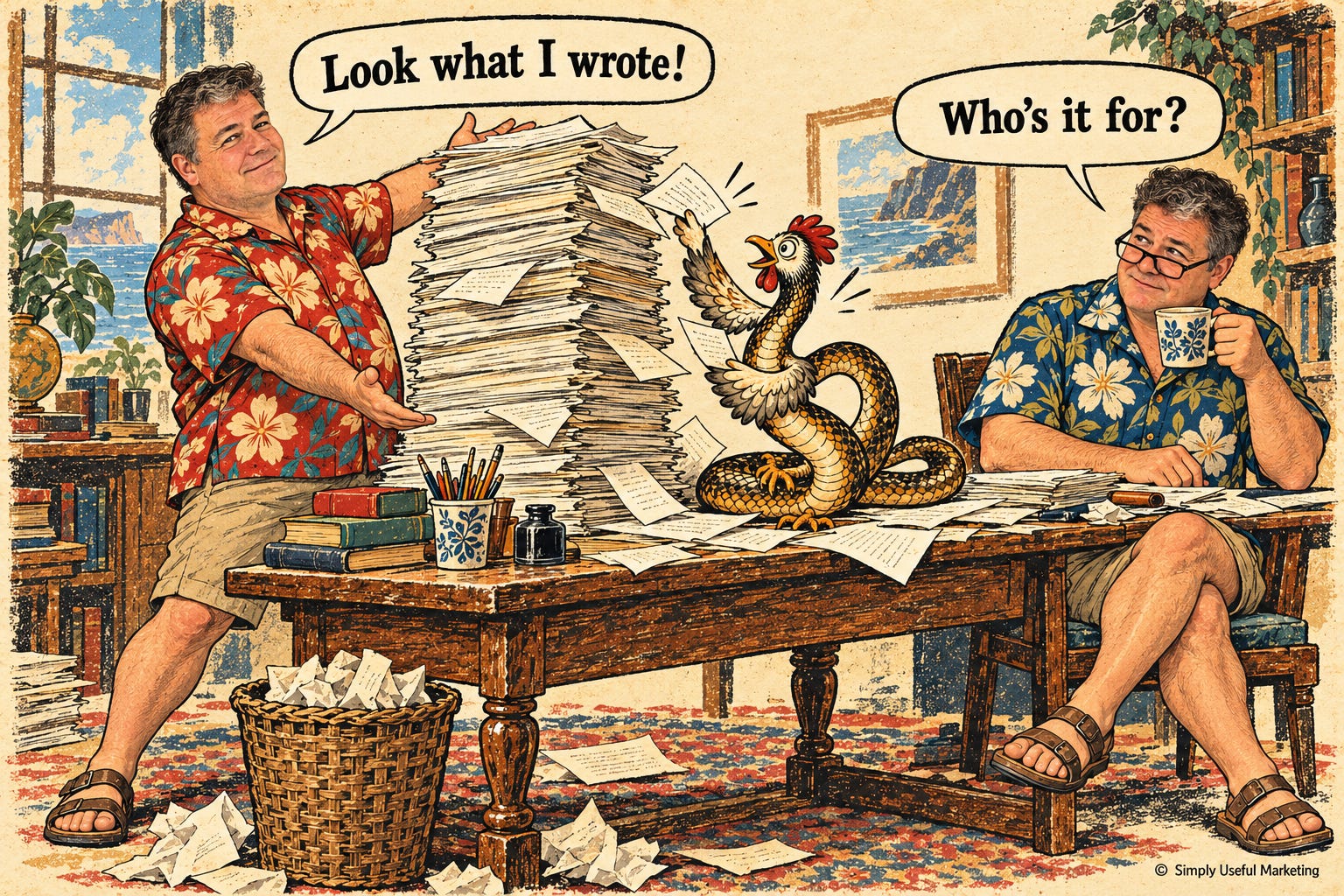
If you’re on Substack, you’re a publisher. Other than the writer, the most essential person in publishing is the editor.
Yes, I am a former magazine editor. Yes, I am biased. No, I don’t care to revise that statement. :)
I’ve bounced between writing and editing and marketing my entire career, so I know I have a different mindset when I’m editing a piece of writing versus creating a piece of writing.
Writing is telling someone something.
An editorial mindset makes the decision if that something is worth telling.
If you think editing is just about grammar, spelling, and style, I hope you’ll think differently by the end.
The Reader Is the Boss/The Reader Is the Reason
I’m intentionally using “reader” rather than audience. You perform for an audience. You sell to an audience. You work for the reader. You serve the reader.
Your reader is your customer. Audience has too much marketing stank.
You see it here on Substack. The writers/publishers effectively building here are building relationships with people. With their readers.
Reader is singular. You can know your reader. One of the things I miss most about my time as editor at AIIM is that it was a member organization. Over time, I met and got to know many of them (a few are still friends). When you know your readers as people, you damn well do your best for them.
Sometime in the mid- to late 2000s, a reader emailed to say an article we’d published helped get a stalled project started. I can’t remember the exact phrasing. But it just felt good. It felt like I did my job.
And practically, if you aren’t serving your readers, they’re going to leave, and you will go out of business.
Be Led By Your Readers
Smart editors let their readers lead them. Do a reader survey every year. Ask what topics they’re interested in. Write about those topics.
As an editor, I emailed a yearly survey to our readers. I asked what topics interested them and what was keeping them up at night. Every year, I ran 20 to 30 print and online articles lifted directly from reader answers. I’d still like to know who said, “That Duhon guy is an ass.”
You have to serve them at least some of what they want; otherwise, they leave. Then you lose your reason to exist (as a publication; you, as a person, are lovely). They are the reason your publication exists and you can eat. Respect that.
However.
Lead Your Readers
You have a broader perspective than most of your readers. Your job is to use that perspective and access to information to help your reader understand a topic or angle they don’t know exists or don’t realize is important.
Be a Lighthouse
Tell readers where the dangerous reefs and currents are, too.
One of my favorite columns was “Tales from the Trenches.” Information professionals would share horror stories.
Borrow/Rip Off Ideas
The “Trenches” column above was directly inspired by Irma Kurtz’s Agony Column in Cosmopolitan.
I also borrowed from “Inside the Actors Studio” for the “15 Minutes” section of Infonomics (and Inside the Actors Studio had adapted their questions from a French program). The questionnaire gave readers a look at the person behind the professional bio.
There are good ideas all around you. Steal them. Adapt them to serve your readers.
Enjoy “House Style”
Oxford comma, em dash, and lists of words to use/not use are all yours to decide. It’s your world. Make it your own using the linguistic quirks you like. If you make the same mistake twice, it’s no longer a mistake; it’s house style! Within reason!
When I was working with our community bloggers, I told them: “Write like you write. I’m not interested in having all bloggers sound the same.” Publications with a single style are boring to me. There was also the small matter of it being literally impossible to edit everyone and get anything else done.
I’ve always thought of your writing voice and point of view in this context as well. No one can write like you. Don’t let genAI tools sand all of your rough edges to a smooth blandness.
It might take you a while to find your point of view. I’ve been on here for three years and I’ve just started to identify that for myself. Try to be faster than me! But also realize it’s a process. Bonus points when you also realize that it’s a process that doesn’t end.
Putting Together a Puzzle
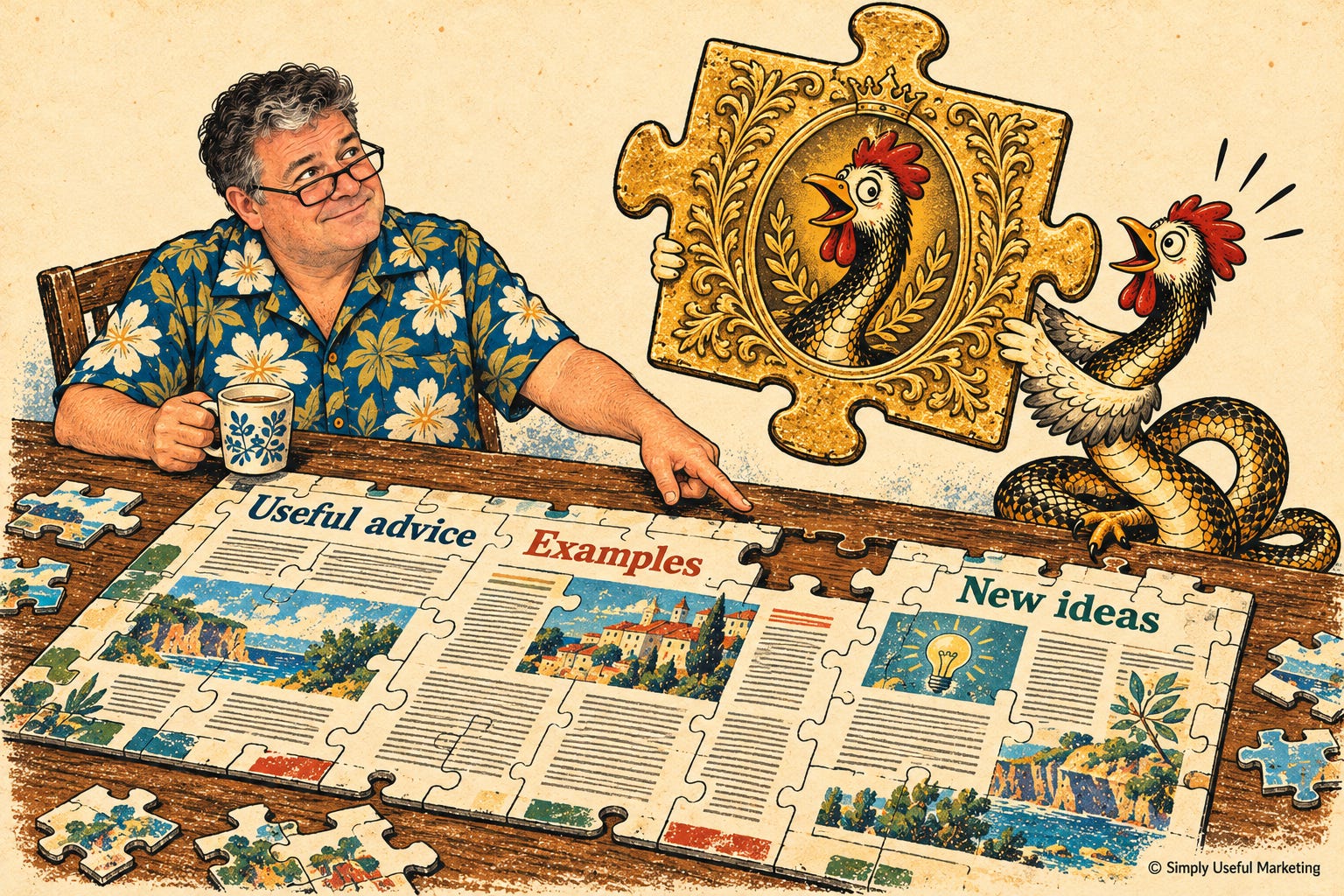
I looked at every issue like a puzzle. How do I use the limited amount of dead tree space to include multiple topics that include how-to advice, examples, and exposure to new trends?
Substack is similar except you do this a post at a time rather than 45 pages of printed content at once. Over the course of a year, your Substack newsletter/website (yeah, you have a website if you’re here; the newsletter part is only the bit that goes out via email) is also a puzzle to solve. Imagery. Topics. Frequency. Length. Figure it out.
You Are a Gatekeeper
I once ran a cover with a burly doorman behind a velvet rope (though I cannot for the life of me remember the topic and my hard copies are buried in my basement).
That’s a good image to keep in mind because when you’re successful, other people will want access to your readers. I covered the unstructured content industry. All of the vendors in it wanted access to my readers because they were the people making the buying decisions for those products.
Today, it’s easy to partner with people here. Don’t do it just because you want to. Do it when you each have something unique to share with the other’s readers that fits into what you focus on.
You are also the gatekeeper of ideas. There are always more ideas to write about than there’s time for. GenAI multiplies this. Just because you can write about something doesn’t mean you should.
Beware of Marketing Language
Views. Clicks. Eyeballs.
Never forget that each one of those represents a person on the other end of the Internet taking an action because of your words.
They’re absolutely important to monitor. But don’t let the language cause you to forget there’s an individual behind each one.
And each one of those actions is an opportunity to build a relationship with that person.
FOCUS
You can’t write about everything. Don’t try. The only exceptions here are if you’re a polymath (and you probably aren’t one) or if you’re good enough that your brand is “you” and people love your work so much they’ll follow along as you switch from topic to topic.
The vast majority of us ain’t that.
I mentioned earlier that I covered the unstructured content industry. Here’s a partial list of the technology within the industry — document scanning/conversion, workflow/business process management, forms processing, document management, records management (which has multiple member associations by itself), and storage. Within each technology, there were multiple business angles to cover: ROI, implementation, case studies, change management, etc.
Then there was the overall perspective: Do I cover this from a hardcore technology angle or from a higher-level business angle?
I went with option two for a few reasons:
I have a master’s in international relations. My in-depth understanding of how technology works remains at a 5-year-old’s level. I couldn’t edit a hard-core tech pub.
There were pubs like InformationWeek, ZDNet, and others that already touched on the technology better than I could.
I cut topics like document delivery because competing pubs covered that better than I could.
The decision makers at businesses aren’t always in the weeds of building systems. The doers would read up to see how technology they knew in depth fit into a broader ecosystem. Decision makers weren’t going to read down to the technical details.
Also, it was just me. With a $20k writing budget for the year. I relied on contributions from our community, some of them vendors. Allowing them to write about tech details risked copy tweaked to how their product worked. Was actually fooled once on a somewhat technical piece by a vendor. Never allowed a contribution from them again.
I shared this personal history lesson because whatever your topic is, it’s already huge when you start digging. I could’ve written an entire year of issues on any one of the topics.
It’s a good thing to be known for something. I love neworleansfootball.com. I don’t go there expecting to read about the NFL at large or the Failcons (not a typo) unless it impacts the Saints.

Have Fun!
I love sharing the unicorn in a mankini image here because it was the result of a Twitter conversation gone sideways on a Friday afternoon in 2011/12.
Every industry has its fun side. Find it. Or make it.
I used to run ECM haiku contests online.
SharePoint is really
confusing. Free? Cheap? Hardly.
Where does it fit best?
For World Paperfree Day, I ran a “Messiest Desk” contest. I “think” we had partnered with Fujitsu to give away a few of their ScanSnap desktop scanners to the “winner.” Folks loved the photos.
Also ran an ECM in 60 seconds video contest. And, wow, the channel I created for it is still live on YouTube. Still love the winner. And it’s still accurate.
Kill Your Babies
Or murder your darlings. Whichever way around you prefer the saying, edit/cut/delete/excise what doesn’t fit your article regardless of how much you love it.
I don’t do this nearly as much as I should. When I do, I keep a running document of turns of phrase that I loved but didn’t fit where I had them. One of the nice things about genAI is you don’t have to remember them to use them. I keep the document in GPT and Claude to pull from when repurposing and editing my work.
You and the Role/Position Are Two Different Things
Companies will tell you you’re brilliant for asking a stupid question if you’re in a gate keeper position.
Don’t mistake positive comments or outright flattery for sincere praise. Vendors wanted access and would say whatever they thought would get them into my magazine. After a year, I developed a filter: if someone called my absolutely stupid question brilliant, I wouldn’t trust them.
Now, there were times when I didn’t understand something and I’d ask for someone to explain it to me like I was a slow five-year-old. And there were some legitimate kudos from folks because I did do a damn good job. But it ALWAYS pays to have your bullshit meter active.
We’ve all met someone who thinks they’re a genius because people listen to them without understanding that they’re generally thought to be a moron or an asshole. I worked with a few.
And there you are. One once-and-maybe-future editor’s idiosyncratic take on the editing mindset.
Comments, criticisms, and witticisms welcomed.
If deciding what to publish for your business keeps eating time you don’t have, I can help. I’ll help you sort through your ideas, find what your customers would find useful, and get the writing done.
That can mean getting a newsletter going with my Newsletter-in-a-Box service, planning regular content, or taking that overdue piece off your plate. Send me an email and let’s talk about what you need: bryant@simplyusefulmarketing.co.