

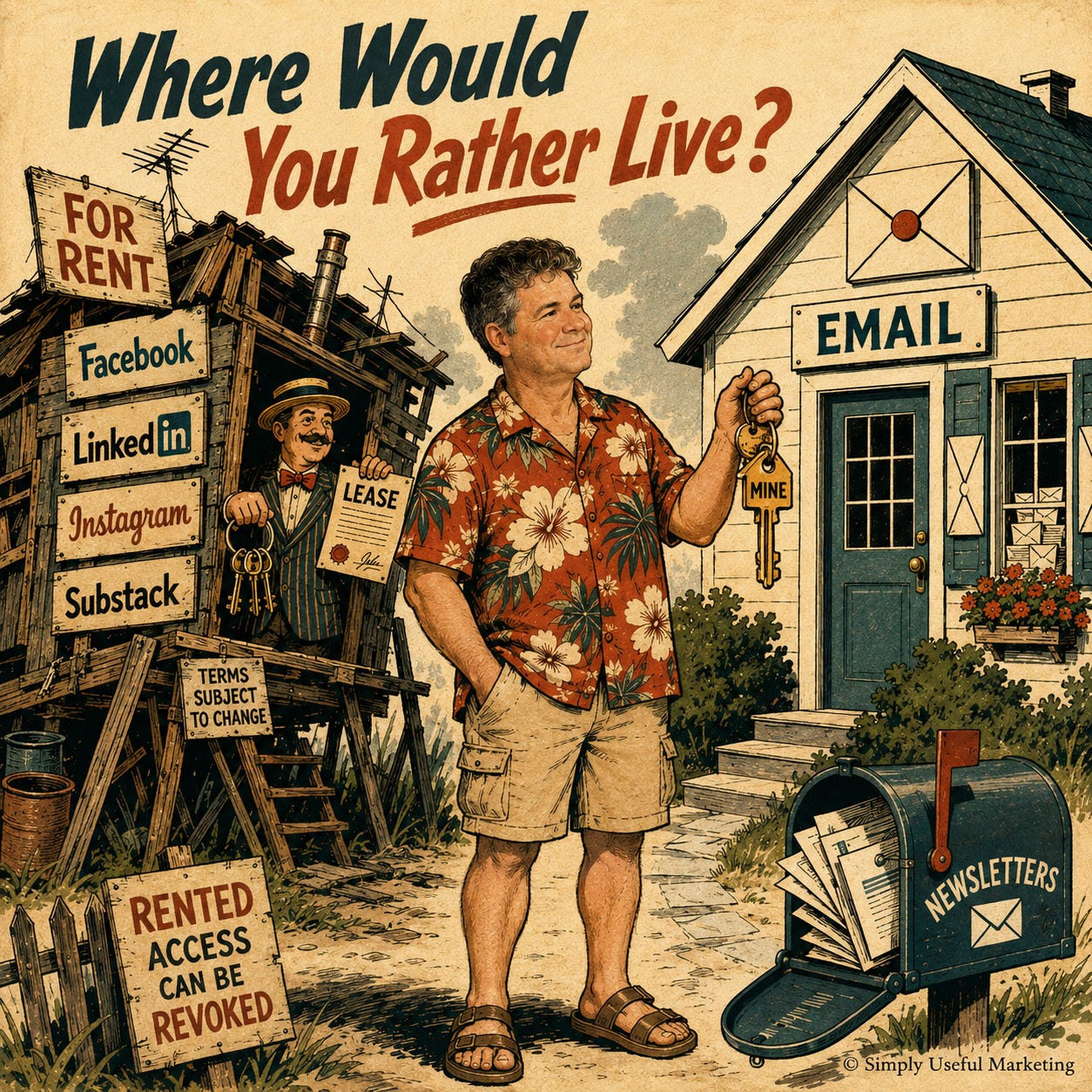
The only digital point of connection you own with your customers is their email address.1
If you still think Facebook or LinkedIn or Instagram or insert-your-favorite-platform-here shows everything you share to everyone who follows you . . . well, no. They don’t.
The platforms decide who sees what, generally based on algorithms designed to predict what will keep each user engaged.
And the numbers can be brutal. One 2025 analysis of brand accounts found the average Instagram post reached about 3.5% of followers. Facebook was roughly 1–2%.
These are essentially advertising platforms masquerading as community platforms. We are their product, not their customer. Their customers are the advertisers trying to reach us.
Use them. I do. Just don’t confuse having followers with owning a way to reach them.
Email gives you that.
Trust
I’ve written about trust endlessly because it’s the foundation for nearly everything in your marketing.
Show up, be useful, repeat — and familiarity becomes trust. Repetition helps people remember you exist and builds trust that shifts them from prospect to customer.
Trust isn’t a hazy, granola-munching, tree hugger feel-good intention. It’s measurable, and it’s a multiplier. Customers spend more. The market forgives mistakes faster.
This is why I’m annoying about newsletters. They aren’t magic, but the impact on your business can be magical. A newsletter is a concrete strategy to own your customer relationships. It’s where you show up consistently, using plain language, about what you actually heard from your customers, until familiarity becomes trust, in a channel nobody can take away from you.
And trust has an ROI of its own.

Sales
I believe marketing needs to be useful and helpful. I also believe you do that — in addition to being a good human being — so that you can make more sales.
Marketing has to make a business money, directly or indirectly.
We just covered indirectly. Now the direct part.
Email lets you sell through:
Links to relevant products and offers inside a useful newsletter.
Direct promotional emails — new products, services, special offers, coupons, events.
Nurture sequences that move someone from interested to ready to buy.
Abandoned-cart emails for ecommerce.
Reorder, replenishment, renewal, or expiration reminders.
Win-back campaigns to customers who haven’t bought from you lately.
Post-purchase cross-sells and upsells.
You’ve already done the hard part: earned access to someone who knows your business. Email gives you repeated opportunities to turn that existing relationship into revenue.
The Research That Backs This Up
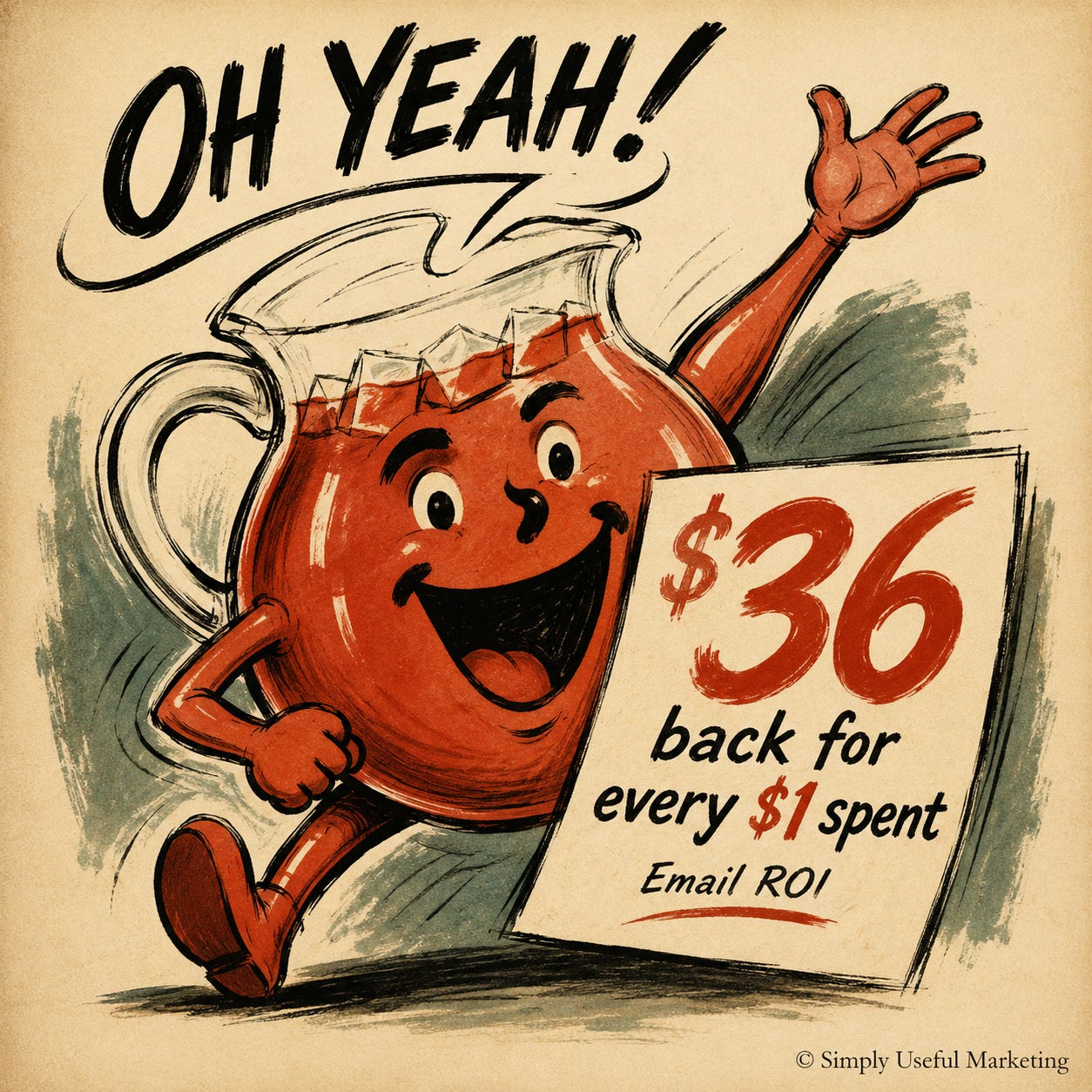
You’ve probably seen some version of this statistic if you’ve done any research into email marketing ROI: email generates $36 for every $1 spent.
Is $36 precisely correct for your business? Of course not. But is it a good shorthand way to show how valuable email can be? As the Kool-Aid Man would say, “Oh, yeah!”
Litmus surveyed nearly 500 marketers for its 2025 State of Email research. Thirty-five percent reported returns between $10 and $36 for every $1 spent, another 30% reported $36 to $50, and 5% reported more than $50. Newsletters were the highest-ROI email type reported by both direct-to-consumer companies and agencies/professional services.
The UK’s Data & Marketing Association landed in almost exactly the same neighborhood. Its 2026 Marketer Email Tracker, based on responses from 250 marketers across sectors, reported £40.96 returned for every £1 spent.
Now, specifically on newsletters: HubSpot surveyed more than 400 newsletter professionals for its 2025 State of Newsletters report. Twenty-five percent said their newsletters had produced substantial profit growth over the previous year, and 45% expected newsletter profits to increase significantly over the next 12 months. The primary way those newsletters made money was by marketing products, services, or memberships inside the newsletter itself.
Content Marketing Institute gives us another newsletter-specific data point from outside the email-platform world. In its 2026 B2B Content and Marketing Trends research, 1,015 B2B marketers ranked email newsletters as the second-most effective channel for distributing thought leadership: 54%, behind only LinkedIn at 76%.
Different surveys. Different methodologies. Different numbers.
Same conclusion.
Email makes businesses money. And newsletters are one of the ways it does it.
Collection
You have to get your customers’ emails.
This can become complicated, but it doesn’t need to be to start.
Ask at the point of sale. Whether you have a physical register, online checkout, appointment desk, or service counter, simply ask customers if they’d like to receive useful information and offers from you. Bare bones: a sign-up sheet in a notebook or clipboard will do.
Put signup opportunities on your website. Homepage. Footer. Checkout. Booking confirmation. Contact forms. Don’t make someone hunt for the privilege of hearing from you again.
Give them a reason. A discount works. So does early access, a genuinely useful guide, a loyalty program, useful tips, or information customers actually want. DMA’s 2026 research found discounts and offers were the strongest signup driver, but useful information, loyalty programs, email receipts, and brand trust all worked too.
Use the physical world. QR codes on receipts, packaging, counter cards, invoices, menus, event signage — anywhere customers already interact with your business.
You don’t need every email address.
You need to steadily collect email addresses from people who already have a reason to care about you — and then give them reasons to keep caring.
Facebook, LinkedIn, Instagram — use them. They’re useful places to find people. Just remember whose land you’re building on. The goal is to turn rented attention into a relationship you can keep. Collect the email address. Send something useful. Keep showing up. Make offers when you have something worth selling. Repeat. You don’t need a giant list. You need customers who know you, trust you, and can hear from you when you have something worth saying without letting the algorithm decide who gets to hear from you.
If you have customer emails sitting in a spreadsheet, CRM, or point-of-sale system and know you should be doing more with them, you don’t need a giant marketing plan. You need a useful reason to show up in their inbox consistently. That’s what I build with my Newsletter-in-a-Box service. Drop me a line, tell me where your sticking points are, and let’s figure out how a newsletter fits into your marketing plans: bryant@simplyusefulmarketing.co.
Yes, there are other customer contact points you can take with you, including mailing addresses and phone numbers. I don’t play in direct mail or SMS. My focus here is email. As I was pushing “publish” I thought of online communities; they are also a way to own the relationship, especially if hosted on your own website. But community management is a world unto itself; and is HARD work (I was a community manager for about 18 months).
I’ve thought a lot about platforms over the past couple of weeks, wondering whether I should stay or go.
I’ve started looking at Substack as part of my retirement plan. I’m not too concerned about the money side of it, but I probably do need to cut back on how much time I spend here.
Social platforms are basically landlords who keep changing the locks, moving the staircase and occasionally informing you that the apartment you’ve lived in for seven years is now a video-first experience. 😂
Use the platforms, absolutely. But building an entire business around the assumption that they’ll continue letting you reach the people who chose to follow you seems increasingly insane.
Email may be ancient technology at this point, but at least Gmail doesn’t make me dance on camera before delivering the message. 😂