


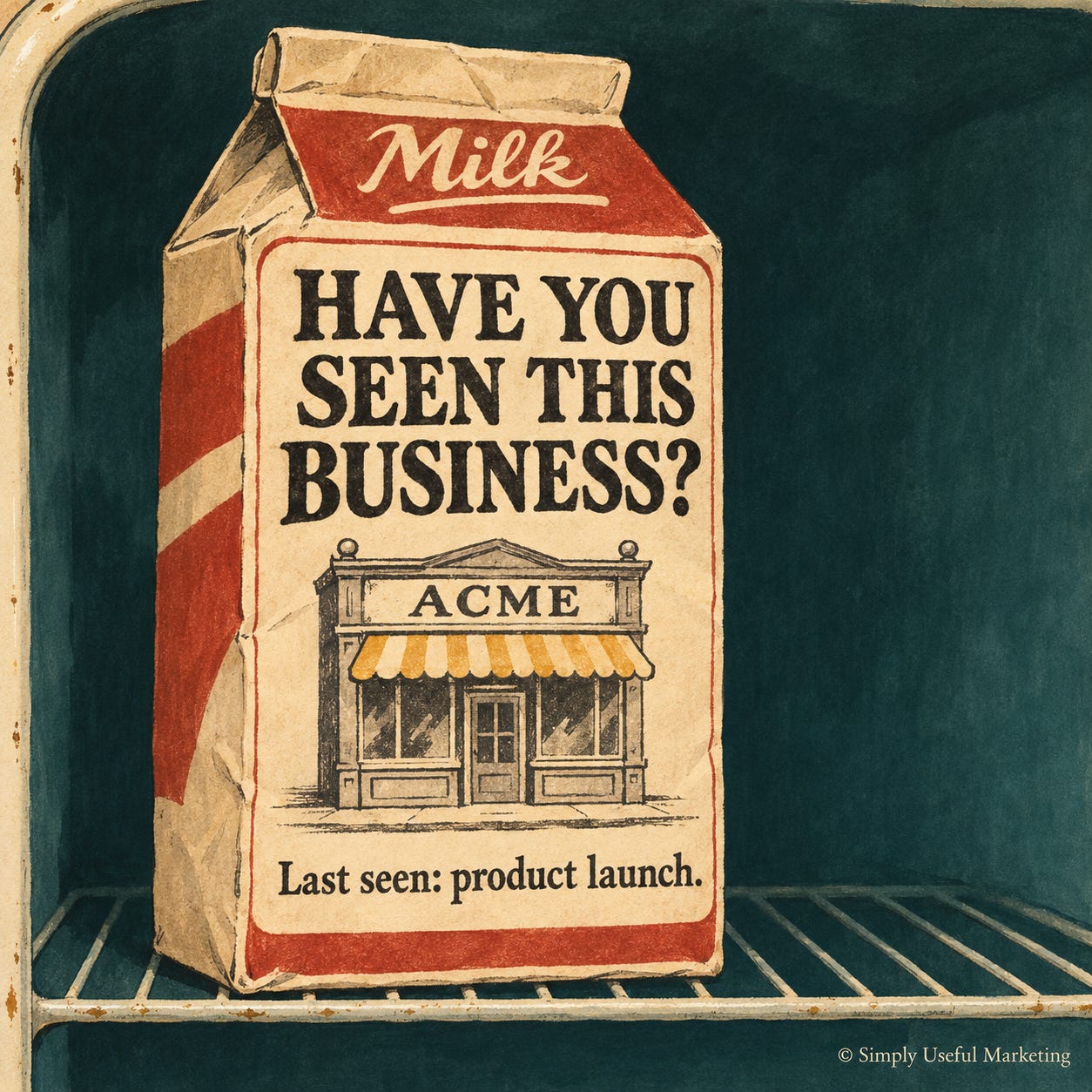
You have to share more than you want to.
It’s a lesson I learned during my time as a magazine editor.
Here on Substack, you see writers every day waking up to the fact that their words will not magically create an audience. Many seem unhappy about that.
You have to share your work.
Dare one say, “Market it.”
The same applies to a business: just because you have something worth buying doesn’t mean people will remember you sell it.
Repetition Is How You Stay on Their Radar
As editor of a tech trade pub for 13 years, I’d get hundreds of pitches every year — most often some version of “my product is great.”
A note about adjectives such as “leading,” “innovative,” “cutting-edge,” “revolutionary,” and “best-in-class”: if everyone else is using the same words, they mean nothing. Maybe try to be different.
Keep in mind there were (still are) hundreds of companies in the industry. AIIM had 200 to 300 vendor members at the time. There were probably about the same number of other companies in the industry that might have been worth talking to.
Even when I had an assistant editor, there were two of us and hundreds of vendors. What with having to plan, write, and edit 10 issues a year (plus various other internal tasks), it was impossible to talk to everyone AND get work done.
Every year, a few vendors would hire a PR company and juice up their marketing around a product launch. We’d hear from them weekly-ish, trying to get placement in the mag, whether as a source for a feature or through a direct contribution.
It was a full-court press for six months. Then the contract would run out.
Cue crickets.
Now and then, they were important enough to continue to track. But not usually. Usually they just slid off the radar.
Tip for anyone trying to get an editor’s attention: make their life easy. Know what they cover. Provide a resource or editorial angle that aligns with the editor’s goals. Be honest. Check in now and again.
Every industry has a few companies an editor has to track. The rest are competing for whatever attention is left.
There aren’t enough hours in the day to remember everyone. So, as an editor, when someone showed up, helped me with content my audience would be interested in, and was nice and low on the BS meter, they had a better chance of getting attention than the company with perhaps a better product I never heard from.
Oh, boo hoo, editor-boy is whining about not being able to talk to everyone. Who cares.
You should.
My job was to stay on top of the industry.
Keeping track of your company isn’t part of your customers’ job.
Your customers are trying to fix a problem. If you aren’t part of their world — through a regular newsletter, ad campaigns, or email nurture campaigns — maybe they’ll find you in a search when they need what you have.
Maybe.
Regular contact gives them more opportunities to know who you are before they need you.
Research on advertising offers support for the value of those repeated appearances. A 2015 meta-analysis in the Journal of Advertising found that, in experimental settings, recall continued improving through at least eight exposures to an ad. The effects of repetition also faded over time.
How Often Should You Send?
But won’t people get tired of hearing from you?
MailerLite analyzed more than 1.4 million campaigns from over 42,000 accounts using 2025 data. Here’s how the averages compared:

The senders averaging less than one email a month had more than twice the unsubscribe rate of weekly senders. These are comparisons between different senders, not proof that increasing your frequency will produce the same results. We often worry about being “too much.” But sending less frequently clearly isn’t a guarantee that people will stick around (Read more about the research: www.mailerlite.com.)
My answer to the frequency question: aim for at least once a month, then send more frequently when your time or budget allows you to do it well.
If unsubscribes rise or engagement drops after you increase frequency, look at what changed — including whether what you’re sending is worth reading. Then adjust.
No one is thinking about your company. Your job is to make them. Give them a reason to remember you.
As an editor, I had to pay attention to the movers and shakers. But some of the smaller companies were consistent in their outreach, and over time I learned to trust some of them and use them as resources.
That’s the opportunity for your business. Share something that helps customers understand a problem, make a decision, or do their work. Give them a reason to open the next issue.
Each issue gives them another chance to get to know you and decide whether you’re someone they’d want to work with.
I wasn’t going to remember every vendor in my industry. Your customers aren’t going to remember every company that could conceivably help them, either.
You have to remind them you’re there. Give them something useful to remember you by.
If you want your customers to hear from you regularly but don’t want another writing job, I can help. I work with business owners to plan, write, and publish newsletters that put their knowledge to work for their customers.
Want help getting yours started — or keeping it going? Tell me where you’re stuck: Bryant@SimplyUsefulMarketing.Co.
This is sooooooooo true.
One thing I've learned is that people aren't sitting around wondering when we're going to publish again. They're working, raising families, dealing with life, and occasionally trying to remember why they walked into the kitchen. 😂 That's me btw.
We tend to experience our own work as a major event because we've spent hours writing the damn essay. For everyone else, it's one item competing with a thousand other things.
Happy Tuesday Bryant
That's you and me both with the “why am I in this riom” befuddlement. I had started to worry 10 years ago then remembered was doing the same in high school. So suppose been middle aged my entire life 😀
Thanks, Neela, and Bappy Tuesday from Dodge's gas mart and chicke. From somewhere off I 81 in Virginia