

The future of work was, is, and always will be about content — creating it, managing it, and protecting it for business use.
I’ve always loved prediction season because predictions are fun.
They feel like work, but allow you to indulge in a bit of whimsy and speculation without having to worry about being wrong.
They’re even better when you get them right!
12 years ago, a Gartner analyst I know (Hanns Kohler-Kruner) invited a large number of folks in the ECM* (enterprise content management) industry to make predictions about the future of work for research Gartner was conducting at the time (never read that research).
Doing some overdue spring dead-heading of old content on LinkedIn (along with seeing if anything is worth refreshing) and started reading the short essay I wrote in response to Hanns’ request.
Much to my surprise, I was actually mostly right. And while we’re still too early for 2027 prediction season, I thought I’d share anyway.
Below is my original post, along with combined responses from Claude and ChatGPT for accuracy and my grade (and no, I didn’t tell them to grade on a curve!). The stuff from the robots is in brackets.
The Future of Work – All About Content
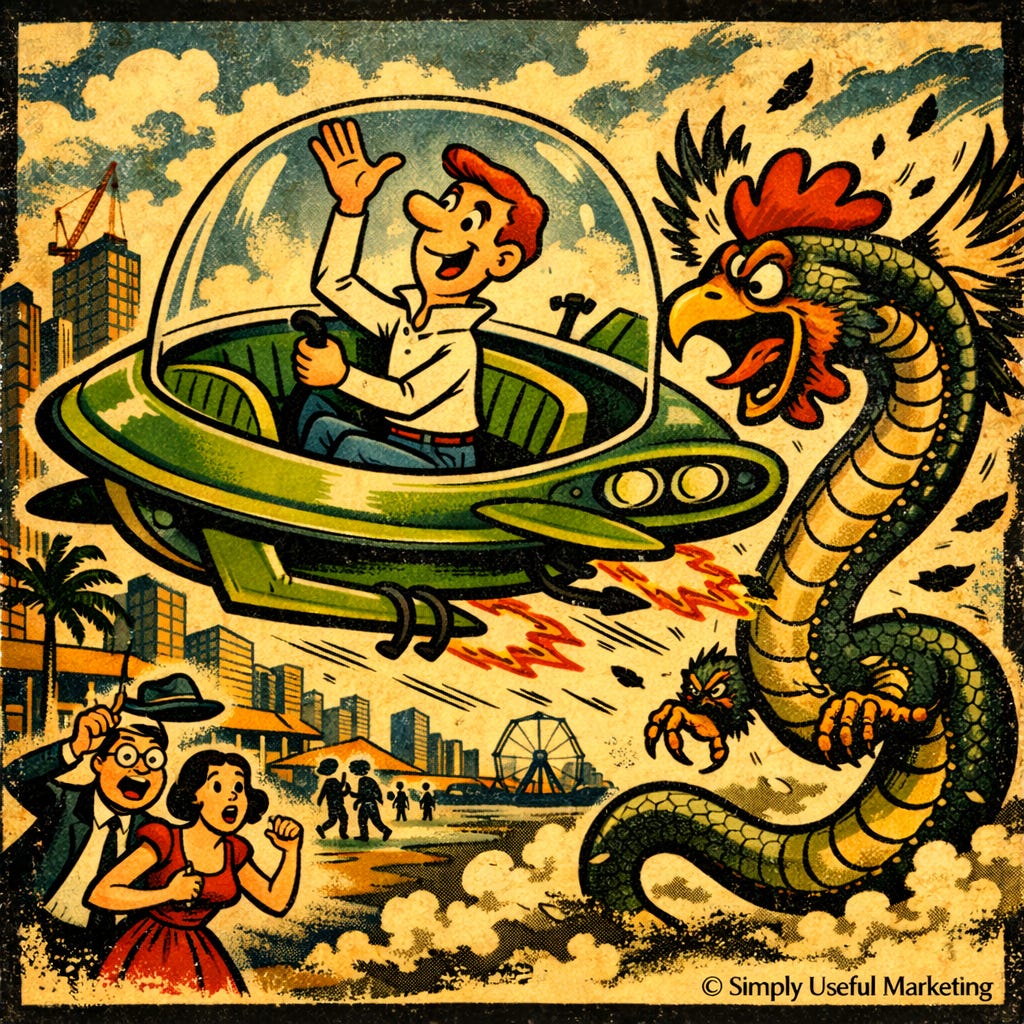
Unlike George Jetson, I’m pretty sure we won’t be able to fly our car to the office, push a red button, and then relax until it’s quitting time (barring our blustering boss pushing HIS button to yell at us). Work will still be work. How we get it done . . . that might be a lot cooler.
Two things first off. One, half of everything everyone writes will be collectively wrong — I’m still waiting on my flying car. Two, we should be clear that we’re focused on office/knowledge work. While technology will of course affect tracking, assigning, etc. other work; digging a ditch is still digging a ditch.
[Holds up. Software wraps around more work now, but the ditch is still a ditch.] Me again: I will add here that robots work autonomously in warehouses and I do think that there’s potential for automating manual work outdoors with robots as technology continues to improve.
The future of work will be reliant upon effective creation and maintenance and then distribution of content/information/documents/data (pick a word). The companies that take this fire hose of information and point it in the right direction will be the ones that win.
[Arguably more true now than in 2014. Every shiny AI demo is still sitting on top of content, data, documents, workflow, and retrieval. The model isn’t the moat. The plumbing is. Sadly, nobody wants to talk about the plumbing.]
I’m going to assume that we’ll get the maintenance and storage of content mostly right going forward, otherwise, we should all buy stock in storage companies now.
[Partial credit. Storage got cheap and abundant. Findability, governance, and basic “where did we save that” remain a mess in most organizations.]
I think we’ll get to a heads up display for work, which will make the “office” even more portable than now. To interface with this HUD, we’ll have some combination of input from eye tracking or direct “jacking” into brain waves.
[Directionally correct, early on timing. Apple Vision Pro ships with eye tracking and is pitched at productivity; Meta’s Orion points the same direction. Brain-wave input remains clinical and experimental, not something anyone uses to clear their inbox. Call it right in concept, a decade optimistic on adoption.]
I think from a marketing standpoint; companies will be able to slice and dice a huge amount of data from customer interactions to pinpoint and deliver targeted ads/offers (whatever you want to call them) to consumers at point of sale/point of looking in the aisle (if you have your mobile device/embedded chip turned on); geographically or online.
[Full marks. Retail media is its own category now. Every major grocery chain runs an ad network. Transaction, loyalty, and behavior data drive targeting at the moment of intent. The embedded-chip line reads less like a joke than it did in 2014.] Me again: This was inspired by a conversation I had had with the guy who created the software that spat out those personalized ads/coupons on the back of your grocery store receipt.
I think Facebook and/or Google will be less about “the Web” and more about delivering that customer data to advertisers.
[Right in substance. Alphabet closed 2025 at $402.8 billion in revenue, most of it still advertising; Meta’s revenue is overwhelmingly ad-driven. “Less about the Web” is the part that needs a tweak — Search is still the cash register — but both companies are fundamentally ad and data businesses with products as the delivery mechanism.]
[Note: this might be more today than the future.] Unlike the other brackets, this was an original aside.
[Accurate self-catch. This was already underway in 2014.]
I think we’ll stop worrying about the bullshit divide between work and personal and finally acknowledge that because the office is so portable, office hours really don’t mean much beyond some basic, core ability to be able to meet with your team at a mutually convenient time. There will be times when 9 to 5 is needed. Other times, the ability to be untethered to a cubicle but still connected will unleash a huge wave of productivity — and maybe even decrease the amount of time we all spend in rush hour (a productivity saving all by itself).
[The most optimistic paragraph in the piece, and where it misses hardest. Portability happened — roughly a quarter of US. paid workdays are remote — but the divide didn’t dissolve. It collapsed into always-on. Late-night meetings are up, cross-time-zone work expanded, and the boundary is worried about more now, not less. Right on the technology. Wrong on what humans would do with it.]
Despite 1 and 4, the value of face-to-face, real-time meetings (virtually or IRL) will continue to be a powerful way to collaborate.
[Correct. Hybrid won. Pure async didn’t.]
Paper — or at least some sort of digital paper — will continue to be with us. People like to write stuff down.
[Right. Quocirca survey data still puts printing as necessary for a clear majority of SMBs, and paper note-taking remains stubbornly popular among the people supposedly living in the future.] Me again: Recent AIIM research shows about 50% of all business processes run on paper. The supply chain industry remains almost entirely paper-based; and with something like 100 documents for a single container and with the average container ship ferrying 10,000 – 20,000 containers . . . that’s a LOT of paper, ripe for automation.
Cultural issues will hold productivity back more than technology. Dilbert’s Pointy-Haired Boss (hmmmm, any resemblance to Cosmo Spacely?) will still be with us and not all companies will be able to be truly creative as C-level continues to focus on productivity measures that just don’t matter.
[The piece’s most durable prediction. Gallup’s 2026 report shows global employee engagement dropped to 20% in 2025, the lowest since 2020, with disengagement pegged at roughly $10 trillion in lost productivity in 2024. Technology keeps improving. Management keeps underperforming. The culture lag is the real bottleneck, and it has been for decades.]
And, as Gregg Easterbrook says in his brilliant Tuesday Morning Quarterback column: All predictions wrong or your money back.
[Not all wrong. No refund issued.] I am delighted to just now discover that he still writes the column here; and I just subscribed. Now just need football season to hurry up and get here! WhoDat!
Roughly 7 right, 2 half-right, 1 early.
Final grade: B+. Strongest on ad-tech targeting, paper not dying, the primacy of culture over technology, and the portability of office work. Weakest on assuming portability would feel like freedom rather than a longer leash. Would be an A- with slightly less cheerful naivete about what humans do with always-on tools.
Your turn. Dig up something you wrote 5, 10, 12 years ago. Read it. Grade it. You’ll probably be more right than you remember — and wrong in ways that are useful to notice. Hit reply and tell me what you found. Love to see what y’all come up with.
Thanks for reading, comments, criticisms, and witticisms welcomed.
If the same amount of money being put into AI had been put into revolutionizing culture and management - where would be now?
This was my favoritest Bryant article of all time.
BTW, I'm still waiting on my flying car too. Although at this point I'd settle for a self-driving one that doesn't try to kill me. B+ is generous - most people can't even predict what they're having for lunch. Well done, Bryant