

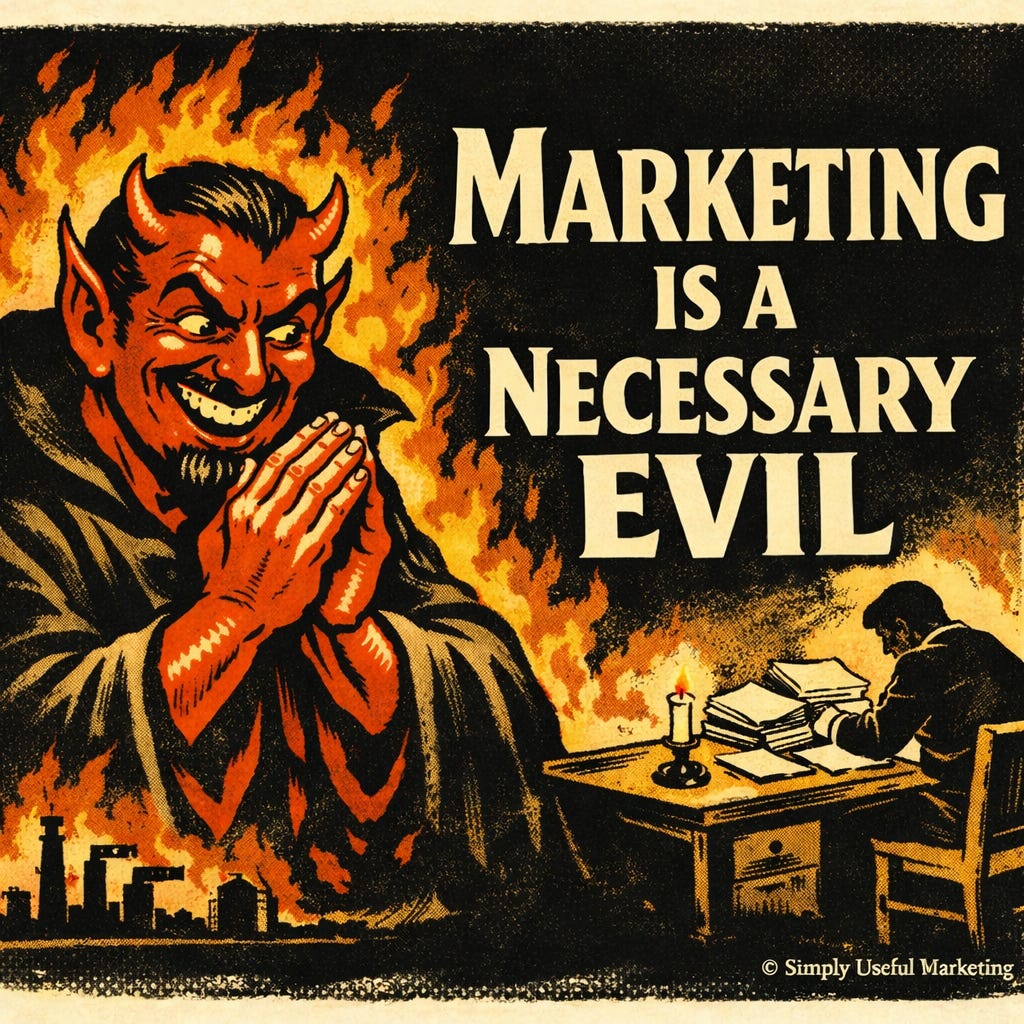
I believed “marketing is evil” for the first 15 years of my career.
Then over two years or so my role slid from magazine editor to social media and online community manager and then into content and inbound marketing.
I quickly realized that while marketing CAN be evil, it doesn’t have to be. Shouldn’t be, for that matter.
Marketing is about serving your customers and potential customers. Believing that marketing is “just” something you have to do prevents your business from doing as well as it could.
Now, some people just want shortcuts and will use marketing to say anything they need to move someone closer to a sale.
Others degrade their marketing efforts for more understandable reasons.
They “tried” and it didn’t work — usually meaning they wrote a few blog posts, didn’t get immediate results, and decided marketing was a waste.
It’s hard to tie ROI directly to marketing, so it’s an easy cut in favor of the sales team.
Or, as in my case, they were exposed mostly to bad marketing and assumed that’s all it was.
As an editor of a trade press magazine, I was on the receiving end of a lot of bad marketing and PR — focused on features, larded with over-the-top language (THE BEST, leading, cutting-edge, unique, seamless) for the first 12 or so years of my career.
Over time, I began to notice a difference between companies that treated marketing with respect and those that treated it as a checkbox on the way to customers and the bank.
Here’s what the research shows — and more importantly, here’s what I’ve watched happen in practice.
What “Necessary Evil” Thinking Actually Produces
When a business decides marketing is a cost center and obligation, you can see it. The strategy deck might be fine, but the marketing output itself suffers.
Budgets get cut first because marketing is hard to tie to a specific sale. The sales team has a number. Marketing has... awareness? Engagement? Good luck defending that in a budget meeting.
So spending gets squeezed, which means the work gets cheaper. Which means more cold outreach, more interruptive ads, more low-value email blasts to lists that haven’t been touched in two years, more mindless AI or Fivrr content. More “we need leads NOW” thinking that treats potential customers as a disposable contributor to your bottom line rather than people trying to solve a problem.
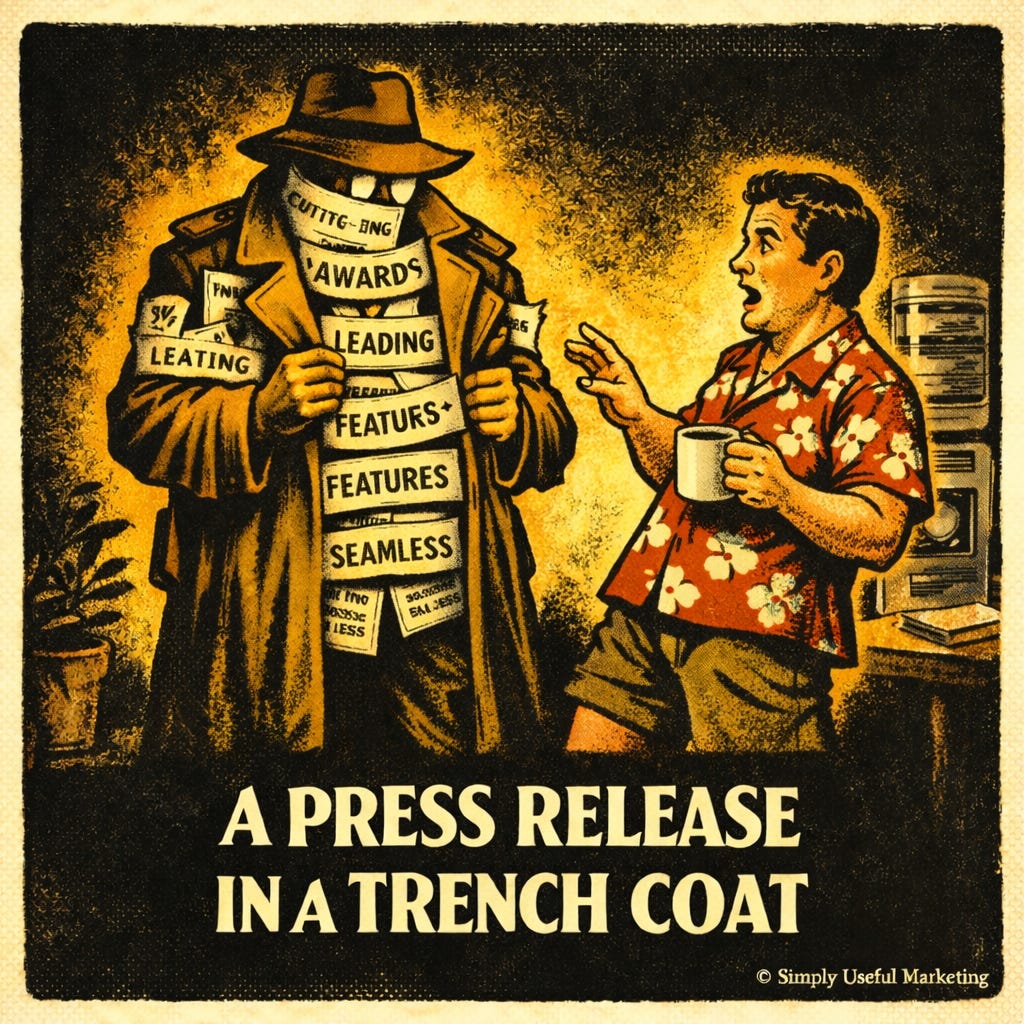
The content, if there is any, becomes a press release in a trench coat. Features. Awards. “We’re pleased to announce.” Random pictures of staff in the same t-shirt doing community service.
Nobody asked. Nobody cares.
Customer questions go unanswered because nobody’s job is to answer them publicly. The blog, if it exists, hasn’t been updated since 2024. The newsletter went out — sporadically — seven times and then quietly died.
Meanwhile, the sales team is out there trying to build relationships with people who’ve never heard of you or already formed an opinion about your company based on sloppy marketing.
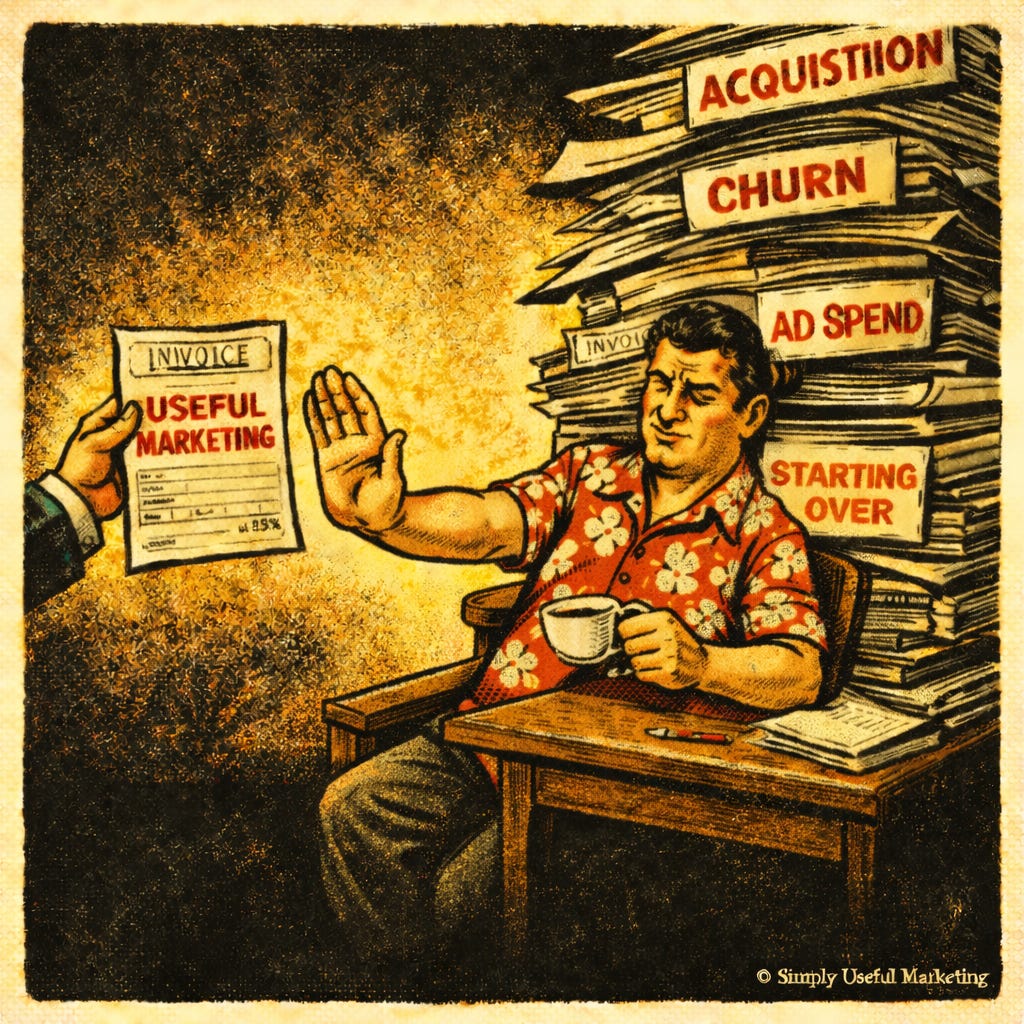
Even worse: the companies trying to save money by treating marketing as a necessary evil are almost certainly spending more than the companies investing in it properly. More on acquisition. More on interruptive ads. More replacing churned customers they could have kept. They think they’re being fiscally responsible. Nope. They’re just paying for it across multiple line items, so the true costs stay hidden.
This is the slow bleed of “necessary evil” thinking. It doesn’t always kill a business; it just keeps one from growing as much as it could.
Why This Costs You Money
Edelman’s 2025 Trust Barometer puts it plainly: trust now equals price and quality as a purchase consideration. Not “nice to have.” Equal footing with the two things businesses have always competed on. And 71% of global consumers say trust is a “buy or boycott” factor — meaning distrust doesn’t just mean someone ignores you, it means they actively go elsewhere and sometimes tell people why.
Here’s the number that should keep “necessary evil” thinkers up at night: 79% of B2C leaders believe their customers trust them. Only 52% of customers agree. That gap — nearly 30 points — is what happens when you assume goodwill you haven’t actually earned.
(I went deeper on the trust-ROI connection in a previous issue — worth a read if you want the full picture. Click here to read.)
On the retention side: Bain & Company found that a 5% increase in customer retention can increase profits between 25% and 95%. And it costs somewhere between 5 and 25 times more to acquire a new customer than to keep an existing one. The “necessary evil” approach typically optimizes hard for acquisition — the expensive end — while quietly destroying the conditions that make retention possible.
One more: Content Marketing Institute found that content marketing costs 62% less than traditional marketing while generating three times more leads. The cheap, interruptive tactics that “necessary evil” thinking defaults to are, somewhat ironically, more expensive and less effective than just being useful.
None of this is complicated. It’s just easier to ignore when you’re staring at a quarterly number.
What the Other Approach Actually Looks Like
It’s not complicated, which I think is part of why people resist it. There’s no secret framework here.
You show up consistently with something useful. You answer the questions your customers are already asking — the ones your sales team hears every day, the ones sitting in your service inbox, the ones showing up in your site search. You write like a person, not a committee. You make offers, clearly, to people who actually want what you’re selling.
That’s it.
A quick example of what this looks like in practice. When I was helping copier dealers with their marketing, the billing team at one dealer was asked every single month to explain invoices to confused customers. We created a short blog series answering those questions. Cut support calls. Gave the billing team something to point people to. Built a small but real amount of trust with customers who previously just felt frustrated.
The “necessary evil” company never writes that post. The trust-oriented company writes it, publishes it, and keeps benefiting from it for years.
If you just read that copier billing example and thought "we have something like that" — questions your team keeps answering, problems your customers keep running into — that's a newsletter waiting to happen. Not a big production. Just useful answers, sent regularly, to people who want them. That's what Newsletter-in-a-Box is. Reply or email me at bryant@simplyusefulmarketing.co and tell me what question your customers keep asking.
The companies that do this well don’t have bigger budgets or better writers. They have a different assumption underneath everything: that marketing’s job is to serve the customer, not to drag them toward a sale. The goal is still ultimately a sale (this is business after all), but you get there by helping, not hustling.
Over time, this compounds. People remember you when they’re ready to buy. They refer you because you helped them. They forgive mistakes because you’ve built up goodwill instead of just hunting them for leads.
None of this is fast. That’s why the “necessary evil” crowd doesn’t do it. They want the shortcut. The problem is the shortcut costs more and produces less.
The Companies That Get This Are Pulling Away From You
Some businesses will read this and shrug. They’ll keep treating marketing as a line item to minimize, a necessary evil to tolerate, a checkbox before the “real work” of selling.
And some of those businesses will be fine — for a while. Markets can carry a mediocre marketing program if the product is strong enough or the competition is weak enough.
But those conditions don’t last. And when they change, the businesses that have been quietly compounding trust — showing up, being useful, treating customers like people — will be in a completely different position than the ones that were just running plays.
Marketing that helps people isn’t a moral stance. It’s a business strategy. A boring, unsexy, works-every-time business strategy.
The companies treating it as a necessary evil are betting that shortcuts compound the same way consistency does.
They don’t.
P.S. — You don't need a content strategy to start. You need one customer question and 15 minutes. The strategy part comes after you've been showing up for a while. bryant@simplyusefulmarketing.co