

This is the first in an occasional series I’m calling Marketing and the Movies. The concept is simple — I watch (or rewatch) a movie I love or have always wanted to see, and any time an action, plot twist, or character decision reminds me of a marketing lesson, I write it down.
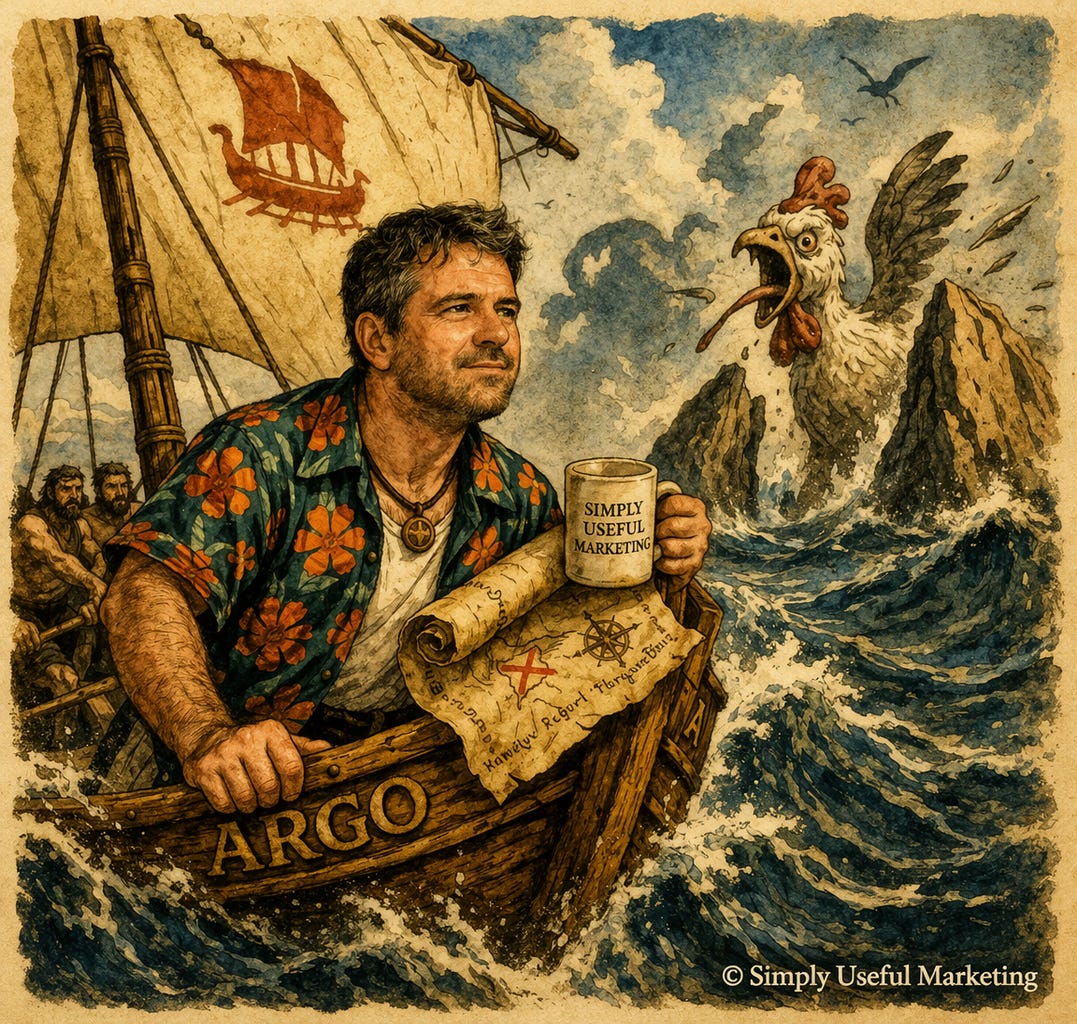
First up: the 1963 classic, Jason and the Argonauts, with the superb Ray Harryhausen’s animation. Questionable acting, glorious stop-motion animation, and a surprising number of useful things to say about running a business.
If you enjoy a Greek myth and like a sword and sorcery movie, this one’s for you. I know, I know; not everyone’s cup of tea but the article will still be worth your while.
Let’s go.
Make People Feel Special and They’ll Do Hard Things for/with You
To select the crew of the Argo, Jason holds what is basically an Olympic competition — archery, discus, the works. This is a journey to the end of the earth. Nobody knows if they’re coming back alive. And yet people are competing for the right to go.
Because they feel special. They feel chosen.
If you make someone feel like they’re part of something worth doing, they’ll go out of their way to help you. That applies to customers, collaborators, and anyone you want on your ship.
Brains Over Brawn
After the competition, Hylas arrives late and misses his spot on the Argo. He challenges Hercules for a place. Hercules selects discus throwing and points out to sea at a large rock. “No man has ever hit that rock with a disc.” Hercules, because he’s Hercules, hurls a disc a quarter mile and clangs it off the rock.
Hylas — slim, not muscular — takes his disc and skips it across the water like a frisbee. It bounces right off the rock.
Brains over brute strength.
Sometimes when you’re staring at a problem, stop bashing your head against the wall. Take a step back. Look at it from a different angle. Check if the wall ends two or three feet to your left and just walk around it. If you can’t go around, go over, under, or through. There’s usually a unique solution — you just have to stop relying on pure force long enough to find it.
Believe in Your Abilities
Jason was transported by Hermes to Mount Olympus where Zeus gave him his quest and also five chances to call on Hera for help. Zeus also offered to hand-pick his crew and give him a ship. Jason refused — he knew he had a plan and could handle it himself.
Don’t use help you don’t need. If you can do it, do it — especially if there are strings attached to the offer.
But Also: Get Help When You Need It
Hera is the figurehead (though at the back of the ship – look, I didn’t film it), for the ship. In tight, impossible spots, Jason talks to Hera through it. No one on earth is a god, obviously, but there’s no shame in learning from someone who knows more than you do. And if you can pay with money rather than time, you’re one step closer to where you want to be.
Get help when you need it. You probably need it more often than you think.
The Gods Are Fickle
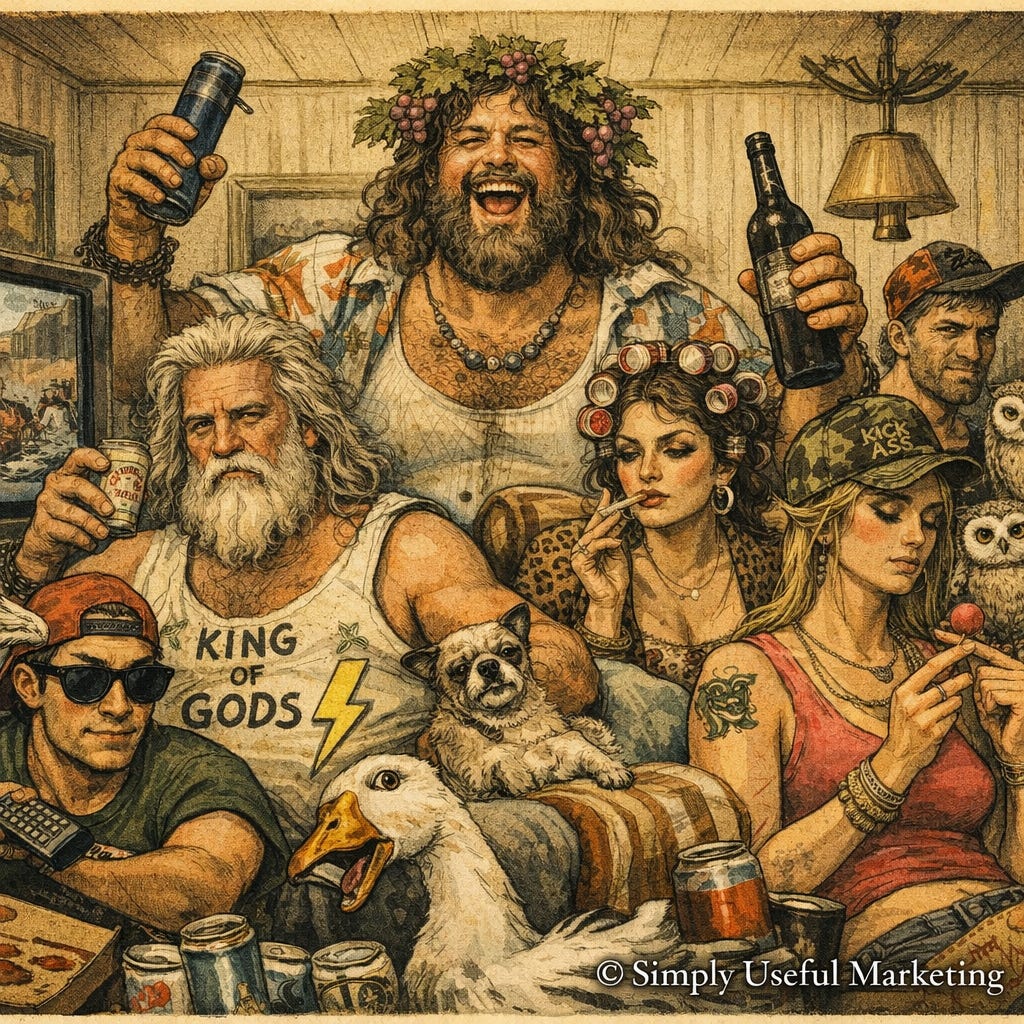
The gods in this movie are basically watching TV and meddling. Zeus and Hera are married and constantly competing, and, really, the entire pantheon is essentially an inbred trailer park soap opera — only worse, because they have actual power over people’s lives.
But they do have power. And they use it.
In our lives, there are powerful forces that shape the world we’re in — market shifts, algorithm changes, economic headwinds — that you can’t control and sometimes can’t even see. It’s trite, but still true. You can’t always fight the current. Sometimes you just have to go with it, and just hope you can stay roughly on course — or simply don’t drown.
Don’t Take More Than Is Given
Hera directs the Argonauts to a safe island to repair the ship. Simple instructions: fix the boat, drink some water, don’t take anything, be on your way.
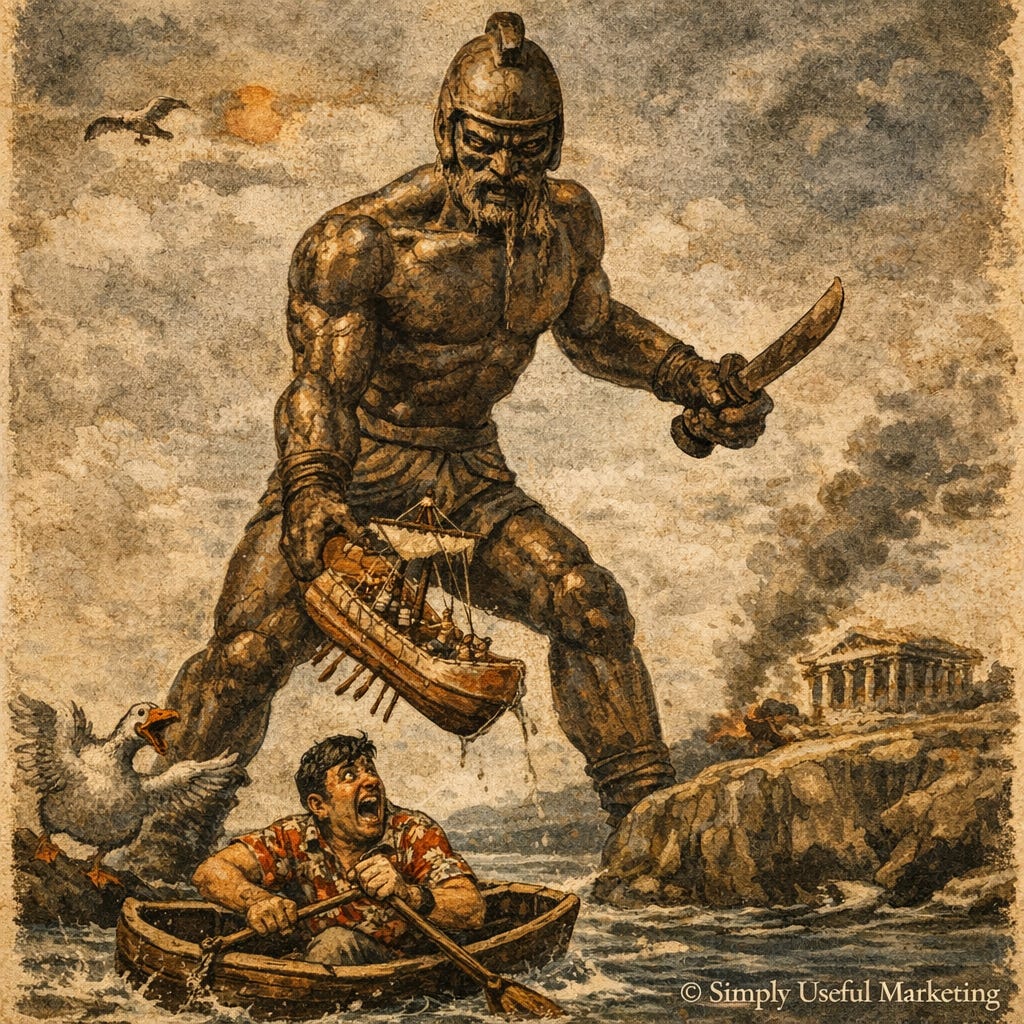
Hercules finds a treasure room underneath a giant bronze statue — Talos — and helps himself to whatever catches his eye.
Talos, naturally, tries to kill all of them.
Don’t take more than is given. Just be decent and don’t be greedy.
Everyone Has a Weakness
Talos is a hundred-foot-tall bronze golem with a big sword. Impervious to everything the Argonauts throw at him. But like a lot of mythology, the monster has a weak spot — he’s full of some kind of boiling liquid, and there’s a plug in his heel. Jason sneaks behind him, loosens the cap, the oil flows out, and Talos goes down.
Everyone has a weakness. You, me, your competitor. Know your own and guard against them. And, not to change the light-hearted nature of this post, understanding your competitors’ weaknesses is also a damn good thing.
On a more positive spin, you also need to understand your customers’ pain because your job is to provide a product or service that soothes it or makes it go away.
Sometimes You Have to Stop, Pause, and Reset
Talos picks up the Argo and drops it into the sea. The ship gets torn a new asshole. So because Hercules was a greedy idiot (if you read mythology he’s not nearly as charming as the guy in the Disney movie), they have to take even more time to repair the ship.
Sometimes you get stuck. You make a wrong choice. You anger the wrong giant iron golem. It happens. Take a step back, recalibrate, move on.
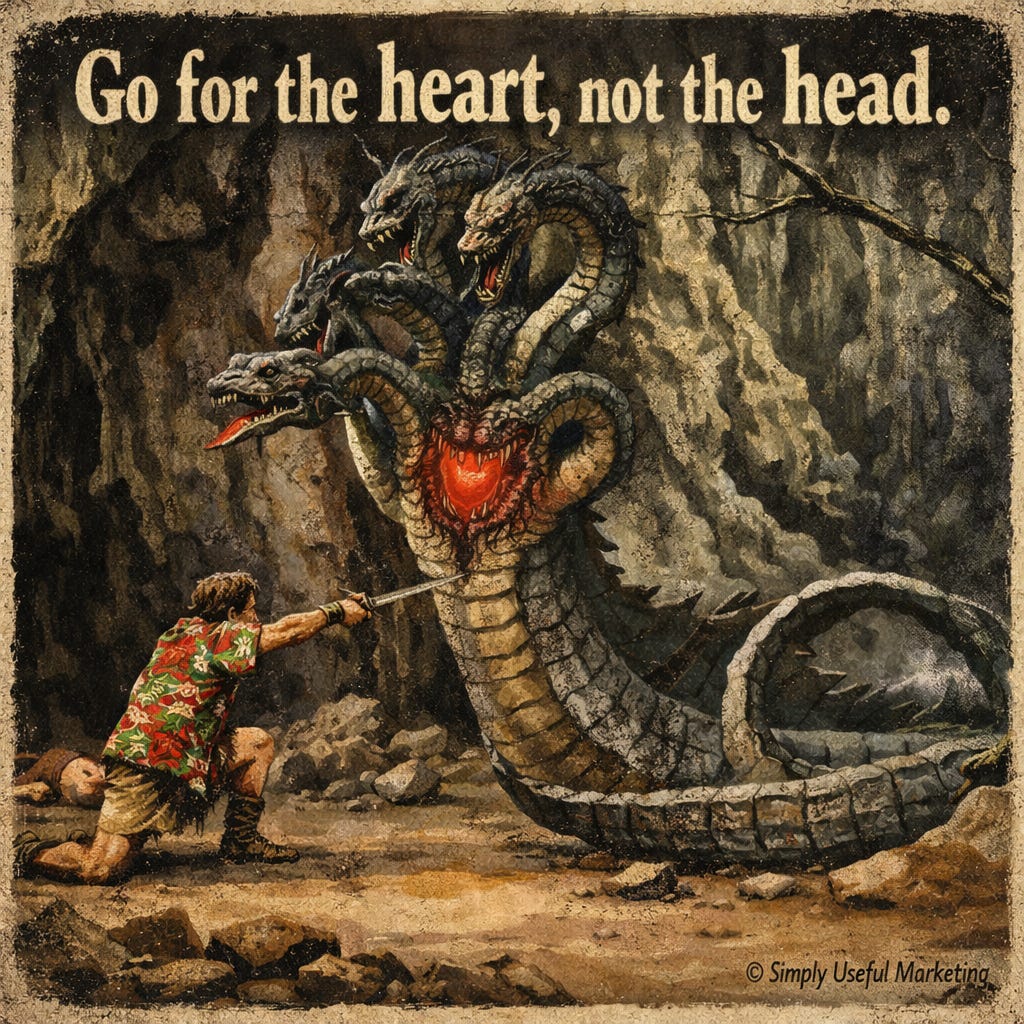
Ignore the Heads. Go for the Heart.
You know the Hydra myth. Cut off one head, two more grow back. Jason finally kills it by ignoring the heads and stabbing the thing in the body.
Same thing in marketing.
We all live under the illusion that we make decisions rationally. We very, very rarely do. We make an emotional decision and then retroactively apply logic and data to justify what we’ve already decided.
I’m not saying lie or make outlandish claims. But your writing should appeal to emotions — appeal to how your product will make someone feel, paint a picture of how their life will be different. Once you’ve got them by the heart, the head will usually follow.
If your newsletter reads like it was written for heads instead of hearts — all features, all logic, no feeling — that’s the kind of thing Newsletter-in-a-Box is built to fix. I help you find the stories and angles that actually make people care. If you’re curious what that would look like for your business, reply or email me at bryant@simplyusefulmarketing.co.
Be Helpful and Make Connections
Later in the movie, Jason rescues a woman from a shipwreck near the Clashing Rocks. Turns out she’s the high priestess of Colchis — and she ends up saving his life at the end. And, of course, she falls in love with Jason.
You never know when the person you helped out of a jam turns out to be the one who opens a door for you later.
The friends you make online — on Substack or LinkedIn or wherever — probably aren’t high priestesses. (If you are, please friend me.) My high school English teacher used to say, “Friends are like shoes; you’ve got them, use them,” which still makes me laugh. There’s truth in it, though. True friends will support you. And even if a friendship never “comes in handy,” it’s never a bad thing to have a friend.
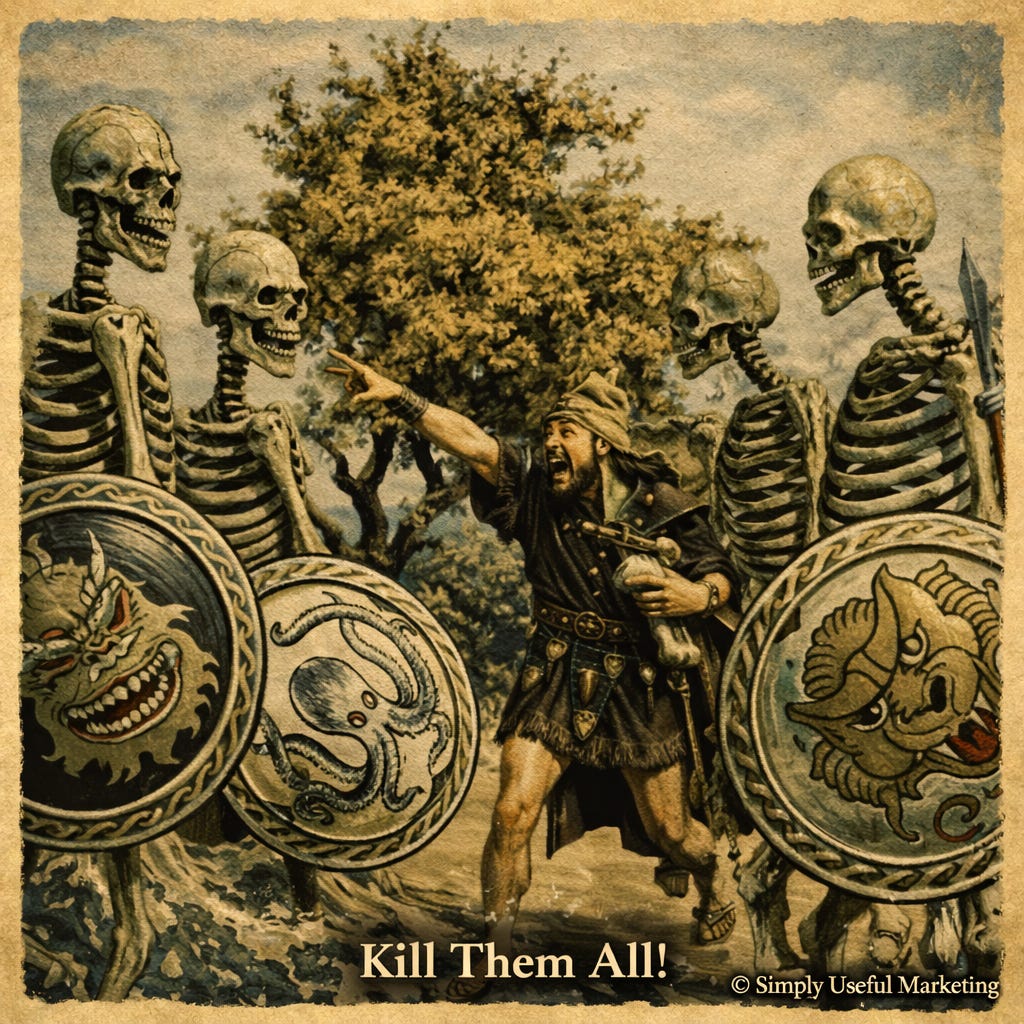
Be Direct
Near the end of the movie, the king has cornered Jason and his men by a temple. His command to the hydra/dragon teeth skeletons is simple: “Kill them. Kill them all.”
Sometimes the most direct course is the best one. (It didn’t work out for the king, but that’s beside the point.)
Tell people what you want them to do. When you’re clear and direct, you’ve got a better chance of them actually doing it. Don’t hide the fact that you’re a business with something for sale — even if you’re a business of one. Especially if you’re a business of one.
Fate Is Not a Strategy
Fate makes a great story device. It’s a terrible way to run your business.
Nothing is fated. Results come from whatever actions you take today and tomorrow. Be consistent. Keep going. Twenty years from now, when you’re kicking back on the beach in Maui, you can say it was fated — but it wasn’t. It was work.
Even Gods Get Bored
There are recurring shots of the Greek gods lounging around a pool, watching Jason and the Argonauts like it’s Netflix.
No lesson here. Just struck me as funny that even gods need something to watch. I suppose eternity gets dull.
There are no new ideas in marketing. But sometimes a 62-year-old movie about Greek myths reminds you why the old ones hold up.
Skip the disc across the water. Go for the heart, not the heads. Show up, do the work, and don’t steal from giant bronze statues.
Next month: Conan the Barbarian. Mostly just the one god; CROM!; and more swords.
Also, if you’ve got a movie suggestion; I would LOVE to hear it. I’ve got tentatively: Krull, Beastmaster, Sword and the Sorcerer, The Hobbit (the Rankin-Bass cartoon from the 70s), Excalibur, and Dragon Slayer on the list.
PS — If you’ve been meaning to start a newsletter (or restart the one that’s been collecting dust since September), I can get you from blank page to first send without it becoming your new part-time job. Reply with what kind of business you run and I’ll tell you what the lightest version looks like. bryant@simplyusefulmarketing.co
This was a fantastic read. So many things to think about on so many levels. In 2020 I adapted and staged a version of Jason and the Argonauts. It opened one night in March and closed the next (COVID). I always hoped we would revisit it just to recreate the stage combat.
This was a great read! I have not seen Jason and the Argonauts but this piece kind of reminds me of Mystery Science Theater 3000 but for marketing.