

Back in the 1990s, I worked on a newsletter called Doc.1 - Your Eye on the Document Management Industry. We delivered it by fax. Email delivery was brand new, and that list was tiny compared with the fax list.
Every Friday night, I sent the newsletter out in batches — 700 or so subscribers at a time. One of those Fridays, I sent it to the wrong list. The entire wrong list.
This was a $4,000 mistake.
I got to spend part of my Monday morning explaining that to my boss, Priscilla. To her credit, she was kind about it. Her response amounted to: You screwed up. Don’t do it again. Especially since I couldn’t even say what I did wrong other than “I got itwrong.”
I have never made this particular mistake again over thousands of emails and newsletters since. Knock wood.
Thirty-plus years later, I still double- and triple-check the list before sending anything. I check the copy. I check that the right email is attached to the right workflow. That everything is going where it’s supposed to go.
The paranoia remains. But I did learn something.
That story came up when Steve Weissman and I recorded our latest Nattering Nabobs of Information episode, “Failure Is Always an Option.” Steve’s point was that failure gives you information. Which I then stole: “Failure is information. It’s not judgment.”
You can listen to us here. Steve has some excellent observations about information governance as well. He had also made a Dad joke just before this thumbnail.
Though I don’t I recommend spending $4,000 to learn to check a mailing list.
Fortunately, you can experiment with your marketing much more cheaply.
A blog post that nobody reads isn’t going to tank your business. You spent some time writing it. You didn’t get the response you wanted. You can look at what happened and decide what to try next.
Let’s state the obvious, though: don’t try something that could seriously hurt your business. If getting it wrong could put you out of business, find a smaller experiment. “Just do it” still requires some judgment.
But writing a blog post? Trying a different subject in your newsletter? Those are things you can afford to get wrong.
You won’t know what works until you put it in front of people. You can have an idea, a suspicion, an inkling. You can draw on experience. You can still be wrong.
Join me for practical advice, lessons learned from mistakes made, and other simple, useful knowledge on how to earn business through trusted content.
I hate when my preferred headline loses an A/B test. I thought it was better. The folks I wanted to read the thing disagreed.
A wee blow to my ego. Also, information I can use when I write the next headline.
Sometimes the explanation you thought was clear will confuse people. Sometimes a topic you thought was fascinating won’t interest them. You may need to explain it differently or find something more useful to write about.
Sometimes you simply won’t get it right. That’s OK. It doesn’t mean you never will.
The important part is what you do with what you’ve learned. Repeating the same mistake gets expensive and annoying. Priscilla was quite clear about that part and that there would be consequences if it happened again.
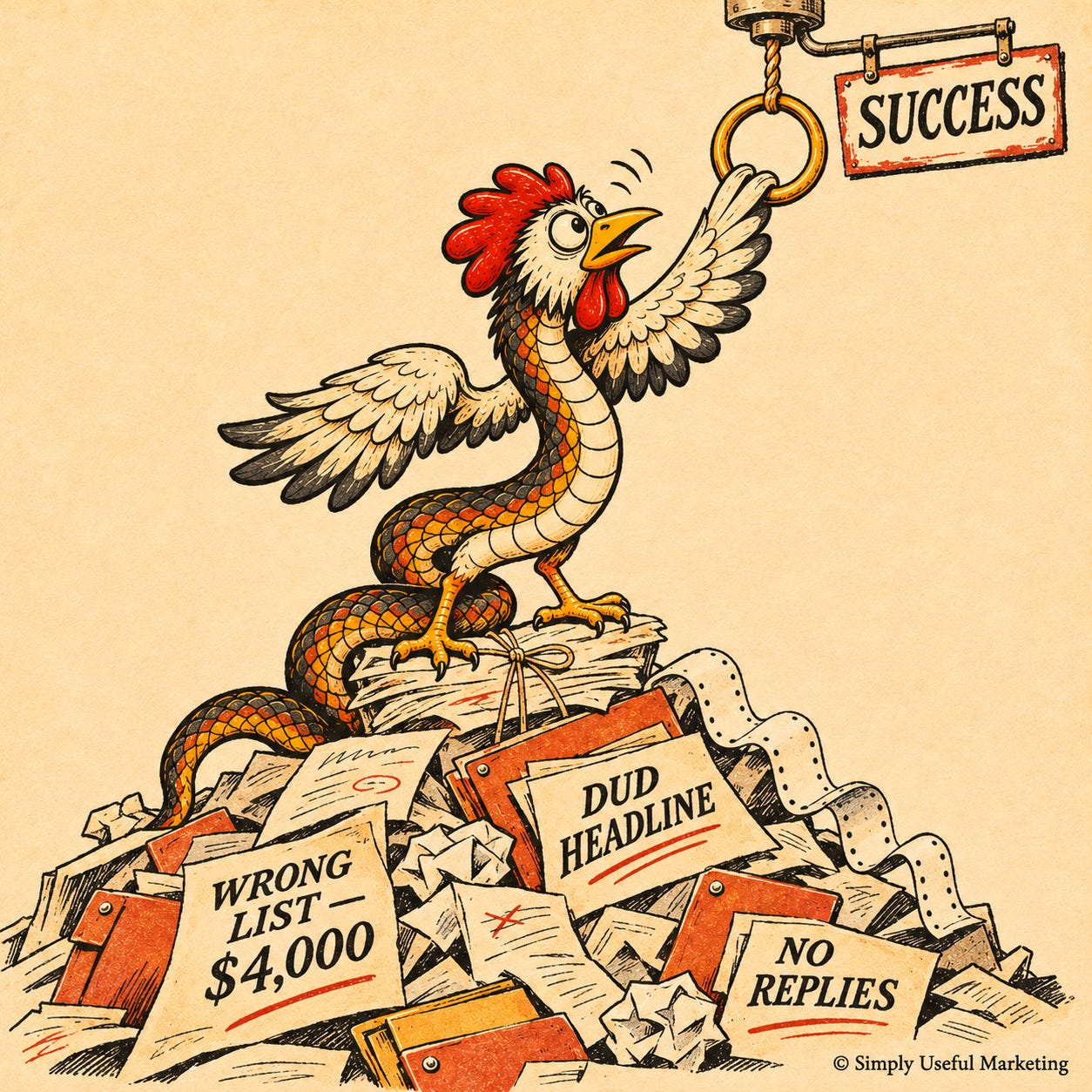
Success is often built on a stack of failures. By the time something works, you’ve discarded ideas, changed your approach, and learned things you couldn’t have known before trying. “Overnight successes” almost always have years of experimentation and false starts in their past.
Those earlier attempts helped you work out what to do. That’s why a blog post that falls flat can still contribute to marketing that works — provided you pay attention to what happened and use it.
If you need help planning, setting up, or writing a newsletter, that’s the work I do. Tell me what you have in mind. No pitchslap. Bryant@SimplyUsefulMarketing.co.