


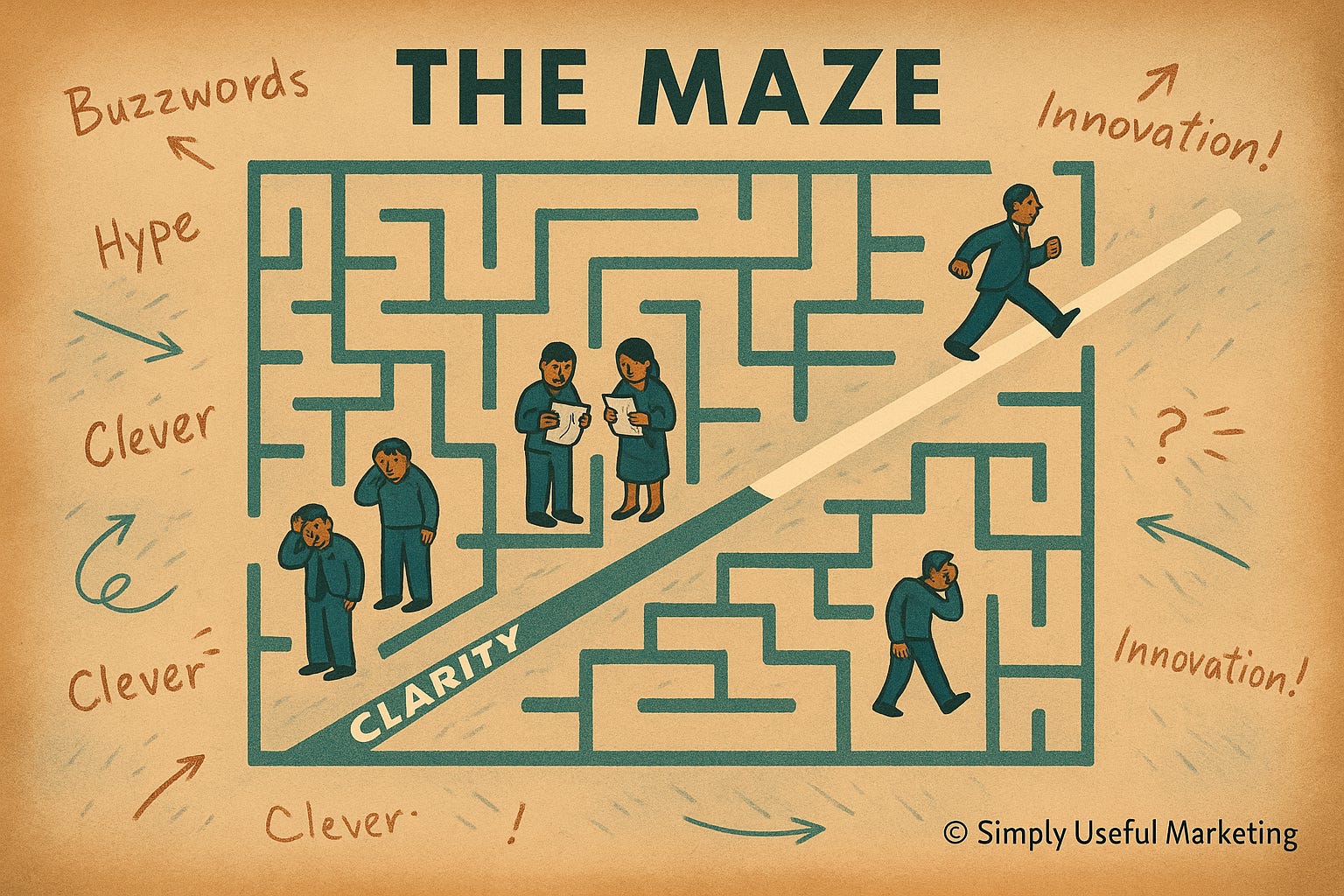
Clever isn’t evil. It’s just insecure. It’s trying too hard to be smarter than your audience because you’re afraid to be clear.
Does your marketing sounds like it was written by a committee with a thesaurus addiction? Change it.
I’ve spent my career around people who are brilliant but terrified to sound “unprofessional.” Like if they use use instead of utilize, the business gods will smite them for not sounding Important Enough.
So they reach for clever. They lace every sentence with jargon, buzzwords, and “world-class, best-in-class, cutting-edge” fluff — and end up sounding exactly like everyone else.
Clever is writing to impress.
Clear is writing to be understood.
Your customers don’t wake up hoping to be dazzled by your vocabulary. They wake up thinking about their own problems: the busted workflow, the broken process, the sales pipeline that looks like a shot of the Sahara.
They don’t need you to be clever. They need you to be useful.
My “Clever” Newsletter Subject Lines Never Were
For years I curated an ECM-focused newsletter (enterprise content management) for a professional association. Before HubSpot and the ability to run A/B tests, I would periodically “test” a clever (something I thought would be funny or tongue in cheek).
Got my teeth kicked in nearly every time I swapped out a simple, declarative, “here’s what’s inside” subject line with one that made me giggle a bit.
Opens would decrease. Shares would decrease. Click throughs would decrease.
And yet, like a goldfish swimming to the other side of the bowl and bumping my nose again, a month . . . two months and I would think “THIS time it’ll be different.”
Never was.
I was trying to show how smart and how good of a writer I was; not 100% focused on helping my readers get better at their profession.
Since then I’ve (usually) managed to focus on clear over clever.
Even without my personal experience, the research backs that up.

What the Data Says About Clear Language
A few highlights from people who’ve actually done the math:
A 2020 plain-language study of 500 Americans found that when text was rewritten in plain language, readers understood it faster and better — message clarity scores went up by a third and retention jumped by 40%. ( Source: University of Minnesota – Plain language study summary)
A digital agency case study showed that simply rewriting product descriptions and calls-to-action in straightforward, benefit-focused language (instead of jargon) led to a 12% boost in conversion rates in a month — less confusion at the final step, more people completing purchases. Source: BlackSheep Communications – Plain language delivers business results
A conversion-rate study from Portent found that website readability does correlate with conversion rates: pages that were easier to read tended to convert better, reinforcing that friction in the copy shows up directly in your revenue. Source: Portent – “The Readability of Your Website is Affecting Your Conversion Rates”
On trust: a 2024 piece from a digital services firm points out that plain language reduces misunderstandings and makes information feel more trustworthy — people are more likely to rely on information that’s easy to understand. Source: Coforma – “Use Plain Language to Build Trust”
And since we’re talking subject lines:
Mailchimp-analysed data (summarized by Econsultancy) found that descriptive, straightforward — even “dry” — subject lines like “{Company} Jan/Feb Newsletter” consistently achieved some of the highest open rates across 40+ million emails. Source: Econsultancy – case studies on effective subject lines
A roundup of subject-line research notes that around a third of recipients decide whether to open an email based on the subject line alone — and nearly 70% will report emails as spam purely because of how the subject line reads. Sources: Data Axle – “17 Subject Line Statistics to Transform Your Email Marketing” and Juicebox – “Recruitment Email Subject Lines”
There’s even a classic MarketingSherpa/AWeber test where “creativity vs clarity” subject lines went head-to-head — and the clear, descriptive version came out on top. Source: AfterOffers – case studies on winning subject lines
So no, it’s not just cranky old content people yelling at clouds. There’s real evidence that clear, plain language isn’t just nicer — it performs.
Why We Reach for “Clever”
Clever feels safer than clear.
Clear language is specific. It pins you down.
“We help small B2B firms get more repeat customers from their existing list”
is measurable. Someone can come back in six months and ask, “So… did that happen?”
“Empowering digital transformation through next-generation solutions” is slippery. No one knows what it means, which means no one can hold you to it.
We also reach for clever because we’re writing for the wrong audience. Instead of writing for the customer, we write for:
the boss who loves big words,
the peers on LinkedIn we’re trying to impress,
the imaginary award-show judge who might give us a trophy.
The result? A lot of noise and very little signal.
Why Clear Wins
Clarity is credibility. If you need to look up a word before putting it into your marketing or sales material, your customer will likely need to as well. That’s friction. Friction kills decision-making. Clear, concise language helps to eliminate friction.
Every extra brain-cycle your reader spends deciphering a sentence is a tax on their attention. Enough tax, and they bounce.
Clear:
Makes it obvious who you’re for and what you do.
Makes it easy for people inside a company to advocate for you.
Makes you sound confident instead of desperate.
When you write like a person — like you’d explain it to a friend over a drink — you make it easy for people to believe you. They can hear you. They can feel the intent behind your words. And when they feel that you’re not trying to impress them, but to help them, you become memorable.
A Simple “Clever vs Clear” Test
Grab a line from your website, proposal, or LinkedIn profile and run it through this:
Would my best customer say this out loud?
If it sounds like something only a brochure would say, it’s probably clever, not clear.Can a stranger repeat it after one read?
If they can’t paraphrase it without looking, it’s too fuzzy.Does it point to a concrete outcome?
“Drive innovation” is mush. “Shorten quote-to-cash cycles” is concrete.Could I explain this to a smart 15-year-old?
If the answer is no, you’re hiding behind words.
Bonus: for subject lines, ask “If this popped up on my phone, would I instantly know why I should care?” If not, you’ve drifted back into clever.
How to Shift From Clever to Clear
You don’t need a full rebrand. You need a blue pen (I’m a bit red/green color blind, my editing pen is blue, not red) and a bit of courage.
Pick one key asset (homepage, services page, or your LinkedIn “About”) and:
Replace big, vague words with small, specific ones.
“Leverage best-in-class solutions” → “Use tools that actually work.”
“Optimize stakeholder engagement” → “Keep your best customers coming back.”
Swap “we” language for “you” language.
“We are a leading provider of…” → “You get…” / “You stop…” / “You finally…”
Name the problem in plain English.
“You’re answering the same customer questions over and over.”
“Your CRM is full, but your pipeline is empty.”
End with one clear next step.
“Book a 20-minute call to see if this would work for you.”
“Hit reply and tell me your biggest roadblock.”
In your email subject lines, try this tiny discipline:
write the fancy, clever version first… then force yourself to write the boring, brutally honest one. Send the honest one. Let your ego pout.
The Tiny Scary Thing That Changes Everything
Clear doesn’t mean boring. You can still tell stories, crack jokes, be yourself. It just means the story is in service of a point your reader cares about, not a performance to prove how smart you are.
Every word of your marketing either makes you the hero, or makes the customer the hero. Hint: You aren’t the hero.
The irony is, when you stop shouting about yourself — and stop trying to be the cleverest person in the inbox — that’s when people finally start listening.
If your marketing sounds more clever than clear and you’re too close to untangle it, that’s the work I do. I help small and mid-sized businesses rewrite websites, emails, and newsletters in plain language that customers actually respond to — and, if you want, we can build a simple newsletter system (Newsletter-in-a-Box) so you keep showing up consistently. If that sounds useful, hit reply or email me at Bryant@SimplyUsefulMarketing.co with “clarity” in the subject line and tell me where you’re stuck.
I've written a few ‘world-class, paradigm-shifting, best-in-breed’ sentences in my day… and I regret every one of them. Cheers to Clarity.
Happy Friday, Bryant....
Shit hot. 🔥