

I’ve always thought of AI as ones and zeros rubbing up against each other really, really fast. That allows us to do things really, really fast, which is awesome.
Steve Weissman’s response when I offered that description during our latest Nattering Nabobs of Information episode: “Can’t that start a fire?”
While I remain bitterly disappointed in myself at missing the obvious Billy Joel joke, the conversation is a serious one. We take a chance every time we use AI; whether generative, agentic, or otherwise.
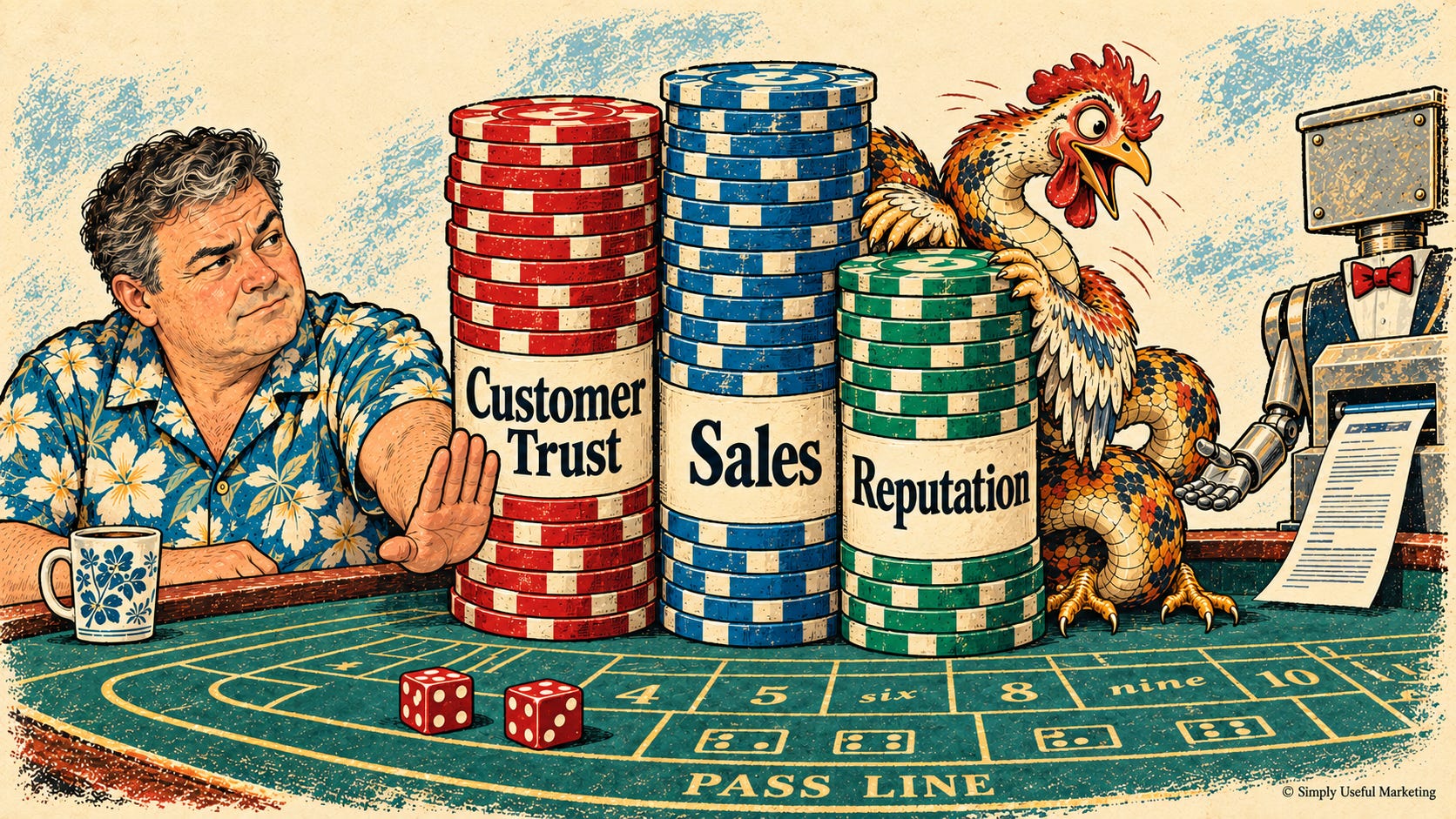
As Steve put it, “It looks like magic, but fundamentally it’s math. It’s gambling.”
A wrong answer in your marketing becomes something a customer might rely on. You get to explain the mistake when that blows up.
That doesn’t mean we stop using it. I’m a marketing guy. Steve’s an information governance consultant. Neither of us gets to pretend it isn’t everywhere in our professions.
We kicked around hypothetical odds, and I said that 70% struck me as a bad gamble for something like customer chat. If three in ten answers about what you sell are wrong, that can get expensive in lost sales, confused customers, and poor word-of-mouth.
Steve brought up financial reporting and audits. “So you’re saying that actually needs to be correct,” I said.
The same question belongs in marketing. What are we willing to guess about? A few possible subject lines are one thing. An answer about what your service does, or what a customer should expect from it, needs more attention.
The problem also starts well before we ask AI to write anything. If the tool is working from last year’s prices or a description of a service you no longer offer, you’re — what’s a polite word? — screwed.
Steve told a story about a health insurance letter that illustrates the other half of that problem. Right person. Right account number. Right expiration date. By the time it arrived, though, the person had already been without coverage for three weeks — without knowing it.
There was no AI involved. The information was correct, but the communication had failed. As Steve said, “It did it right, but it’s wrong.”
That’s where marketing and information governance meet. I think of content marketing as useful information given freely in return for a hoped-for sale in the future. The useful part matters. If the information is wrong, or arrives too late to help, we’re failing at the thing that’s supposed to give someone a reason to trust us.
We need good information to start with, and we need to look at what comes out. Giving the tool better instructions can help steer it. If the first answer is wrong, correct it before asking the tool to build on it. Letting it run “ollie ollie oxen free” is how we get the AI crap we keep talking about.
During the conversation, I mentioned a phrase I’d heard: “human at the helm.” I heard it first from Paula Goldman, Salesforce’s Chief Ethical and Humane Use Officer, in an article I skimmed earlier this year. I like it much better than “human in the loop.”
You’ve got to be driving the boat, or conning the ship, or whatever the hell you do when you’re doing a boat thing.
For marketing, that starts with knowing what you’re trying to communicate and having information you can stand behind.
When I was running content for an inbound agency, we asked clients to review near-final copy before publishing. We didn’t need them to rewrite it. We needed them to catch factual mistakes, anything important we’d missed, and anything that misrepresented their business.
Steve and I have been having versions of this conversation since I was a baby editor. Automating the wrong workflow gets you to the wrong result faster. Add AI, especially something set up to act on the result, and you can go really wrong really quick.
I’m happy to have help doing the work. But I want a human at the helm before the boat leaves the dock.
Steve and I get into that letter, gambling with your information, and why you need a human at the helm. Here’s the full conversation.
This article is based on our 2nd podcast episode, with a few extra marketing-specific tangents based on what we talked about.
Check us out, faces made for radio, voices perfect for print!
For the curious, this was written with a combination of my extra thoughts after listening to the episode which ChatGPT then rubbed the 1s and 0s together with the transcript to create a first draft. I edited from there. Yes, I used genAI to plagiarize myself. Problem? Go read someone else.
You don’t have to do all the writing yourself to keep a human at the helm. I help businesses turn their expertise into useful newsletters and other marketing content. If you need a regular newsletter or help with writing your team hasn’t had time to get to, reply and tell me what you’re working on: Bryant@SimplyUsefulMarketing.co.